
























第 5 课 · The Nursing Process
The Nursing Process: An Overview
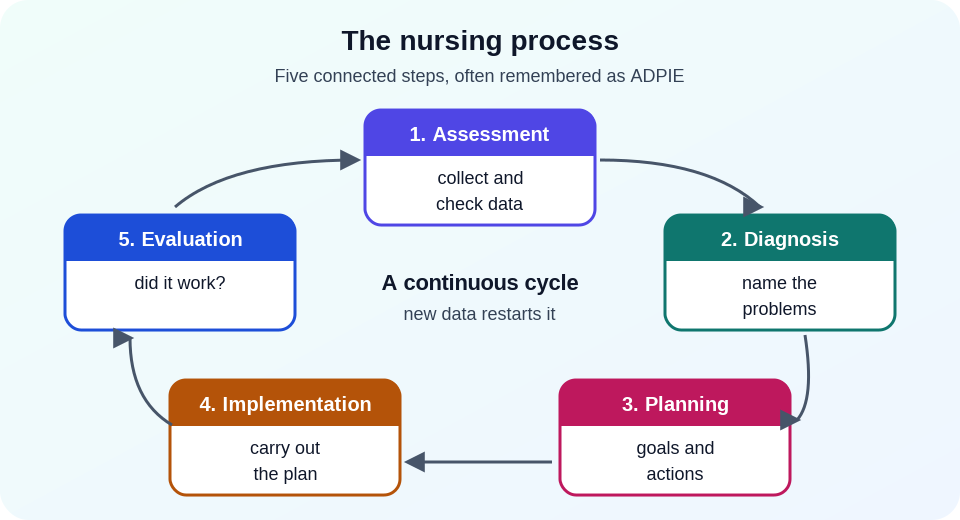
Meet the nursing process: assessment, diagnosis, planning, implementation and evaluation. See how the five steps form a cycle with a simple patient example.
How does a nurse decide what to do? Good care does not come from guesswork or from a fixed list of tasks. Nurses use a structured way of thinking called the nursing process.
It helps you collect facts, understand problems, make a plan, act and check the results. Many students remember it with the letters ADPIE.
What you will learn
- The five steps of ADPIE and the question behind each
- Why the process is a cycle
- How it differs from a medical diagnosis
- How to follow one patient through all five steps
The five steps
| Step | Key question |
|---|---|
| Assessment | What is happening with this person? |
| Diagnosis | What are the main problems or risks? |
| Planning | What do we want to achieve, and how? |
| Implementation | Are we carrying out the plan safely? |
| Evaluation | Did it work, and what changes now? |
Some frameworks name a sixth step, outcome identification, between diagnosis and planning. The thinking is the same: decide what result you want before choosing actions.
Why it is a cycle
Health changes. A plan that fit this morning may not fit this afternoon. Evaluation produces new information, which is a new assessment. The nurse may keep the plan, change it or end it.
The steps also overlap. While helping someone walk, a nurse is implementing the plan and, at the same time, assessing breathing, balance and pain.
Nursing diagnosis and medical diagnosis
A medical diagnosis names a disease or condition, such as pneumonia. In general, doctors and other authorized clinicians make it.
A nursing diagnosis describes how a person is responding to health problems or life situations, in ways nursing care can address. For example, a person with pneumonia might have trouble coughing up mucus, feel very tired or worry about work.
Some countries and workplaces use standard lists of nursing diagnosis terms. Others write nursing problems in their own forms. Follow local practice.
One patient, five steps
Meet Mrs. Garcia, a fictional patient who had surgery yesterday. This is a simplified teaching example, not a care protocol.
1. Assessment
She says, "It hurts when I move, so I am staying still." The nurse observes that she holds her body stiffly and needs help to sit up. The nurse also checks the other information needed according to local practice.
2. Diagnosis
The nurse identifies problems: pain that limits movement, and a risk of complications from staying still.
3. Planning
With Mrs. Garcia, the nurse sets a goal: "By this evening, Mrs. Garcia will sit in a chair with help and say her pain is manageable for her." Possible actions come from the care plan and the team's orders.
4. Implementation
The nurse reports her pain, follows the pain plan, explains why movement matters and helps her sit out of bed using safe handling methods.
5. Evaluation
In the evening, Mrs. Garcia sat in the chair for a short time but felt very sore. The goal was partly met. The nurse records this, talks with the team and adjusts the plan.
When you read a case, ask five questions in order: What do I know? What is the problem? What do we want? What will we do? How will we know it worked?
Thinking, not just filling in forms
The process can look like paperwork. Its real purpose is clinical reasoning: connecting facts, noticing what is missing and deciding what matters most. Experienced nurses often move through the steps quickly. They still follow the logic.
Good clinical reasoning includes:
- Checking your first impression against the facts
- Asking what else could explain a finding
- Asking for a second opinion when something feels wrong
- Treating the patient's own report as important evidence
Benefits for the team
A shared process helps people communicate. When the care plan states the problem, the goal and the actions, the next nurse can understand why something is done. It also makes it easier to see when care is not working.
The process in a very short encounter
The nursing process is not only for long care plans. It can take a few minutes.
Imagine a fictional visitor to a clinic who asks for a chair and looks pale.
- Assess: The nurse asks how the person feels and looks more closely.
- Identify the problem: The person says they feel faint, so there is a risk of falling.
- Plan: Keep the person safe and get the right help.
- Implement: Help them sit, stay with them and call a qualified colleague as the local procedure says.
- Evaluate: Are they safer now? Do they feel better or worse? What happens next?
Afterwards, the event is reported and recorded if local rules require it.
What the process does not do
The process does not give you answers by itself. It is a way to organize thinking. You still need knowledge, practice, ethics and help from others. It also does not replace emergency action. If someone's life may be at risk, act according to your emergency training first and complete the paperwork later. A good thinking tool supports quick action because you already know which questions to ask.
Common mistakes
- Jumping from one fact straight to action without assessing enough.
- Writing goals without asking the patient what matters to them.
- Doing tasks but never evaluating whether they helped.
- Treating ADPIE as a one-time checklist.
Try it
Put the five steps back in order. Click them in the correct sequence.
Check your understanding
Quick check · 4 questions
of 4 answered You scored / 4 · perfect!
-
1. What does the A in ADPIE stand for?
The process begins with collecting information about the person. -
2. Why is the nursing process a cycle?
Results feed back into assessment. -
3. A nursing diagnosis mainly describes
It focuses on human responses that nursing care can help with. -
4. In the example, Mrs. Garcia sat briefly but was very sore. What is the best judgment?
Honest evaluation records partial progress and leads to adjustment.
Summary
- ADPIE means assessment, diagnosis, planning, implementation and evaluation.
- The steps overlap and repeat.
- Nursing and medical diagnoses focus on different things.
- The process supports clinical reasoning and teamwork.