
























第 24 课 · More Chords
Seventh Chords
Learn open A7, D7, E7, G7, C7 and B7 chords, how a seventh chord is built, and why a dominant seventh sounds as if it wants to move on.
You already know major and minor chords. A seventh chord adds one more note, and that note gives the chord a new color. The type you will meet here, the dominant seventh, is common in blues, folk, rock, country and many other styles.
The good news: several seventh chords are very easy to play.
What you will learn
- What a dominant seventh chord is made of
- Open shapes for A7, D7, E7, G7, C7 and B7
- Why these chords often lead to another chord
- A short practice loop
How the chord is built
A major chord uses three notes from the major scale: the root (1), the third (3) and the fifth (5). A dominant seventh adds a flat seventh (b7). That means the seventh note of the major scale, lowered by one fret.
For A7, the notes are A, C#, E and G. The G is the flat seventh. When you see a chord name like "A7" with only the number 7, it means this dominant type. A "Amaj7" is a different chord, with G# instead of G.
The shapes
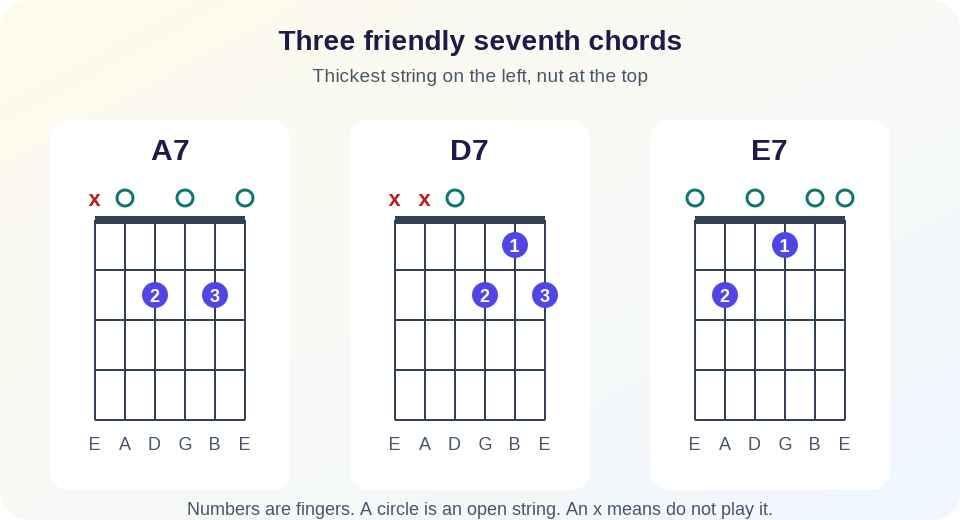
Frets are listed from string 6 to string 1. An x means do not play that string. A 0 means open.
| Chord | Frets (6 to 1) | Notes you hear |
|---|---|---|
| A7 | x 0 2 0 2 0 | A E G C# E |
| D7 | x x 0 2 1 2 | D A C F# |
| E7 | 0 2 0 1 0 0 | E B D G# B E |
| G7 | 3 2 0 0 0 1 | G B D G B F |
| C7 | x 3 2 3 1 0 | C E A# C E |
| B7 | x 2 1 2 0 2 | B D# A B F# |
In C7, the flat seventh is written A# above because it is the same pitch as B flat. In music theory you would call it B flat. The shape leaves out the fifth (G), which is common and still sounds clearly like C7.
Fingerings that work well
- A7: finger 2 on string 4 fret 2, finger 3 on string 2 fret 2.
- E7: like the E chord, but lift the finger on string 4. Finger 2 stays on string 5, and finger 1 on string 3 fret 1.
- D7: finger 2 on string 3 fret 2, finger 1 on string 2 fret 1, finger 3 on string 1 fret 2.
- G7: finger 3 on string 6 fret 3, finger 2 on string 5 fret 2, finger 1 on string 1 fret 1.
- B7: finger 2 on string 5, finger 1 on string 4, finger 3 on string 3 and finger 4 on string 1.
Choose a different fingering if it is more comfortable and still sounds clean.
Why sevenths want to move
A dominant seventh has a sense of tension. Our ears often expect it to move to a chord whose root is five scale steps below. For example, E7 often leads to A, and A7 often leads to D. D7 often leads to G, and G7 often leads to C.
Play E7, then A. Listen to how the second chord feels like arriving. This is one of the most useful sounds in music. Remember that this is a strong tendency, not a rule. Blues, for example, often uses seventh chords on every chord without resolving in this way.
A worked example: a resolving loop
Play two beats of down strums per chord:
| D7 D7 | G G | A7 A7 | D D |
You will hear two small "pull and arrive" moments: D7 to G, and A7 to D. If you have not practiced D or G recently, review them first.
Practicing the changes
- Place the first chord and strum once. Check every string you play.
- Release the pressure, but keep your fingers near the strings.
- Move to the next shape and place all fingers together if you can.
- Strum once, then repeat the pair ten times.
Look for anchor fingers, which can stay put. Moving from E to E7, you only lift one finger. Between A7 and A, your finger 2 on string 4 can stay.
Pluck each string of a new shape one at a time. A muted or buzzing note is easy to hear this way, so you can fix it before you strum.
Hearing the difference
Try a small listening test. Strum A major, wait, then strum A7. Then play Amaj7 (x 0 2 1 2 0). All three share the root, the third and the fifth. Describe each sound in your own words, such as bright, restless or soft. There are no wrong words. They help you remember.
Repeat with E and E7. In this E7 shape, the open fourth string gives you the flat seventh, which is a D. When you lift one finger, a new note appears.
Sevenths in songs
You will often see a seventh chord just before a change to a new chord. For example, a song in C might play C, then C7, then F. The C7 adds a small push toward F. Songs in blues-based styles may use seventh chords on several chords, which gives the whole piece its flavor.
Other seventh types
You may also meet minor seventh chords, written like Am7 (x 0 2 0 1 0) or Em7 (0 2 2 0 3 0). They use a minor chord plus the flat seventh. Many people hear them as mellow, and these two are easy open shapes. You do not need to learn every type now. Learn the chords your songs actually use.
Common mistakes
- Strumming string 6 on A7, C7 or B7, or strings 5 and 6 on D7.
- Reading "A7" and playing Amaj7. They are different chords.
- Letting a fretting finger touch the next open string.
- Pressing much harder than needed, which tires your hand.
Try it
Pick the correct shape for each chord.
Check your understanding
Quick check · 4 questions
of 4 answered You scored / 4 · perfect!
-
1. What note does a dominant seventh chord add to a major chord?
The dominant seventh uses 1, 3, 5 and b7. -
2. Which chord does E7 often lead to?
E7 is a common lead-in to A. -
3. Which string do you not play in A7?
The A7 shape starts from string 5, the A root. -
4. How is Amaj7 different from A7?
A major seventh chord uses the natural seventh of the A major scale, which is G#.
Summary
- A dominant seventh is 1, 3, 5 and a flat 7.
- A7, D7 and E7 are friendly first shapes.
- Skip the strings marked x.
- Dominant sevenths often lead to the chord five steps below, but styles such as blues use them freely.
- Use anchor fingers to make changes easier.
Next: The F Chord