
























Bài 11 · Listening
TOEFL Listening Overview and Note-Taking
Meet the four TOEFL iBT Listening tasks, learn why single-play audio changes your method, and build a short, useful note-taking system.
Listening is different from reading in one big way: the words do not stay in front of you. The ETS test specifications say that recordings are played once. So you must follow the meaning as it arrives and keep the important parts.
What you will learn
- the four Listening task types
- how the section is built
- what to listen for
- a compact note-taking system
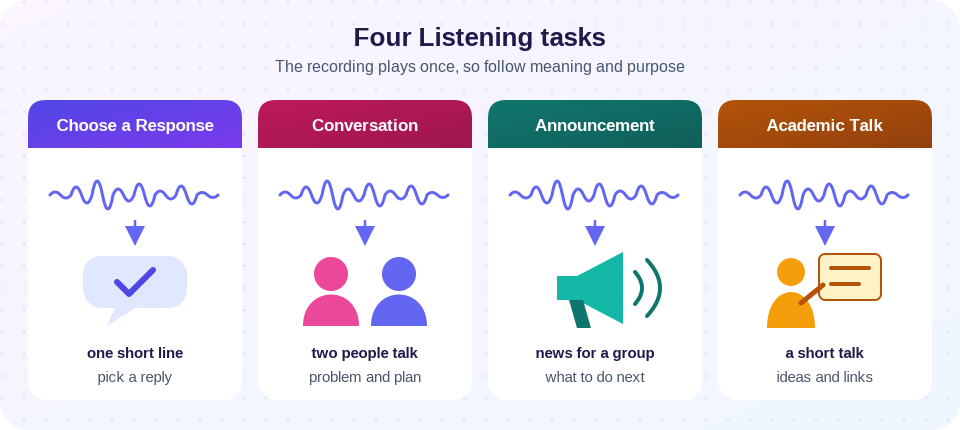
Four task types
| Task | What you hear | Listen for |
|---|---|---|
| Listen and Choose a Response | Something very short | What the speaker means and what reply fits |
| Listen to a Conversation | Two people | Problem, plan, details, intent |
| Listen to an Announcement | Campus or class information | Purpose, key facts, next steps |
| Listen to an Academic Talk | A short talk on an academic topic | Main idea, support, organization, inference |
ETS lists 47 items, and the time can vary. The section is two-stage adaptive. The audio ranges from very short utterances to talks of up to about 250 words. ETS says the audio uses AI-generated voices and sometimes human voice actors, with a range of accents that includes North American, British and Australian English. ETS's test-taker page for Speaking also mentions New Zealand accents.
Before the audio
During the audio
After the audio
What to listen for
Most spoken situations answer a few simple questions.
- Why is this person speaking?
- What is the problem or topic?
- What changes or is surprising?
- What happens next?
- How does the speaker feel or how sure is the speaker?
If you can answer these, you can often answer detail questions too, because details hang on this frame.
Signal words
| Signal | What it often means |
|---|---|
| actually, as it turns out | a correction or surprise is coming |
| but, however, although | a contrast or limit |
| instead | a plan is replaced |
| the main thing is, remember | important point |
| for example, take | support for an idea |
| so, that's why, as a result | a result |
A note system
Do not write sentences. Write keywords, symbols and short forms that you will understand a few seconds later.
| Symbol or short form | Meaning |
|---|---|
| → | leads to, changes to |
| b/c | because |
| ≠ | is not, differs |
| ↑ ↓ | increases, decreases |
| ? | question or doubt |
| ex | example |
| w/ , w/o | with, without |
For a conversation, make two columns, one for each speaker. For a talk, write the topic at the top and indent the support under each point.
Worked example
You hear:
"I was going to hand in my history outline today, but my laptop wouldn't start. The help desk says they can lend me one this afternoon. Could I send it by tonight instead?"
Notes: outline due today / laptop ✗ / desk lends this pm / ask: send tonight?
From these notes you can answer: what is the problem, what help is available and what the speaker wants.
When you miss something
You will sometimes miss a word. Do not stop to think about it. The audio keeps going, and one lost word can easily become three lost sentences. Keep listening. Later information often repeats or explains the missed part. When the audio ends, use the meaning that you did catch and choose the most supported answer.
Training your ears
- Listen once without text, write the main idea, then replay with a transcript to find what you missed.
- Mark why you missed it: unknown word, linked sounds, speed or lost attention.
- Practice linked speech: in natural English, "Did you" can sound like "Didja", and "going to" can sound like "gonna".
- Listen to several accents. Choose short material that you can repeat after the first attempt.
Questions come after the audio
According to the ETS specifications, you respond to items after each recording, typically with a printed question and answer choices. A short item may have one question, while a longer recording may have a set. This is why a general understanding matters: do not count on knowing the exact question while you listen. Listen for the whole picture, and let your notes hold the facts that would be easy to confuse, such as two different times or two rooms.
A two-listen study cycle
For study, as opposed to test rehearsal, use two clearly separate listens. During the first, behave as you would in a single-play task: listen, take brief notes and answer your own questions. Do not pause. During the second, pause as often as you like and compare the audio with a script, if you have one. Mark each place where your notes were missing or wrong, and name the cause. An unknown word calls for vocabulary work. A familiar word that you did not recognize in fast speech calls for sound practice. A lost thread calls for attention and signal-word practice. Different causes need different exercises, so naming them saves time.
Common mistakes
- Writing so much that you stop listening.
- Freezing over one unknown word.
- Writing the first plan and missing the change that follows.
- Practicing only with subtitles or a transcript open.
Try it
Press Listen once, take a note, then answer. If audio does not work, use "Show script", read it once and hide it.
Choose the best short note for each line.
Check your understanding
Quick check · 4 questions
of 4 answered You scored / 4 · perfect!
-
1. How many times is each recording played, according to the ETS specifications?
Recordings are played once. -
2. What should you do when you miss a word?
The audio does not pause. -
3. Which word often signals that a plan has been replaced?
"Instead" points to a replacement. -
4. What are good notes?
Notes should support attention, not replace it.
Summary
- Listening has four task types.
- Recordings are played once.
- Listen for purpose, problem, change, next step and attitude.
- Keep notes tiny.
Theo dõi tiến độ của bạn
Tạo tài khoản miễn phí để đánh dấu bài đã học và tiếp tục từ chỗ bạn dừng lại trên mọi thiết bị.