
























Bài 20 · Rhythm and Arrangement
Beats, Bars, and Tempo
Learn how beats, bars, tempo and subdivisions work in a DAW, how to convert BPM into milliseconds, and how to read a 16-step drum grid with confidence.
Almost every decision in a track sits on a time grid. Where does the snare land? How long should a delay last? When does the chorus start? You can answer all of these once you understand beats, bars and tempo.
You do not need to read sheet music. You only need to count, and to know what your DAW grid is showing you.
What you will learn
- The difference between a beat, a bar and a phrase
- What tempo in BPM means
- How to count eighth and sixteenth notes
- How to turn BPM into milliseconds and seconds
Beat, bar and tempo
The beat is the steady pulse you tap your foot to. A bar (also called a measure) is a group of beats. The time signature tells you how the group is built.
Much popular and electronic music uses 4/4. In 4/4, each bar has four beats, and a quarter note counts as one beat. Other signatures exist. In 3/4, a bar has three quarter-note beats, which gives a waltz-like feel. In 6/8, a bar has six eighth notes, usually felt as two groups of three.
Tempo is the speed of the pulse. It is measured in BPM, beats per minute. At 60 BPM you get one beat each second. At 120 BPM you get two beats each second.
Be careful with compound time such as 6/8. Programs differ in which note value their BPM number counts. Check your own DAW before you rely on a calculation there.
Phrases
Bars group into phrases. In many styles, phrases are 4, 8 or 16 bars long. Listeners start to expect a change at these points, such as a new instrument, a drum fill or a new section. This is a habit of many styles, not a law. A 6-bar phrase can sound fresh because it breaks the expectation.
Your DAW usually shows position as bars, beats and smaller units, for example 9.1.1. That often means bar 9, beat 1, first subdivision. The exact format depends on the program.
Subdivisions
You can split each beat into smaller equal parts.
| Note value | Per 4/4 bar | How to count one beat |
|---|---|---|
| Quarter | 4 | "1" |
| Eighth | 8 | "1 and" |
| Sixteenth | 16 | "1 e and a" |
| Eighth-note triplet | 12 | "1 trip let" |
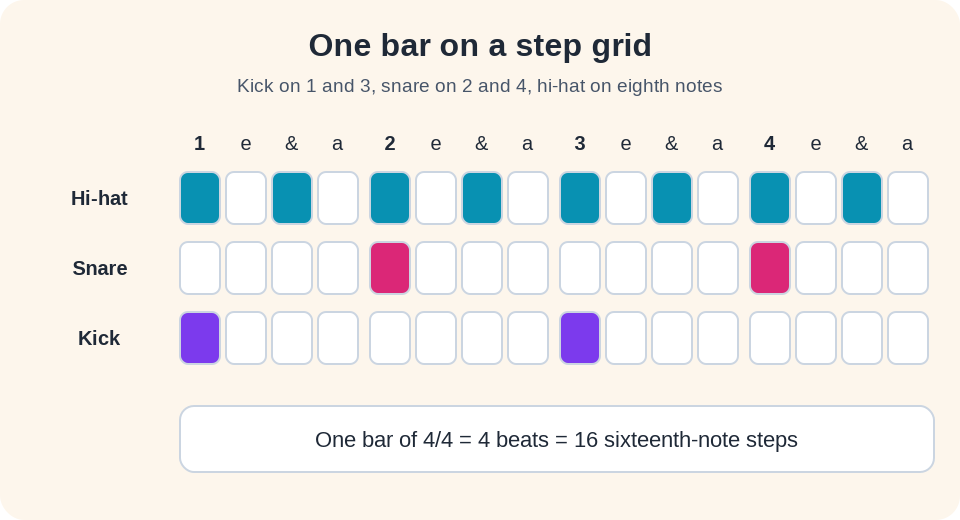
A step sequencer often shows one bar as 16 steps. Each step is a sixteenth note. The four beats start on steps 1, 5, 9 and 13.
A dotted note lasts one and a half times its normal length. A dotted eighth note therefore lasts as long as three sixteenth notes.
From BPM to time
Delays, reverb pre-delay and video timing often need real time units. One minute has 60,000 milliseconds, so:
- One beat (quarter note) = 60,000 ÷ BPM milliseconds
- One 4/4 bar = four beats
- One eighth note = half a beat
- One sixteenth note = a quarter of a beat
- One dotted eighth = three quarters of a beat
Worked example at 120 BPM. One beat is 60,000 ÷ 120 = 500 ms. A bar is 2,000 ms, or 2 seconds. An eighth note is 250 ms. A sixteenth is 125 ms. A dotted eighth is 375 ms.
Worked example at 90 BPM. One beat is about 667 ms. A bar is about 2.67 seconds.
You can also work out track length. In 4/4, seconds = bars × 4 × 60 ÷ BPM. A 96-bar track at 128 BPM lasts 96 × 4 × 60 ÷ 128 = 180 seconds, which is exactly three minutes.
If you are unsure of a song's tempo, use a tap tempo tool. Tap on each beat for at least eight beats. If the result is about double or half of what you expect, you may be tapping a different pulse level.
Half-time and double-time
Tempo and feel are not the same thing. Imagine a project at 140 BPM. If the snare lands only on beat 3 of each bar, the groove feels like it moves at half speed. This is called a half-time feel. The grid is still at 140. In a double-time feel, the drums suggest a pulse twice as fast.
This is why two tracks with the same BPM can feel very different. Choose your tempo by ear, then choose where the strong drum hits go.
Worked example: planning a short track
Say you want a track of about two and a half minutes at 96 BPM. One 4/4 bar lasts 240 ÷ 96 = 2.5 seconds. A length of 150 seconds is therefore 60 bars.
Now split those bars into phrases. You could use a 4-bar intro, two 16-bar verses, two 8-bar choruses and an 8-bar outro. That adds up to 60. The plan may change later, but you now know how much music you need to write. You also know that an 8-bar chorus lasts only 20 seconds.
As a counting exercise, play a song and say "1, 2, 3, 4" with the beat. Replace the 1 with the bar number: "1, 2, 3, 4, 2, 2, 3, 4". After a few songs, you will start to feel where each 8-bar phrase ends without counting every beat.
Common mistakes
- Recording audio before setting the project tempo. The audio may not line up with the grid later.
- Counting from zero. Musicians count bar 1, beat 1.
- Choosing a tempo only because a genre chart says so. Sing or play the main idea and check that it feels comfortable.
- Mixing up bars and beats when you type a loop length.
Try it
Change the tempo and watch the note lengths update. Then guess the quarter-note time before you look.
Check your understanding
Quick check · 4 questions
of 4 answered You scored / 4 · perfect!
-
1. How long is one beat at 100 BPM?
60,000 divided by 100 is 600 milliseconds. -
2. In a 16-step bar of 4/4, which step starts beat 3?
Each beat has four steps, so the beats start on steps 1, 5, 9 and 13. -
3. A dotted eighth note is as long as which of these?
A dot adds half of the note's length. Two sixteenths plus one more makes three. -
4. What usually creates a half-time feel?
The grid tempo is unchanged. The drum accents suggest a slower pulse.
Summary
- A beat is the pulse, a bar is a group of beats, and a phrase is a group of bars.
- BPM sets the speed. One beat lasts 60,000 ÷ BPM milliseconds.
- A 4/4 bar has 16 sixteenth-note steps.
- Feel depends on where the accents fall, not only on BPM.
Theo dõi tiến độ của bạn
Tạo tài khoản miễn phí để đánh dấu bài đã học và tiếp tục từ chỗ bạn dừng lại trên mọi thiết bị.