
























Bài 32 · Study Plans and Test Day
Building a study plan that works
Set a realistic IELTS goal, find your weak spots with an honest baseline and turn your hours into a weekly plan that includes review and rest.
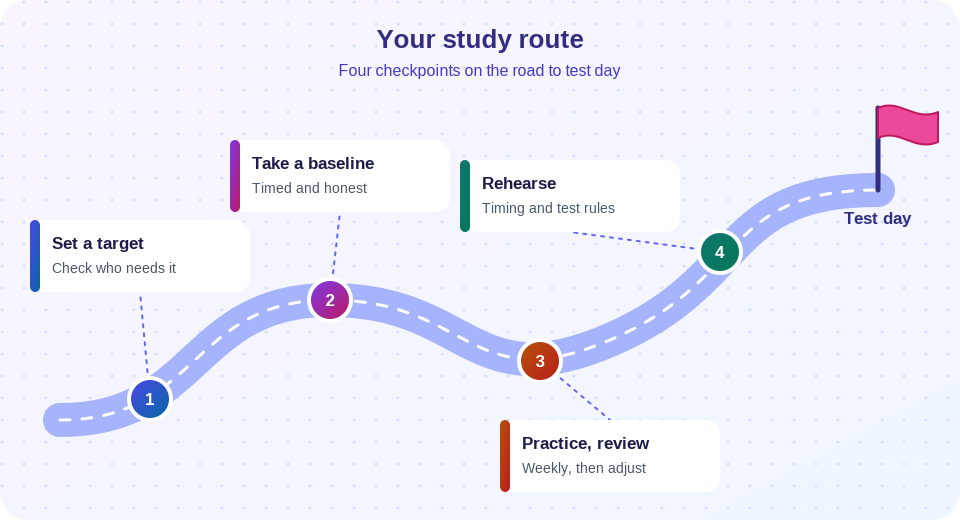
A good study plan answers four questions: what score do you need, where are you now, how much time do you have and what will you do each week? A plan does not need to be fancy. It needs to be honest and easy to follow.
What you will learn
- How to set a target from real requirements
- How to take a useful starting measure
- How to divide your time
- How to adjust the plan as you learn
Target
Baseline
Plan
Review
Step 1: find your real target
Ask the university, employer or authority that wants your result which test type they accept, what overall band they require and whether each skill has its own minimum. Check their official pages, because requirements differ and change. The official scale runs from 0 to 9, with half bands. The overall score is the average of the four skill scores, rounded to the nearest half or whole band. The official guidance says that an average ending in .25 rounds up to the next half band, and one ending in .75 rounds up to the next whole band.
For example, scores of 6.5, 6.5, 5.5 and 7.0 add up to 25.5. The average is 6.375, which rounds to 6.5. A required minimum in each skill is a separate condition: here the 5.5 would fail a minimum of 6.0, even with a good overall result.
Step 2: take a baseline
Use official sample or practice materials under realistic timing. For Listening and Reading, you can count correct answers with the official key. The official site notes that raw-score conversions vary slightly between test versions, so treat any estimate as rough. For Writing and Speaking, ask a qualified person for feedback if you can. Self-marking is useful for finding errors, but it is hard to judge your own band.
Write down what went wrong, not only the number: "ran out of time in Reading", "missed plural endings in Listening", "did not finish Task 2".
Step 3: share out your time
| Skill | Sign of need | Practice activity |
|---|---|---|
| Listening | Losing your place, spelling errors | Listen, answer, then study a transcript if one is provided |
| Reading | Not finishing, misreading questions | Timed sections, then explain every wrong answer |
| Writing | Weak plan, repeated errors | Plan, write, revise, update the error log |
| Speaking | Short answers, long gaps | Daily speaking, recordings, a partner |
Give more time to weak skills, but do not drop the strong ones.
Step 4: a weekly pattern
Here is an example for about seven hours a week. Move the blocks to suit your life.
| Day | Block | Time |
|---|---|---|
| Monday | Reading section and review | 60 minutes |
| Tuesday | Speaking cards and recording | 45 minutes |
| Wednesday | Essay plan and body paragraph | 60 minutes |
| Thursday | Listening practice and review | 60 minutes |
| Friday | Vocabulary and error log | 30 minutes |
| Saturday | One timed Writing test | 75 minutes |
| Sunday | Light review and speaking, then rest | 90 minutes |
These blocks add up to 420 minutes, which is seven hours.
Review is where learning happens
Doing many practice tests without review can fix your mistakes in place. After each task, ask: why was this wrong, what clue did I miss, what will I do next time? Revisit old errors after several days.
Adjust the plan
Every two weeks, compare your work with your goal. If a skill is not moving, change the method, not only the hours. If your plan is too heavy to follow, make it smaller. A modest plan that you keep beats an ambitious one that you abandon after a week. If you can, leave some spare days before the test for review and sleep.
No plan can promise a score. It can only help you use your time well. The practice writing set and the practice speaking set give you material to put into the plan.
A four-week example cycle
If you have several weeks, give each stretch a theme. This sample cycle is for a learner whose weaker skills are Writing and Speaking.
| Week | Main aim | End-of-week check |
|---|---|---|
| 1 | Learn the formats and take a baseline | A list of the three biggest problems |
| 2 | Paragraphs and Part 2 talks | Two developed paragraphs and two recordings |
| 3 | Timing | One full timed Writing test and a speaking rehearsal |
| 4 | Review and repeat | Compare new work with week 1 |
Keep your week 1 samples. Comparing them with later work shows changes that are hard to feel from day to day. If you have only two weeks, combine the stages and focus on the most frequent errors. If you have six months, repeat the cycle and add wider reading and listening in English for pleasure.
Common mistakes
- Picking a target without checking the actual requirement.
- Doing practice tests without reviewing the errors.
- Studying only your favorite skill.
- Making a plan so heavy that you give up.
Try it
Enter your weeks, weekly hours and the need for each skill. The planner shares your hours in proportion. It cannot predict a score.
Check your understanding
Quick check · 4 questions
of 4 answered You scored / 4 · perfect!
-
1. Where should your target score come from?
Requirements differ between organizations. -
2. Four skills are 7.0, 6.5, 6.5 and 6.5. What is the overall band?
The average is 6.625, and the nearest half band is 6.5. -
3. What should follow a practice test?
Review turns mistakes into learning. -
4. How should a plan treat strong skills?
Strong skills still need maintenance.
Summary
- Take your target from official requirements.
- Measure your starting point honestly.
- Give weak skills more time and review everything.
- Adjust the plan when it does not work.
Next: Test day: what to expect
Theo dõi tiến độ của bạn
Tạo tài khoản miễn phí để đánh dấu bài đã học và tiếp tục từ chỗ bạn dừng lại trên mọi thiết bị.