
























Bài 16 · Reading Charts and Tab
Reading Chord Charts
Read chord charts with confidence: bar lines, beat slashes, repeat signs, song sections and chord names such as Am, D7, Csus4 and G/B, with examples.
A chord chart tells you which chords to play and when. It usually does not tell you exactly how to strum. That freedom makes charts quick to read and useful when you play with other people.
Chord charts come in several styles. This lesson shows the common building blocks, so you can understand most of them.
What you will learn
- How bars and beats appear on a chart
- Repeat signs and song sections
- What common chord names mean
- How to plan before you play
Bars on a chart
Vertical lines, |, usually separate bars. A simple chart in 4/4 might look like this:
| G | C | D | G |
When a bar has one chord, play that chord for the whole bar: four beats in 4/4.
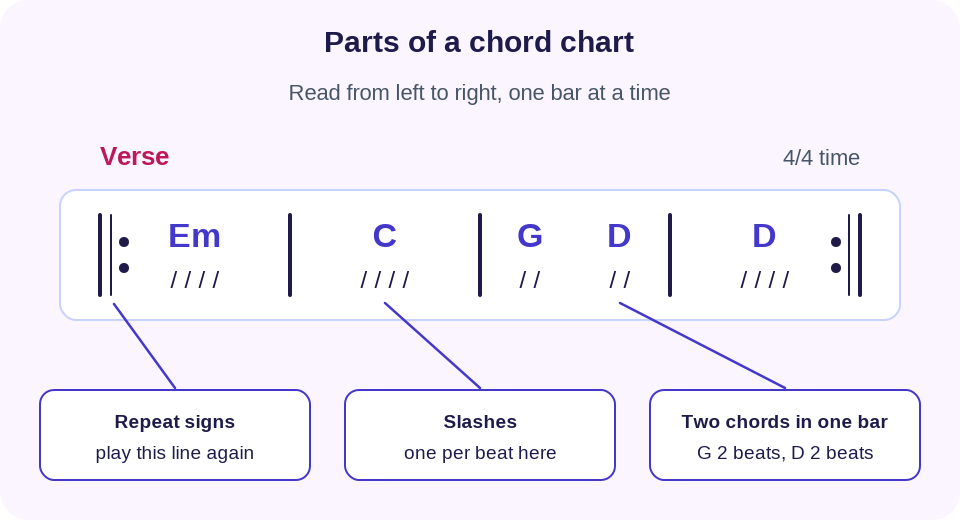
When a bar has two chords, they often share the beats equally:
| G C | D |
Here G gets two beats, C gets two beats, then D gets four.
Not every chart is exact about this. If you need precise timing, look for slashes. Each slash / often shows one beat:
| G / / / | C / D / |
In the second bar, C lasts two beats and D lasts two beats. In some charts the chord name itself counts as the first beat, and slashes show the remaining beats. In others, each slash is one beat and the name sits above it. Read the first bars to find which style is used.
Repeats
| Sign | Common meaning |
|---|---|
|: and :| |
Repeat the part between these signs |
x4 or (4 times) |
Play the line or section four times |
% |
Repeat the previous bar |
N.C. |
No chord: stop strumming or play without a chord |
Longer charts may use words such as D.C. (go back to the beginning), D.S. (go back to a sign), Fine (the end) or Coda (a closing section). Look through a new chart before you start so these jumps do not surprise you.
Song sections
Charts often label sections: Intro, Verse, Chorus, Bridge and Outro. A section label helps you and other players find the same place. If someone says "from the chorus", everyone knows where to start.
Chord names
| Symbol | Name | Example |
|---|---|---|
| C | C major | C |
| Cm | C minor | Am, Em |
| C7 | C dominant seventh | A7, D7, E7 |
| Cmaj7 | C major seventh | Fmaj7 |
| Cm7 | C minor seventh | Am7 |
| Csus2, Csus4 | Suspended chords | Dsus4 |
| C/G | C chord with G in the bass | G/B, D/F# |
Be careful: C7 and Cmaj7 are different chords with different sounds. A capital letter tells you the root. A # means sharp and b (often printed as ♭) means flat.
Slash chords
In G/B, play a G chord with B as the lowest note. The letter after the slash is the bass note, not a second chord. A beginner shape for G/B is x 2 0 0 0 3. Be sure to mute string 6. If a slash chord is too hard right now, playing the chord before the slash is often an acceptable temporary choice, but you lose the bass line.
Charts with lyrics
Some charts place chord names above the words of a song. The chord usually changes on the syllable right below the name. These charts often lack bar lines, so you need to know the song's rhythm by listening to it. Lyrics are protected by copyright in many places. Copyright rules differ by country, so respect them when you share charts.
Plan before you play
- Find the time signature and tempo, if given.
- Find repeats and jumps.
- List every different chord. Check you know each shape.
- Practice the hardest change alone.
- Count in and play slowly.
A worked example
Here is an original practice chart in 4/4:
Verse
|: Em    | C     | G     | D     :|

Chorus
| C   D  | G     | C   D  | Em    |
The verse repeats once, so you play those four bars twice in total. In the chorus, bar 1 splits into C (two beats) and D (two beats). Start with one down strum per chord change. When that works, add a pattern from strumming patterns.
Charts leave choices to you
Two players can read the same chart and sound different. One may strum once per beat, another may use an eighth-note pattern, and a third may pick the strings one at a time. All of these can follow the chart correctly, because the chart mainly gives the chords and their order. Start with the simplest version: one clean down strum on each chord. Next, play one down strum on every beat. Only then add a longer pattern. If the pattern makes you miss changes, step back to the simpler version.
Writing your own chart
Writing a chart helps you understand charts. Choose chords that you know and make four bars. Put a bar line between the bars. Add the time signature at the top, such as 4/4, and a tempo you can manage. Mark any repeat clearly. Then play your chart from the page without changing it from memory. If you feel unsure at any point, the chart may need clearer beats or a better section label. Keep your charts in your practice notebook, so you can review them later. When you play with others, give everyone the same version.
Transfer to your guitar
Do not only read the chart with your eyes. Point to each bar while you count out loud, then play it with the guitar. Try to look one bar ahead. This gives your fretting hand time to prepare. Looking ahead is hard at first, so practice it with a very easy pair such as Em and Am before you try a longer chart.
Common mistakes
- Playing a two-chord bar as two full bars.
- Missing a repeat sign and ending too early.
- Reading Cmaj7 as C7.
- Reading the bass note in G/B as a separate chord.
- Starting to play before you check every chord in the chart.
Try it
Count the beats that each chord receives.
Check your understanding
Quick check · 4 questions
of 4 answered You scored / 4 · perfect!
-
1. In 4/4, a bar shows "G C" with no other marks. What is the most usual reading?
Two chords in a bar often share the beats equally. -
2. What does G/B mean?
The letter after the slash names the bass note. -
3. What do the signs |: and :| usually mean?
They mark a repeated section. -
4. What does N.C. mean?
N.C. marks a place without a chord.
Summary
- Bar lines and slashes show when chords change.
- Repeat signs and words like D.S. change the order of the music.
- Chord names show the root and type; a slash shows the bass note.
- Scan a chart and prepare hard changes before you play.
Next: Reading Guitar Tablature
Theo dõi tiến độ của bạn
Tạo tài khoản miễn phí để đánh dấu bài đã học và tiếp tục từ chỗ bạn dừng lại trên mọi thiết bị.