
























Ders 23 · Chords and Harmony
Major and Minor Triads
Build major and minor triads on any piano key by counting half steps, learn the chords found in C major, and play them with comfortable fingering.
A chord is a group of notes that sound together as one unit of harmony. The most useful beginner chord is the triad, which has three different notes. With a few triads you can support many simple melodies.
In this lesson you build chords from distances, not from memorized shapes only. That way you can find a chord even when you have never played it before.
What you will learn
- The names of the three notes in a triad
- How to count half steps to build major and minor chords
- The diminished and augmented triads in brief
- The seven triads of C major
- How to play chords with a free hand
Root, third and fifth
The root is the note that gives the chord its name. The third is three letter names up, counting the root as one. The fifth is five letter names up. For a chord on C, the letters are C, E and G.
When the root is the lowest note, the chord is in root position. You will move the notes around in a later lesson.
Counting half steps
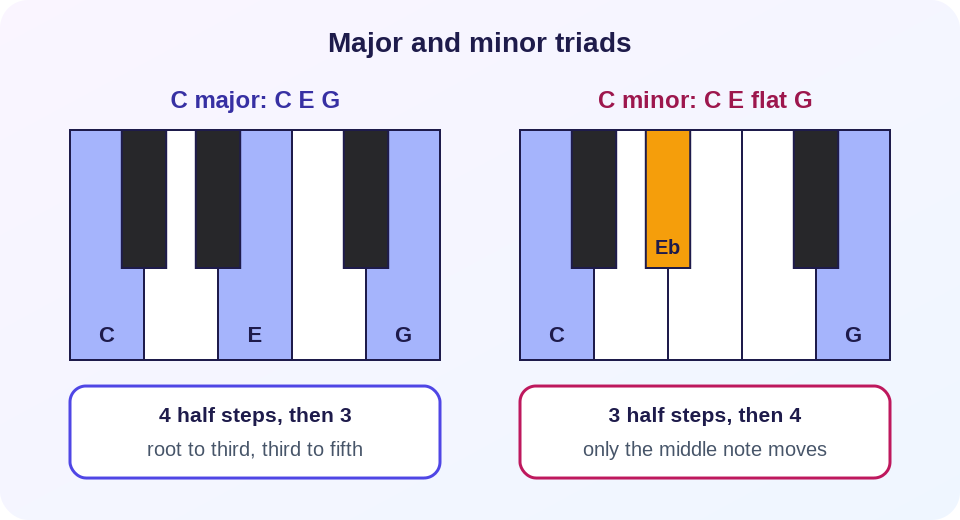
Letter names tell you which letters to use. Half steps tell you exactly which keys. Count each new key, black or white, as one step. Do not count the starting key.
| Chord type | Root to third | Third to fifth | Example |
|---|---|---|---|
| Major | 4 | 3 | C E G |
| Minor | 3 | 4 | C E flat G |
| Diminished | 3 | 3 | B D F |
| Augmented | 4 | 4 | C E G sharp |
In both major and minor chords, the root and fifth are 7 half steps apart. Only the middle note changes. To turn a major triad into a minor one, lower the third by one half step. To go the other way, raise it by one.
Worked examples
D minor. The root is D. Count 3 half steps: D sharp, E, F. The third is F. Count 4 more: F sharp, G, G sharp, A. The chord is D F A.
D major. Count 4 from D and you reach F sharp. Count 3 more and you reach A. The chord is D F sharp A.
E major. E G sharp B. The third must be a G, because the letters of a chord on E are E, G and B.
F minor. F A flat C. The key for A flat is the same key as G sharp, but the chord spelling needs an A.
B flat major. B flat D F. Here the root is a black key and the other two notes are white.
The triads of C major
Build a triad on every note of the C major scale, using only the notes of that scale. This means you play one note, skip one, play one, skip one and play one.
| Degree | Roman numeral | Chord | Notes |
|---|---|---|---|
| 1 | I | C major | C E G |
| 2 | ii | D minor | D F A |
| 3 | iii | E minor | E G B |
| 4 | IV | F major | F A C |
| 5 | V | G major | G B D |
| 6 | vi | A minor | A C E |
| 7 | vii° | B diminished | B D F |
Capital Roman numerals mean major chords. Small numerals mean minor chords, and the small circle means diminished. The same pattern of types appears in every major key. In G major, for example, I is G major, ii is A minor and V is D major.
Playing chords well
In root position, a common fingering is 1, 3 and 5 in the right hand, and 5, 3 and 1 in the left hand.
- Shape the three fingers just above the keys.
- Let the arm drop gently so all three notes start together.
- Listen: did one note arrive late or sound weak?
- Release the keys and let the hand rest in its natural shape.
If one note is often late, play the three notes one at a time first. This is a broken chord, also called an arpeggio when played in a flowing way. Then play them together again.
Practice changing between two chords, such as C major and A minor. They share C and E. Keep your hand close to the keys and notice that only a small part of the shape needs to move.
Hearing the difference
Play C major, then C minor, several times. Next, close your eyes and have a partner play one of them. Name it before looking. Many people hear major as brighter and minor as darker, but trust your own ears and learn the sound by repetition. Try the same test on D, E and G.
Common mistakes
- Counting the root itself as the first half step.
- Forgetting black keys when counting.
- Spelling D major as D G flat A. The third of a D chord must be some kind of F.
- Locking the whole hand in one stiff shape between chords.
Try it
Switch between chord types and watch which key moves.
Check your understanding
Quick check · 4 questions
of 4 answered You scored / 4 · perfect!
-
1. How many half steps are in a major triad, from root to third and then third to fifth?
A major triad has the larger third at the bottom. -
2. Which notes make C minor?
Lower the third of C major by a half step. -
3. In a major key, which of these chords is minor?
The chords ii, iii and vi are minor in a major key. -
4. What is a common right hand fingering for a root-position triad?
Fingers 1, 3 and 5 fit the spacing of the three notes.
Summary
- A triad has a root, third and fifth.
- Major is 4 plus 3 half steps; minor is 3 plus 4.
- In C major, the triads are C, Dm, Em, F, G, Am and B diminished.
- Make all notes start together with a gentle arm movement.
İlerlemeni takip et
Dersleri işaretlemek ve herhangi bir cihazda kaldığın yerden devam etmek için ücretsiz bir hesap oluştur.