
























Ders 11 · Lenses and Focus
Focal Length and Angle of View
Learn what focal length means, how it changes angle of view, how crop factor works on smaller sensors, and why your distance, not the lens, sets perspective.
Focal length is a number in millimeters that you see on every lens, such as 24 mm or 200 mm. It mostly decides how much of the scene fits in your picture and how large things appear.
It is one of the most useful ideas in photography, and it is often misunderstood.
What you will learn
- What focal length tells you
- How angle of view changes
- How crop factor works
- Why perspective depends on where you stand
Short and long focal lengths
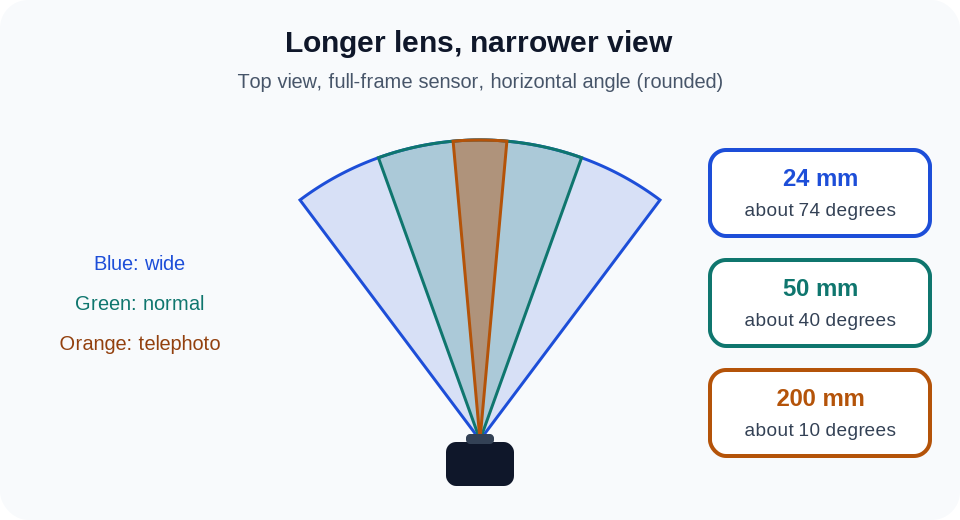
- A short focal length gives a wide angle of view. Things look smaller in the frame, and you fit more in.
- A long focal length gives a narrow angle of view. Distant things look bigger, and you fit less in.
For a simple lens focused far away, the focal length is the distance from the lens's optical center to the image. Real camera lenses have many elements, so the physical length of a lens may not match the number.
Angle of view on full frame
These horizontal angles are for a full-frame sensor, which is 36 mm wide, with the lens focused far away. Values are rounded.
| Focal length | Horizontal angle | Common name |
|---|---|---|
| 24 mm | about 74° | Wide angle |
| 35 mm | about 54° | Moderately wide |
| 50 mm | about 40° | Normal |
| 85 mm | about 24° | Short telephoto |
| 200 mm | about 10° | Telephoto |
For a distortion-free lens focused far away, the formula is: angle = 2 × arctan(sensor width ÷ (2 × focal length)). Real lenses can differ a little, especially at close distances.
Zoom and prime lenses
A zoom lens has a range, such as 24–70 mm. A prime lens has one focal length. See types of lenses.
Crop factor
Smaller sensors record a smaller part of the image that a lens projects. So the same focal length gives a narrower view.
The crop factor compares a sensor's diagonal with full frame.
| Sensor | Typical crop factor |
|---|---|
| Full frame | 1.0 |
| APS-C | about 1.5 (about 1.6 on Canon APS-C) |
| Micro Four Thirds | 2.0 |
To find the full-frame equivalent, multiply the focal length by the crop factor.
Worked examples
- 35 mm on APS-C (1.5): 35 × 1.5 = 52.5, so it frames about like 50 mm on full frame.
- 25 mm on Micro Four Thirds: 25 × 2 = 50, so it frames about like 50 mm.
- To get a view like 24 mm on APS-C (1.5): 24 ÷ 1.5 = 16 mm.
The focal length of the lens itself does not change. Only the view changes, because the sensor sees a smaller part of the image. The shapes of sensors differ too, so "equivalent" views are usually compared by the diagonal.
Phone makers often list their cameras using equivalent focal lengths, because the real focal lengths are only a few millimeters.
Perspective comes from distance
Perspective is the relationship between near and far things: how big they look compared with each other.
Here is the key idea: perspective depends on where the camera is, not on the focal length.
The test
- Stand in one place and take a photo with a wide lens.
- Without moving, take a photo with a long lens.
- Crop the wide photo to match the long one.
The sizes and overlaps of objects match, apart from detail and blur. The long lens just showed a smaller part of the same view.
Why wide lenses seem to stretch faces
With a wide lens, people often move close to fill the frame. When you are very close to a face, the nose is much nearer the camera than the ears, so it looks large compared with the rest. The cause is the short distance.
With a long lens, you step back to fit the same face. From farther away, the nose and ears are nearly the same distance away, relatively. The face looks flatter and more natural to many viewers.
"Compression"
A long lens used from far away can make distant buildings or hills look stacked close together. Again, the distance causes this. The lens lets you fill the frame from far away.
Wide lenses can also stretch objects near the edges of the frame. That is a normal result of projecting a wide view onto a flat sensor. It is most visible with round things, such as heads at the edge of a group photo.
Keep verticals straight
If you tilt the camera up to fit a tall building, its vertical lines seem to lean together. Keeping the camera level and stepping back often reduces this. You can also correct it in editing, at the cost of some cropping.
Handheld and focal length
A longer lens magnifies small hand movements. Check the shutter speed guide and use stabilization or support.
Common mistakes
Saying crop factor changes the focal length. It changes the view, not the lens.
Blaming the lens for face shape. Distance is the main cause.
Zooming instead of moving. Zooming changes framing. Moving changes perspective. Use both on purpose.
Using a very wide lens for a close portrait without noticing. Check how the face looks.
Try it
Choose a sensor and a focal length. The tool shows the equivalent focal length and an approximate angle of view.
Check your understanding
Quick check · 4 questions
of 4 answered You scored / 4 · perfect!
-
1. What does a shorter focal length usually give?
Short focal lengths capture a wider view. -
2. With a crop factor of 1.5, a 40 mm lens frames about like which full-frame lens?
40 times 1.5 is 60. -
3. What mainly determines perspective?
Relative sizes depend on distances from the camera. -
4. Why can a very close wide shot make a nose look large?
At close range, small differences in distance are a big share of the total.
Summary
- Focal length mainly sets how wide the view is and how big things look.
- Longer focal lengths give narrower views.
- Crop factor gives a full-frame equivalent view for smaller sensors.
- Perspective depends on camera position.
- Move your feet and choose your lens on purpose.
Next: Types of Lenses
İlerlemeni takip et
Dersleri işaretlemek ve herhangi bir cihazda kaldığın yerden devam etmek için ücretsiz bir hesap oluştur.