Learn to greet people, introduce yourself and others, answer "How are you?" and remember names, with formal and casual examples and practice conversations.
The first few seconds of a conversation often follow a familiar pattern. That is good news: if you learn the pattern, you can start calmly, even before you know what to talk about.
This chapter covers everyday situations. We begin with saying hello, giving your name and introducing other people.
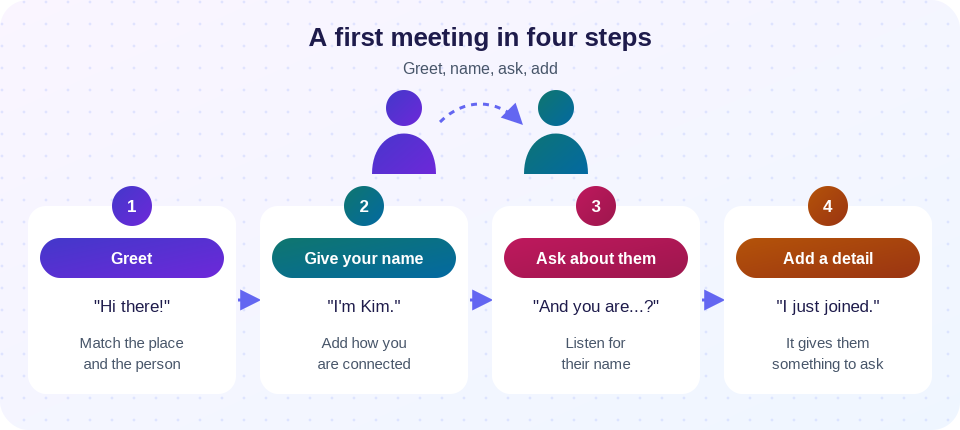
A first meeting often moves through four short steps.
In many everyday meetings, "How are you?" is part of the greeting. The speaker usually expects a short answer.
A: Hi, Lena. How are you?
B: I'm good, thanks. How about you?
A: Not bad, thanks.
Other short answers are "Fine, thank you," "Pretty good," and "A bit tired, but OK." With a close friend, you can say more.
You may also hear casual questions such as "How's it going?" and "How are you doing?" Answer them like "How are you?" The question "What's up?" often gets answers such as "Not much. You?" Customs differ between regions and groups, so listen to how people around you answer.
"How do you do?" is a very formal, old-fashioned greeting that you may rarely hear. "Nice to meet you" is a safer choice.
Use this simple pattern: greeting + name + connection.
"Hi, I'm Arjun. I'm in your evening class."
"Hello, my name is Mei Lin. I've just joined the sales team."
"Hi, I'm Carlos, Ana's neighbor."
The connection gives the other person something to ask about. If your name is hard for some listeners, say it slowly. You can add: "It's Siobhan. You say it like 'shi-VAWN'." Tell people what you prefer to be called: "My name is Alexander, but please call me Sasha."
Notice the difference between these two:
"Nice to meet you" is usual the first time.
"Nice to see you" is usual when you already know the person.
A helpful introduction gives each person a name and a connection.
Nadia: Tom, this is Yuki. We study together. Yuki, this is Tom, my roommate.
Tom: Hi, Yuki. Nice to meet you.
Yuki: Nice to meet you too. How long have you two shared the apartment?
Say "This is Yuki," not "She is Yuki," when you introduce someone who is there. In a formal setting, you can say "I'd like to introduce Dr. Okafor."
Use the title and family name that a person uses until you know that a first name is welcome. If you are unsure, ask: "What would you like me to call you?"
Handshakes, bows, waves, hugs and cheek kisses are used differently around the world, and people also have personal preferences. A good approach is to watch what others do and let the other person lead. You can always smile and say hello.
A first meeting also needs a friendly finish. Combine a goodbye with a short, positive comment:
A: I'd better get to my next class. It was nice meeting you.
B: You too. See you on Thursday.
Notice the form. "Nice to meet you" is usual at the start. "Nice meeting you" is usual at the end. Other useful goodbyes are "See you soon," "Have a good one" (casual) and "I look forward to seeing you again" (more formal).
Here is a short meeting from start to finish. Read both roles, then replace the names and details with your own.
A: Hello, I'm Farah. I live on the second floor.
B: Hi Farah, I'm Ben. I moved in last week.
A: Welcome! How are you settling in?
B: Pretty well, thanks. I'm still unpacking.
A: Well, let me know if you need anything. Nice meeting you.
B: You too. Thanks, Farah.
Practice a first meeting. Choose a reply, say it aloud and read the note.
Meet a new classmate
<!doctypehtml><style>body{font-family: system-ui, sans-serif;margin: 0;padding: 14px;background:linear-gradient(135deg, #faf5ff, #eff6ff);color: #1e1b4b;}.card{background: #fff;border-radius: 14px;padding: 14px 16px;box-shadow: 0 6px 18px rgba(49, 46, 129, .12);margin-bottom: 10px;}button{font: inherit;border: 1px solid #c7d2fe;background: #eef2ff;color: #1e1b4b;border-radius: 10px;padding: 8px 12px;margin: 4px 4px 0 0;cursor: pointer;text-align: left;}button.main{background:linear-gradient(135deg, #4f46e5, #7c3aed);color: #fff;border: 0;}button.good{background: #d1fae5;border-color: #10b981;}button.bad{background: #fee2e2;border-color: #ef4444;}input, select{font: inherit;padding: 6px 8px;border: 1px solid #a5b4fc;border-radius: 8px;max-width: 100%;}.muted{color: #475569;font-size: 14px;}.fb{margin-top: 8px;min-height: 1.4em;}</style><pclass="muted">A scripted practice conversation. Pick your reply, say it aloud, and read the note.</p><divclass="card"id="log"></div><divid="opts"></div><divid="fb"class="fb muted"></div><buttonclass="main"id="restart"type="button">Start again</button><script>const data ={"start":"a","nodes":{"a":{"them":"Hi, I don't think we've met. I'm Omar.","replies":[["Hi Omar, I'm Kim. I just joined this class.","b","You gave your name and a connection."],["Good night, Omar.",null,"\"Good night\" is for leaving. Try another reply."]]},"b":{"them":"Nice to meet you, Kim. So how are you finding it so far?","replies":[["Nice to meet you too. I like it so far. How long have you been coming?","c","You returned the greeting, answered and asked a question."],["Yes.",null,"This does not answer a \"how\" question. Try again."]]},"c":{"them":"Since January. Oh, this is my friend Rosa. She's in the class too.","replies":[["Hi Rosa, nice to meet you.","d","A simple, natural reply to an introduction."],["Hi Rosa, nice to see you again.",null,"You have not met Rosa before, so \"again\" does not fit."]]},"d":{"them":"You too! Sorry, I missed your name.","replies":[["It's Kim.","end","Short, clear and friendly."],["I already said it.",null,"This can sound annoyed. Just repeat your name."]]}}};const$=(id)=> document.getElementById(id);constmake=(tag, text, cls)=>{const el = document.createElement(tag);
el.textContent = text;if(cls) el.className = cls;return el;};functionline(who, text){const p =make('p', who +': '+ text);if(who ==='You') p.style.color ='#4338ca';$('log').append(p);}functiongo(id){const node = data.nodes[id];line('Partner', node.them);$('opts').replaceChildren();
node.replies.forEach(([text, next, note])=>{const b =make('button', text);
b.type ='button';
b.style.display ='block';
b.onclick=()=>{$('fb').textContent = note;if(next ===null){ b.className ='bad';return;}line('You', text);$('opts').replaceChildren();if(next ==='end'){$('opts').append(make('p','End of the conversation. Start again and try another path.'));return;}go(next);};$('opts').append(b);});}$('restart').onclick=()=>{$('log').replaceChildren();$('fb').textContent ='';go(data.start);};go(data.start);</script>
Now say your own introductions before you reveal the models.
Introduction cards
<!doctypehtml><style>body{font-family: system-ui, sans-serif;margin: 0;padding: 14px;background:linear-gradient(135deg, #faf5ff, #eff6ff);color: #1e1b4b;}.card{background: #fff;border-radius: 14px;padding: 14px 16px;box-shadow: 0 6px 18px rgba(49, 46, 129, .12);margin-bottom: 10px;}button{font: inherit;border: 1px solid #c7d2fe;background: #eef2ff;color: #1e1b4b;border-radius: 10px;padding: 8px 12px;margin: 4px 4px 0 0;cursor: pointer;text-align: left;}button.main{background:linear-gradient(135deg, #4f46e5, #7c3aed);color: #fff;border: 0;}button.good{background: #d1fae5;border-color: #10b981;}button.bad{background: #fee2e2;border-color: #ef4444;}input, select{font: inherit;padding: 6px 8px;border: 1px solid #a5b4fc;border-radius: 8px;max-width: 100%;}.muted{color: #475569;font-size: 14px;}.fb{margin-top: 8px;min-height: 1.4em;}</style><pclass="muted">Say your answer out loud first. Then reveal a model answer and compare. You are the judge: the page cannot hear you.</p><divclass="card"><divid="n"class="muted"></div><pid="front"style="font-size:18px"></p><pid="back"class="fb"></p></div><buttonclass="main"id="reveal"type="button">Show a model answer</button><buttonid="yes"type="button">I said it well</button><buttonid="again"type="button">Practice again later</button><script>const data =[["Introduce yourself to a new neighbor.","Hello, I'm Dana. I've just moved in next door."],["Answer \"How's it going?\" and return the question.","Pretty good, thanks. How about you?"],["Introduce your friend Ken, who works with you, to your sister Amy.","Amy, this is Ken. We work together. Ken, this is my sister, Amy."],["You did not hear a name. What do you say?","Sorry, I didn't catch your name. Could you say it again?"],["Greet a former teacher you meet in the street.","Hello! It's nice to see you again. How have you been?"]];const$=(id)=> document.getElementById(id);constmake=(tag, text, cls)=>{const el = document.createElement(tag);
el.textContent = text;if(cls) el.className = cls;return el;};let queue = data.slice(), done =0;functionshow(){$('back').textContent ='';if(!queue.length){$('n').textContent ='Round complete';$('front').textContent ='You worked through all '+ data.length +' cards. Press "I said it well" to start again.';return;}$('n').textContent ='Finished: '+ done +' of '+ data.length;$('front').textContent = queue[0][0];}$('reveal').onclick=()=>{if(queue.length)$('back').textContent = queue[0][1];};$('yes').onclick=()=>{if(!queue.length){ queue = data.slice(); done =0;}else{ queue.shift(); done++;}show();};$('again').onclick=()=>{if(queue.length) queue.push(queue.shift());show();};show();</script>