
























Ders 16 · Spelling and Sound
Spelling and Sound: Why They Differ
Find out why English spelling and sound differ, how one sound has many spellings, what homophones and homographs are and how to learn new words.
Many English learners read a new word, say it the way it is spelled, and get a surprise. The problem is not you. English spelling does not follow a one-letter, one-sound system. One sound can have many spellings, and one spelling can have many sounds.
This chapter gives you patterns that work often, and tells you where they fail.
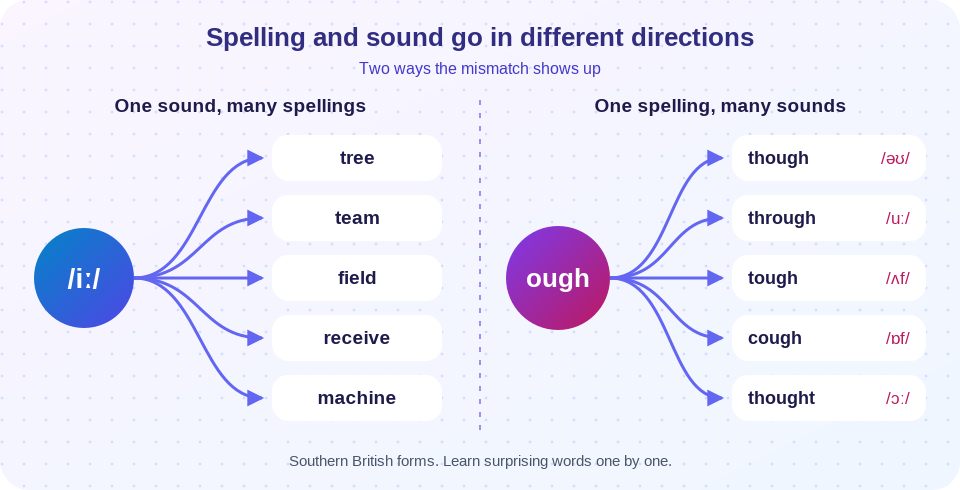
Two problems
Three tools
What you will learn
- Why spelling and sound drifted apart
- What homophones and homographs are
- How to treat patterns as guesses
- A routine for learning a new word
Why the mismatch exists
Several things happened over centuries, and this is a short, simple version:
- Sounds changed while spelling stayed. English vowels shifted a lot between about 1400 and 1700, in a change called the Great Vowel Shift. Spelling was becoming more fixed during part of that period.
- Silent letters remained. The "k" in "knee" and the "gh" in "night" were once pronounced.
- Words came from many languages. English borrowed heavily from French, Latin, Greek and others, often keeping their spelling.
- Scholars changed some spellings. For example, a "b" was added to "debt" to show a link with Latin. It was never pronounced in English.
So spelling often records history more than current speech.
One sound, many spellings
Take the vowel /iː/:
| Spelling | Word |
|---|---|
| ee | tree |
| ea | team |
| ie | field |
| ei | receive |
| e + consonant + e | these |
| i | machine |
| ey | key |
The consonant /ʃ/ also has several: "ship", "nation", "special", "chef", "sugar" and "ocean".
One spelling, many sounds
The letters "ough" are the classic example (BrE forms):
| Word | Pronunciation | Rhymes with |
|---|---|---|
| though | /ðəʊ/ | go |
| through | /θruː/ | too |
| tough | /tʌf/ | stuff |
| cough | /kɒf/ | off |
| thought | /θɔːt/ | sport (BrE) |
| bough | /baʊ/ | cow |
You cannot guess these from the letters. Learn each one as a whole word.
Homophones
Homophones sound the same but have different meanings and usually different spellings:
| Words | Sound |
|---|---|
| sea, see | /siː/ |
| two, too, to (strong form) | /tuː/ |
| there, their, they're | /ðeə/ in BrE |
| flour, flower | often identical |
| knight, night | /naɪt/ |
| write, right | /raɪt/ |
Your accent can change which words are homophones. In non-rhotic BrE, "source" and "sauce" can sound the same. In most American accents they do not.
Homographs
Homographs share a spelling. Some also differ in sound: "I read every day" has /riːd/, and "I read it yesterday" has /red/. "A tear ran down her face" has the vowel of "near", while "tear the paper" has the vowel of "hair" (BrE).
The sentence tells you which one you need.
Treat patterns as guesses
A pattern helps you make a good first guess. Then check it. For example, "ea" is often /iː/ (team, beach, eat), but it can be /e/ (bread, head) or /eɪ/ (great, break).
The next lessons give you the most useful patterns for vowels, consonants and silent letters and word endings.
Worked example: learning "receipt"
- You see "receipt" in a shop.
- You guess from the letters: maybe "re-sept".
- You check a dictionary: /rɪˈsiːt/. There is no /p/.
- You note that "ei" after "c" often gives /iː/.
- You link it with a sentence: "Keep your receipt."
- Next week, you test yourself by covering the word and saying it from memory.
A flexible word log
Keep a list with four columns: word, sound, spelling surprise, sentence. Review it often. A small list that you use is better than a large list that you forget.
Worked example: sorting new words
You collect these words in one week: "meat", "head", "great", "field" and "friend". All contain a vowel pair, but they do not all sound alike.
| Word | Sound | Note |
|---|---|---|
| meat | /iː/ | the most common reading of "ea" |
| head | /e/ | a frequent second reading |
| great | /eɪ/ | rare: also "break" and "steak" |
| field | /iː/ | "ie" in this word |
| friend | /e/ | an unusual reading of "ie" |
Group your words by sound, not by spelling. Then add each new word to the sound group where it belongs. Over time you build a mental list of exceptions that is much easier to remember than a long list of rules.
Why dictionaries remain necessary
Even strong readers meet words whose pronunciation they cannot predict, such as personal names, place names and borrowed words. When it matters, for example before you say a colleague's name, ask the person how they say it. It is polite and it gives you the best possible model.
A note on learning order
Do not try to memorize every spelling in one go. Learn the most frequent words first, because you will meet them every day: "one", "two", "does", "said", "women", "because" and "friend". Several of them break the usual patterns. When you can say them without thinking, add the rarer words you need for your studies or your job. This approach saves time and gives you quick results where they matter.
Common mistakes
- Pronouncing every letter.
- Believing that a pattern has no exceptions.
- Assuming two words rhyme because they end with the same letters.
- Learning a word only by sight, never by sound.
Check your understanding
Quick check · 5 questions
of 5 answered You scored / 5 · perfect!
-
1. What are homophones?
Spelling usually differs. -
2. Why is "k" silent in "knee"?
Spelling kept an older form. -
3. Which word has the vowel /e/ although it uses "ea"?
"bread" is /bred/. -
4. What is a good use of a spelling pattern?
Patterns help but can fail. -
5. Which pair has the same spelling but different sounds?
These are homographs with different vowels.
Summary
- English spelling often reflects history.
- One sound has several spellings and one spelling has several sounds.
- Homophones sound alike; some homographs sound different.
- Use patterns to guess, and a dictionary to check.
- Keep a short list of surprises and review it.
Next: Vowel Spelling Patterns
İlerlemeni takip et
Dersleri işaretlemek ve herhangi bir cihazda kaldığın yerden devam etmek için ücretsiz bir hesap oluştur.