
























Ders 17 · Sampling and Digital Transmission
The sampling theorem and aliasing
Learn why sampling at twice the bandwidth is enough, how spectral replicas cause aliasing, how to choose an anti-aliasing filter and reconstruct with sinc.
How often must you measure a signal to be able to rebuild it exactly? Too slow and the measurements are ambiguous; too fast and you waste storage. The sampling theorem answers with a surprising precision: a signal containing no frequencies above B is completely determined by samples taken at any rate above 2B. The result sits under every digital audio, video and measurement system.
What you will learn
- What the spectrum of a sampled signal looks like.
- The statement of the sampling theorem and the Nyquist rate.
- How aliasing arises and how to compute alias frequencies.
- Why every sampler needs an anti-aliasing filter.
Key terms
- Sampling frequency
fs = 1/Ts: samples per second. - Nyquist rate:
2B, the minimum sampling rate for a signal of bandwidthB. - Aliasing: a frequency above
fs/2showing up at a false lower frequency. - Anti-aliasing filter: a low-pass filter before the sampler.
- Reconstruction filter: the low-pass filter after the converter that restores the continuous signal.
What sampling does to the spectrum
Sampling multiplies x(t) by a train of impulses spaced Ts apart. In the frequency domain, multiplication by a periodic impulse train produces a periodic repetition:
Xs(f) = fs · Σ X(f − k · fs), for all integers k.
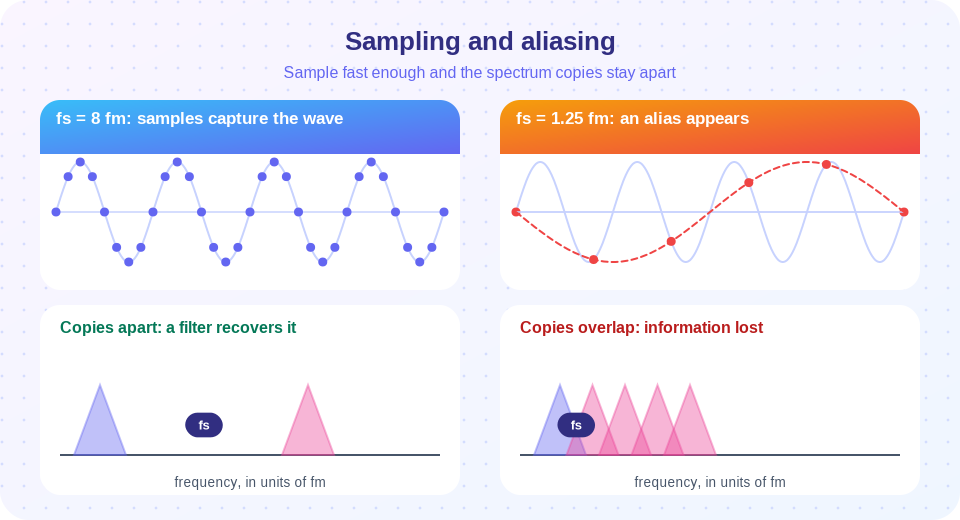
The spectrum of the sampled signal is the original spectrum repeated at every multiple of the sampling frequency. If X(f) is limited to |f| ≤ B, the copies are separated as long as fs − B > B, i.e. fs > 2B. Then a low-pass filter with cutoff between B and fs − B removes all copies except the original, and the original signal is recovered exactly. That is the sampling theorem (Nyquist, 1928; Kotelnikov, 1933; Shannon, 1949; Whittaker's earlier mathematical version, 1915).
Ideal reconstruction in the time domain is sinc interpolation:
x(t) = Σ x(n Ts) · sinc( (t − n Ts) / Ts ).
Each sample contributes a sinc pulse that is 1 at its own instant and 0 at all other sampling instants.
Aliasing
If fs ≤ 2B the copies overlap and cannot be separated: high-frequency content folds down onto low frequencies. A sinusoid at frequency f sampled at fs produces exactly the same samples as one at f − k fs for any integer k. The apparent (alias) frequency is the distance from f to the nearest multiple of fs:
f_alias = | f − round(f / fs) · fs |.
Worked examples:
- A 7 kHz tone sampled at 10 kHz: nearest multiple is 10 kHz, so the alias is
|7 − 10| = 3 kHz. - A 5 kHz tone sampled at 8 kHz: the nearest multiple is 8 kHz, alias
3 kHz. - A 1.1 kHz tone sampled at 1 kHz: alias
0.1 kHz; this is the familiar "wagon wheel" effect in film, where a wheel spinning slightly faster than the frame rate appears to turn slowly forward or backward.
Once aliasing has happened it cannot be undone: the samples are identical to those of the low-frequency tone.
Anti-aliasing and practical rates
Real signals always contain some energy above the nominal band, as do noise and interference. Therefore a sampler is always preceded by an anti-aliasing filter that removes everything above fs/2. Real filters are not brick walls, so systems sample a little above the Nyquist rate to leave a transition band:
- Telephony: speech limited to about 3.4 kHz and sampled at 8 kHz, leaving a guard band from 3.4 to 4.6 kHz (
8 − 3.4). - Audio CD: content to 20 kHz,
fs = 44.1 kHz, so the transition band lies between 20 and 24.1 kHz (44.1 − 20).
A cheaper trick is oversampling: sample at a high rate with a gentle analog filter, then filter and decimate digitally.
Common misconceptions
"Sampling at exactly 2B is fine." At exactly 2B a component at B may be lost (a sine sampled exactly at its zero crossings gives zeros). Use strictly more than 2B.
"Samples are a rough approximation of the signal." If the signal is band-limited and sampled fast enough, the samples determine the signal exactly.
"I can remove aliases afterwards." After sampling, an alias is indistinguishable from a real low-frequency component. Filter before sampling.
Try it
The first example demonstrates aliasing numerically: a 5 kHz tone and a 3 kHz tone sampled at 8 kHz give identical samples up to a sign. The plot shows both curves passing through the same points.
Press Run (or Ctrl + Enter) to see the result here.
Program input · what you'd type while the program runs
Type the answers before you press Run, one per line. Each time the program reads a line (with input()), it gets the next line from this box.
The second example reconstructs a band-limited signal from samples with sinc interpolation. The signal has components at 1 and 3 Hz (bandwidth 3 Hz) and is sampled at 8 Hz, above the Nyquist rate of 6 Hz. The error is small away from the edges of the sampled window.
Press Run (or Ctrl + Enter) to see the result here.
Program input · what you'd type while the program runs
Type the answers before you press Run, one per line. Each time the program reads a line (with input()), it gets the next line from this box.
Check your understanding
Quick check · 5 questions
of 5 answered You scored / 5 · perfect!
-
1. A signal has no content above 12 kHz. The minimum sampling rate for exact recovery is
fs must exceed 2B = 24 kHz. -
2. A 9 kHz tone is sampled at 12 kHz. It will appear at
The nearest multiple of 12 kHz is 12 kHz, and |9 − 12| = 3 kHz. -
3. What does the spectrum of a sampled signal look like?
Xs(f) = fs Σ X(f − k fs). -
4. Why must an anti-aliasing filter come before the sampler?
The aliased samples are identical to those of a real low-frequency tone. -
5. Which interpolation function perfectly reconstructs a band-limited signal?
Sinc interpolation is the ideal low-pass reconstruction; the others only approximate it.
Summary
- Sampling repeats the spectrum at multiples of
fs;fs > 2Bkeeps the copies apart. - Alias frequency:
|f − round(f/fs) fs|; it cannot be removed after sampling. - Always filter before sampling; practical rates include a guard band.
- Ideal reconstruction is sinc interpolation.
Next: Quantization and PCM
İlerlemeni takip et
Dersleri işaretlemek ve herhangi bir cihazda kaldığın yerden devam etmek için ücretsiz bir hesap oluştur.