
























บทเรียนที่ 5 · Goals and Priorities
Start With What Matters
Connect your values, life areas, and goals so your plans reflect what matters to you, with a simple life-area check and worked examples you can copy.
A schedule can be neat and still point in the wrong direction. Before you decide how to use your time, it helps to decide what your time is for.
In this chapter you connect three levels: what matters to you, the goals that express it, and the priorities that guide your days.
What you will learn
- The difference between values, goals, and priorities
- How to look at your life areas without trying to balance them perfectly
- How to notice gaps between what you say matters and what you do
- How to choose a few areas to focus on now
Values, goals, and priorities
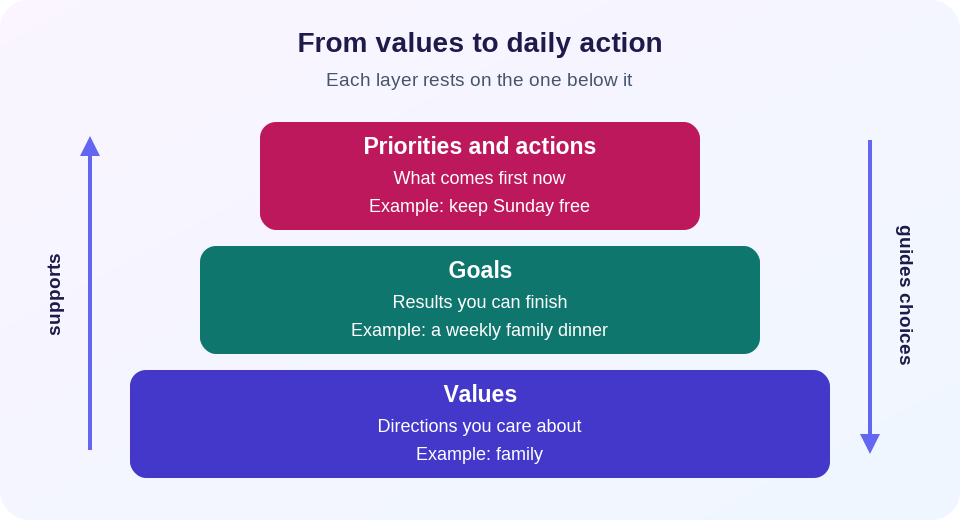
- A value is a direction you care about, such as learning, family, health, honesty, or creativity. You never "finish" a value.
- A goal is a result you want, such as passing a driving test or saving for a trip. You can finish it.
- A priority is what comes first right now when you cannot do everything.
Here is how one value can lead to action.
| Level | Example |
|---|---|
| Value | Family |
| Goal | Have a relaxed weekly dinner with my parents for the next three months |
| Priority this week | Keep Sunday evening free |
| Action today | Send a message to agree on the time |
Without the lower levels, a value stays a nice idea. Without the top level, a goal can become something you chase only because other people do.
Look at your life areas
It helps to look at several areas of your life. Choose the ones that fit you. Common examples:
- Work or study
- Health and rest
- Family and close relationships
- Friends and community
- Money and home
- Learning and personal growth
- Fun and creativity
- Faith or spiritual life, if this matters to you
For each area, ask two questions and give a score from 1 to 5:
- How important is this to me right now?
- How satisfied am I with the time and attention it gets?
A big gap, such as importance 5 and satisfaction 2, may deserve attention. An area with low importance and low satisfaction may be fine for now.
Balance is not equal time
You do not need to give every area the same hours. A new parent, a student in exam season, or a person starting a business may focus heavily on one area for a while. That can be a sensible choice.
The risk is neglecting something important for so long that it breaks, such as your sleep, your health, or a close relationship. For areas you are not focusing on, set a minimum: a small amount that keeps them healthy. For example, one call with a friend each week, or two short walks.
Your values, not borrowed ones
Many goals come from outside: family expectations, social media, coworkers, or what seems impressive. Outside expectations are not always wrong. Some are real duties, and some you share. But check them.
Ask yourself:
- Would I still want this if nobody could see it?
- Is this my choice, a duty I accept, or pressure I have not questioned?
- What would I have to give up to get it?
Some people cannot choose freely, because of money, family needs, law, or health. In that case, priorities may mean finding small spaces for your values inside tight limits.
Check your time against your values
Remember the time audit from Track Your Time with a Time Audit. Put your results next to your life-area scores. Look for mismatches:
- You say health matters a lot, but you often sleep five hours.
- You say friends matter, but you have not seen one in two months.
- You give many hours to a task that you rate as unimportant.
A mismatch is not proof of failure. Some weeks are shaped by things you cannot change. But when a mismatch lasts, it is worth a closer look.
Choose a few focus areas
For the next one to three months, choose one or two focus areas where you want real progress. Keep minimums for the others.
Worked example
Sofia lists her scores:
| Area | Importance | Satisfaction |
|---|---|---|
| Study | 5 | 3 |
| Health | 5 | 2 |
| Friends | 4 | 4 |
| Creativity | 3 | 2 |
Her biggest gap is health (3 points), then study (2 points). She chooses health and study as focus areas for this term. For friends, she keeps her weekly meetup. For creativity, she keeps a small minimum: 20 minutes of drawing on Saturdays. She plans to look at the scores again in two months.
When values compete
Sometimes two things you care about pull in different directions. A promotion may support your wish to grow, but take evenings away from your family. There is no formula that gives the right answer.
It can help to name the tension out loud, talk with the people affected, and choose for a set period. You might decide to try the new role for six months and then review how home life feels. A time limit makes a hard choice easier to revisit.
Common mistakes
- Treating a value like a goal that you can finish.
- Trying to make big progress in every area at the same time.
- Copying other people's priorities without checking whether you share them.
- Ignoring an important area completely instead of keeping a small minimum.
Try it
Score your areas. The tool sorts them by the gap between importance and satisfaction.
Check your understanding
Quick check · 4 questions
of 4 answered You scored / 4 · perfect!
-
1. Which of these is a value rather than a goal?
A value is a lasting direction; you cannot finish it. -
2. What does a priority tell you?
Priorities guide choices when time is limited. -
3. An area is not a focus right now. What can protect it?
A minimum keeps an area healthy without large amounts of time. -
4. Which question helps you check a borrowed goal?
It separates your own wishes from the wish to impress.
Summary
- Values are directions, goals are results, and priorities come first when you must choose.
- Score your life areas for importance and satisfaction.
- Balance does not mean equal hours; keep minimums where you are not focusing.
- Compare your time audit with what you say matters.
- Choose one or two focus areas for the next few months.
ติดตามความคืบหน้าของคุณ
สร้างบัญชีฟรีเพื่อติ๊กบทเรียนที่เรียนแล้วและเรียนต่อจากจุดเดิมได้บนทุกอุปกรณ์