
























บทเรียนที่ 19 · Voice and Delivery
Volume and Projection
Learn to be heard without shouting: breathing, posture, aiming your voice at the back row, using a microphone well and looking after your voice.
A good talk fails if people cannot hear it. When listeners have to strain, they use their energy on catching words, not on thinking about your ideas. Some stop trying.
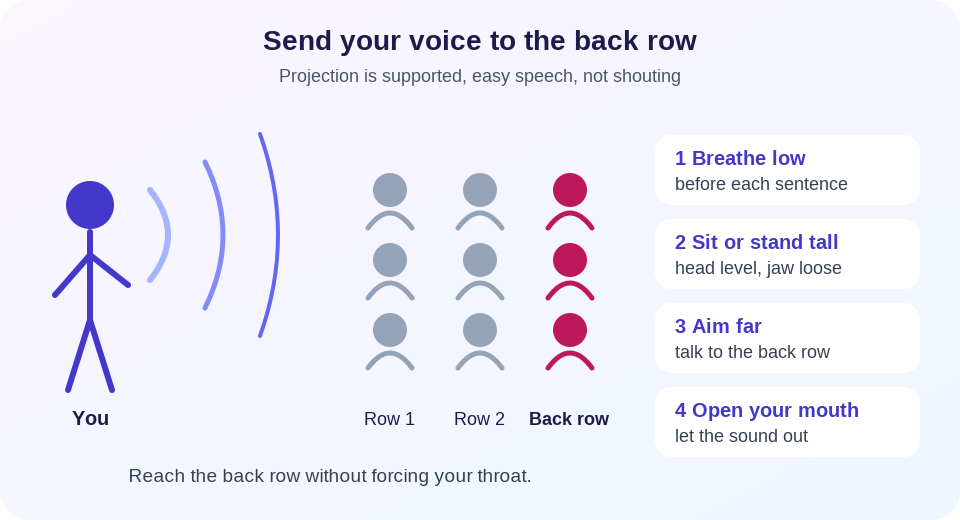
Projection means sending your voice clearly to the farthest listener. It is not the same as shouting. Shouting usually squeezes the throat. Projection relies on steady breath, an easy throat and a clear target. You can practice all three.
What you will learn
- The difference between projecting and shouting
- How breath and posture support your voice
- How to check whether the back of the room can hear you
- How to work with a microphone
- How to protect your voice
Projecting is not shouting
| Shouting often feels like | Supported projection often feels like |
|---|---|
| Tightness in the throat | An easy, open throat |
| Pushing from the neck | Steady breath from lower in the body |
| A sharp, thin sound | A fuller sound |
| Tiredness after a short time | Comfort for longer |
These are general signs, not a medical test. Voices differ. If speaking hurts, stop pushing.
Breath is your power source
You speak on the air you breathe out. If you start a long sentence with very little air, the end of the sentence fades. Listeners often lose the last words, which may be the most important ones.
Try this simple routine while standing:
- Let your shoulders drop.
- Breathe in quietly and comfortably. Let your lower ribs and belly move. Try not to lift your shoulders.
- Breathe out on a long, gentle "sss" sound. Keep it even.
- Breathe in again and say one sentence from your talk.
- Check that the last word is as clear as the first.
Do not hold your breath or force a very deep one. If you feel dizzy, stop and breathe normally.
Short sentences help too. They give you natural places to breathe.
Posture and mouth
Stand or sit tall, but not stiff. A collapsed chest or a chin pointed down can make it harder to breathe and sends your voice toward the floor. Keep your head level and your jaw loose.
Open your mouth enough to let the sound out. Some quiet speakers barely move their lips. A little more movement often makes you easier to hear without much extra effort.
If you use notes, place them where you can glance down with your eyes. Then your head can stay mostly up.
Aim at the farthest listener
Pick a person or a seat near the back. Talk to that spot as if you were having a conversation across the room. Your body often adjusts the volume for the distance.
Before an event, run a back-row check if you can:
- Ask a friend or an organizer to sit at the back.
- Speak two or three sentences at your planned volume.
- Include a quiet sentence and the end of a long one.
- Ask what they could not catch.
Remember that a full room can sound different from an empty one. People absorb some sound and make some noise. Fans, traffic and projectors also compete with you.
Volume as a tool
One fixed loud level is tiring to hear. Once everyone can hear your base level, you can change it on purpose.
- A little louder can signal energy or a key point.
- A little softer can draw people in before something important.
Your softest level must still reach the back row. If it cannot, use another tool, such as a pause.
Using a microphone
A microphone makes you louder. It does not make unclear speech clear. If one is offered in a large room, use it, even if you think your voice is strong. Some listeners have hearing loss, and some venues connect the microphone to hearing support systems or recordings.
- Test it before the audience arrives.
- Ask the technician how close to hold or place it.
- Keep that distance steady. With a handheld microphone, keep it in the same position relative to your mouth when you turn your head.
- With a clip-on microphone, check that scarves, jewelry and jackets do not rub it.
- Speak normally and let the equipment do the work.
- Assume it may be live whenever it is on you.
Look after your voice
- Keep water nearby and sip when you pause.
- Warm up gently with humming and easy sentences.
- Try not to talk over loud noise for long periods.
- Avoid repeated hard throat clearing. A sip of water or a swallow may help.
- Rest your voice when it feels tired.
This is general information, not medical advice. If you have pain, or if hoarseness or voice changes do not go away, see a qualified health professional.
A worked example
Lina presents project updates in a meeting room with a noisy fan. Colleagues often ask her to repeat the last part of her sentences.
She makes three changes. She splits one long sentence into two shorter ones. She marks a breath after each main point in her notes. She also speaks to the colleague who sits farthest away. Then she asks that colleague, "Could you hear the ends of my sentences?" She now has a clear result to check, not just a feeling.
Common mistakes
Do not push from your throat to get louder. Do not let sentences fade at the end. Do not speak toward the screen or your notes. Do not refuse a microphone just because you dislike how it sounds. Do not keep forcing a voice that hurts.
Try it
Choose the best action for each situation.
Check your understanding
Quick check · 4 questions
of 4 answered You scored / 4 · perfect!
-
1. What does it mean to project your voice?
Projection is about reaching people clearly without strain. -
2. Why can the end of a long sentence fade?
Speech uses the air you breathe out, so plan places to breathe. -
3. What is the best way to check your volume in a room?
A listener at a distance gives direct evidence. -
4. Which statement about microphones is correct?
It adds loudness. You still need clear speech and consistent placement.
Summary
- Projection is clear, supported speech, not shouting.
- Breathe before sentences and finish the last word.
- Face your listeners and aim at the farthest one.
- Test the room and use a microphone when it helps people hear.
- Pain or lasting hoarseness needs rest and professional advice.
Next: Pace and Pauses
ติดตามความคืบหน้าของคุณ
สร้างบัญชีฟรีเพื่อติ๊กบทเรียนที่เรียนแล้วและเรียนต่อจากจุดเดิมได้บนทุกอุปกรณ์