
























บทเรียนที่ 19 · Light
Quality and Direction of Light
Learn how hard and soft light differ, how light direction shapes faces and objects, and how to read a scene before you press the shutter button.
A camera does not record objects. It records the light that comes from them. The same cup, face, or street can look flat, dramatic, gentle, or harsh, depending only on the light.
Many beginners look at the subject and forget the light. In this lesson, you will learn to ask two simple questions: How hard is the light? Where does it come from? Light also has a color, which you will study in the next chapter.
What you will learn
- The difference between hard light and soft light
- Why the apparent size of a light source matters
- How front, side, and back light change a picture
- How to find the light in any room or street
Hard light and soft light
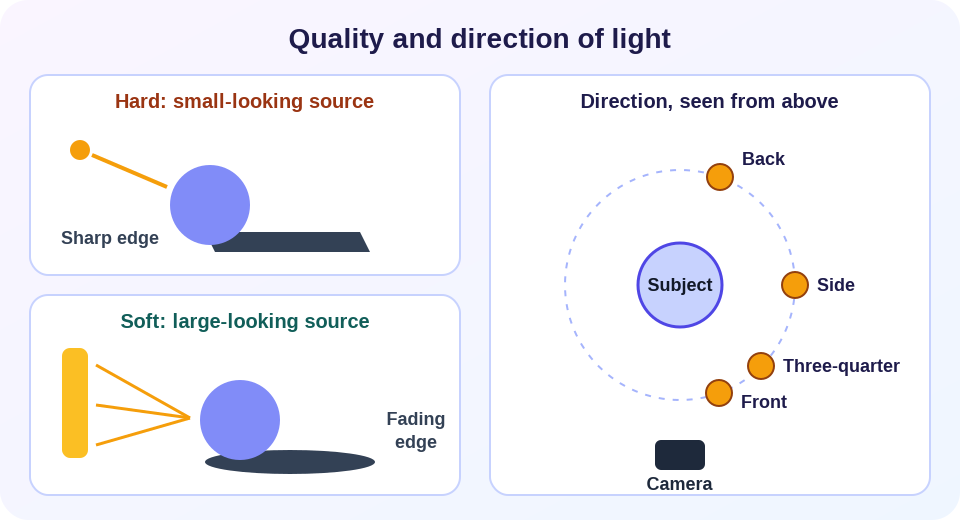
Hard light makes shadows with sharp, clear edges. Contrast between the bright side and the dark side is often strong. Direct sun on a clear day is a typical example. A small bare lamp or a bare flash is another.
Soft light makes shadows with gentle edges that fade slowly. Skin often looks smoother, and details in the shadows are easier to see. An overcast sky, a large window without direct sun, and light bounced off a white wall are soft.
Neither one is "better." Hard light shows texture and shape strongly. It can suit architecture, graphic street scenes, or a bold portrait. Soft light is forgiving and calm. It often suits portraits, food, and small products.
Apparent size matters
Softness depends mostly on how large the light source looks from the subject's position. A large source sends light from many angles. Some of that light reaches into the shadows and softens their edges.
Two things change the apparent size:
- Real size. A big window is softer than a tiny window at the same distance.
- Distance. A source that moves closer looks bigger from the subject, so it gets softer.
The sun is huge in real life, but it is very far away. From where you stand, it looks like a small disk. That is why direct sun is hard. When clouds cover the sky, the whole sky becomes your light source. It is very large, so the light becomes soft.
To make light softer, make the source bigger or bring it closer. A thin white curtain over a sunny window turns the whole window into a soft source.
Distance also changes brightness
For a small light source, brightness drops quickly with distance. If you double the distance from a small lamp to your subject, the subject receives about one quarter of the light. That is a loss of 2 stops. This is called the inverse square law.
The rule is exact only for an ideal point source. Large softboxes and windows used up close do not follow it exactly. Still, the idea helps. When your subject is very close to a lamp, a small step changes the brightness a lot. When the lamp is far away, the same step changes it only a little.
Light direction
Think of a clock face seen from above. Your subject is in the middle. The camera is at six o'clock.
Front light
The light is beside or just behind the camera and hits the front of the subject. Shadows fall behind the subject, where the camera can hardly see them. The result is clear and even, but it can look flat. A small flash on top of the camera makes this kind of light.
Side light
The light comes from the left or right. One side is bright and the other is darker. Shadows show shape and texture, such as the grain of wood or the folds in fabric. A person standing sideways to a window often gets beautiful side light.
Three-quarter light
The light sits between front and side, often a bit above eye level. It shows the shape of a face without leaving half of it dark. It is a popular starting point for portraits.
Back light
The light comes from behind the subject, toward the camera. It can make a bright outline around hair, a leaf, or a glass. If you expose for the bright background, the subject may become a dark silhouette. If you expose for the subject, the background may become very bright. Either choice can work. Decide on purpose.
Be careful when the sun is the back light. Never stare at the sun, and do not point your camera at it while you look through an optical viewfinder. It can injure your eyes.
Top and low light
Light from straight above, like midday sun, often puts dark shadows in the eye sockets and under the nose. Light from below looks unusual on faces because we rarely see it in daily life. Horror films often use it.
A worked example: one face, three setups
You photograph a friend indoors near one window.
- Friend faces the window. You stand between them and the window, a little to one side. The light is front light: even and gentle.
- Friend turns sideways to the window. The light is side light: more shape and mood. The far cheek is darker.
- Friend stands with the window behind them. The light is back light. The face may be dark. You can raise exposure, add a white card to bounce light back, or keep the silhouette.
The only camera change you need is exposure. Yet the mood changes completely.
How to read light before you shoot
Look at the shadows. They tell you almost everything.
- Sharp shadow edges mean hard light.
- Soft, fading edges mean soft light.
- A shadow points away from the source.
- A long shadow on flat ground means a low source.
If you cannot see the effect, hold your hand in the light and turn it slowly. Watch how the shadows on your fingers change. This "hand test" is quick and free.
Common mistakes
- Judging only the subject and ignoring the shadows.
- Keeping a person in harsh midday sun when open shade is a few steps away.
- Thinking that soft light is always better. Hard light can be a strong creative choice.
- Mixing two different light sources without noticing, which can create odd shadows and colors.
Try it
Match each situation with the kind of light it usually creates.
Next, change the distance and watch how the brightness changes for a small light source.
Check your understanding
Quick check · 4 questions
of 4 answered You scored / 4 · perfect!
-
1. What mostly decides how soft a light looks?
A source that looks large from the subject sends light from many angles, which softens shadow edges. -
2. Why is direct sun hard light, even though the sun is huge?
Its apparent size is small, so shadows have sharp edges. -
3. You want to show the texture of an old brick wall. Which direction usually helps most?
Side light creates small shadows that reveal texture. -
4. With a very small lamp, what happens when you double the distance to the subject?
This is the inverse square law: about one quarter, or 2 stops less.
Summary
- Hard light has sharp shadow edges. Soft light has gradual edges.
- A source gets softer when it looks bigger from the subject.
- Direction changes shape, texture, and mood.
- Read the shadows first, then choose where to stand.
ติดตามความคืบหน้าของคุณ
สร้างบัญชีฟรีเพื่อติ๊กบทเรียนที่เรียนแล้วและเรียนต่อจากจุดเดิมได้บนทุกอุปกรณ์