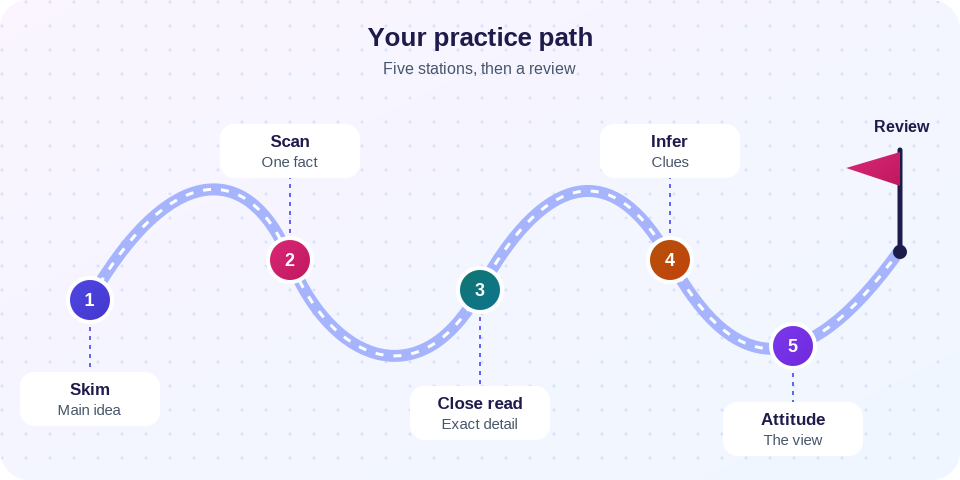
Mixed English reading practice with original texts: skim, scan, close read, infer and judge attitude, with explanations for answers.
This practice set brings together the reading strategies from the earlier chapters. All the texts are original and written for practice. They are not taken from any exam. Work through them in any order, and take breaks.
For each task, choose your strategy before you read. After you answer, read the explanation, then go back and find the words that prove the right choice.
Each station in this set practices a different reading move.
The timers are optional pressure for practice. They are not exam timings, and nothing here gives you a score that means anything outside this page. If a timer worries you, read the same text without it.
Here is how to explain an answer. The question is: "Is the shop open on public holidays?" The text says: "Open daily except public holidays." A strong explanation is: "No, because except removes public holidays from daily." It names the answer and quotes the key word. Try to explain at least two answers this way, either in writing or aloud.
Read the questions first for the scanning task, so that you know your target. For the skim task, do not read the questions first; train your eyes to build a gist. For close reading, read the whole text once, then answer.
After the tasks, pick any one of the texts and write a one-sentence summary. Then write one statement that is supported, one that is contradicted and one that is not stated. Swap with a partner if you can, and check each other's choices against the words in the text. Making questions is a strong way to test your own understanding.
When you finish, rank the five tasks from easiest to hardest. Look at your hardest one and open its review lesson. Spend your next two or three short sessions on that skill with new texts from your own reading, such as a notice at work or a short article. Real material shows you whether the strategy has moved from practice into everyday use.
If you use a stopwatch on your own texts, record two things together: the time you took and how well you understood. Reading faster while understanding less is not progress. A fair check is to read a short text, then say its main idea and two details without looking. Do that with similar texts over several weeks. Small differences from one day to the next usually come from the topic or from how tired you are.
Repeat this set after a few weeks only as a warm-up. You will probably remember some answers, so it will not measure your progress. To measure progress, use new texts of a similar kind and level, as described in the lesson on choosing material.
If you study with someone, take turns. One person reads a task aloud and the other explains the choice, quoting the words that support it. If you disagree, do not vote. Go back to the text and find the exact sentence that settles it. If no sentence does, the honest answer may be not stated, or the question may be unclear. Talking about why an answer is wrong often teaches more than hearing which one is right, because you hear how another reader weighed the same clues.
<style>body{font-family:system-ui,sans-serif;margin:0;padding:12px;background:#faf5ff;color:#1e1b4b;line-height:1.5}.card{background:#fff;border:1px solid #e0e7ff;border-radius:14px;padding:12px 14px;margin:0 0 10px;box-shadow:0 4px 12px rgba(99,102,241,.1)}button{font:inherit;cursor:pointer;border:1px solid #a5b4fc;background:#eef2ff;color:#1e1b4b;border-radius:999px;padding:6px 14px;margin:4px 6px 0 0}button.go{background:#4f46e5;color:#fff;border-color:#4f46e5}button.ok{background:#d1fae5;border-color:#059669}button.no{background:#fee2e2;border-color:#dc2626}button:disabled{cursor:default}input,select,textarea{font:inherit;padding:5px 8px;border:1px solid #a5b4fc;border-radius:8px;max-width:100%;box-sizing:border-box}.fb{margin-top:6px;font-size:14px;color:#334155}p{margin:6px 0}</style><divid="app"></div><script>const seconds =40;const passage =["A place to fix things","On the first Saturday of each month, volunteers at the community hall help people repair broken items. Visitors bring lamps, clothes or small chairs.","The aim is not simply to fix things for others. Volunteers show visitors what went wrong and how they can help with the repair.","Not every item can be saved. Still, organizers say that trying a repair first can mean less is thrown away."];const items =[{"q":"What is the main idea?","options":["The hall sells new lamps","Volunteers help people try repairs and learn while doing it","Every broken thing can be fixed"],"answer":1,"why":"The text stresses shared repair and learning, with limits."},{"q":"What do the volunteers show visitors?","options":["How to buy new chairs","How to run a hall","What went wrong and how to help repair it"],"answer":2,"why":"The second paragraph says so."}];functionel(tag, text, parent, cls){const node = document.createElement(tag);if(text){ node.textContent = text;}if(cls){ node.className = cls;}(parent || document.getElementById('app')).appendChild(node);return node;}functionbuildQuestions(parent){let right =0;let done =0;const total = document.createElement('p');
items.forEach(function(item, n){const card =el('div','', parent,'card');el('p',(n +1)+'. '+ item.q, card);const feedback = document.createElement('div');
feedback.className ='fb';const buttons = item.options.map(function(label, i){const button =el('button', label, card);
button.onclick=function(){
buttons.forEach(function(b){ b.disabled =true;});
buttons[item.answer].className ='ok';if(i === item.answer){ right++;}else{ button.className ='no';}
done++;
feedback.textContent =(i === item.answer ?'Correct. ':'Not this one. ')+ item.why;
total.textContent ='Your count: '+ right +' correct out of '+ done +' answered.';};return button;});
card.appendChild(feedback);});
parent.appendChild(total);}el('p',"Skim the text, then answer.");const start =el('button','Start: '+ seconds +' seconds',null,'go');const clock =el('p','');const text =el('div','',null,'card');
text.hidden =true;
passage.forEach(function(line){el('p', line, text);});const done =el('button','I have finished reading');
done.hidden =true;const again =el('button','Show or hide the text to check');
again.hidden =true;const area =el('div','');let timer =null;functionfinish(){clearInterval(timer);
text.hidden =true;
done.hidden =true;
clock.textContent ='The text is hidden. Answer from what you noticed.';if(!area.firstChild){buildQuestions(area);}
again.hidden =false;}
done.onclick = finish;
again.onclick=function(){ text.hidden =!text.hidden;};
start.onclick=function(){
start.hidden =true;
text.hidden =false;
done.hidden =false;let left = seconds;
clock.textContent = left +' seconds left';
timer =setInterval(function(){
left--;
clock.textContent = left +' seconds left';if(left <=0){finish();}},1000);};</script>
Task 2: scan for facts.
Task 2: Evening classes
<style>body{font-family:system-ui,sans-serif;margin:0;padding:12px;background:#faf5ff;color:#1e1b4b;line-height:1.5}.card{background:#fff;border:1px solid #e0e7ff;border-radius:14px;padding:12px 14px;margin:0 0 10px;box-shadow:0 4px 12px rgba(99,102,241,.1)}button{font:inherit;cursor:pointer;border:1px solid #a5b4fc;background:#eef2ff;color:#1e1b4b;border-radius:999px;padding:6px 14px;margin:4px 6px 0 0}button.go{background:#4f46e5;color:#fff;border-color:#4f46e5}button.ok{background:#d1fae5;border-color:#059669}button.no{background:#fee2e2;border-color:#dc2626}button:disabled{cursor:default}input,select,textarea{font:inherit;padding:5px 8px;border:1px solid #a5b4fc;border-radius:8px;max-width:100%;box-sizing:border-box}.fb{margin-top:6px;font-size:14px;color:#334155}p{margin:6px 0}</style><divid="app"></div><script>const seconds =45;const passage =["Evening classes, autumn term","Cooking basics: Mondays 18:00 to 20:00, Room 3. 8 places.","Beginner Spanish: Tuesdays 19:00 to 20:30, Room 1. 15 places.","Photography walk: Thursdays 17:30 to 19:00, meet at the front door. 10 places.","Classes begin the week of 12 September. Booking closes on 5 September. Members get 10 percent off."];const items =[{"q":"Where do you meet for the photography walk?","options":["At the front door","In Room 1","In Room 3"],"answer":0,"why":"The listing gives a meeting point."},{"q":"Which class has the most places?","options":["Cooking basics","Photography walk","Beginner Spanish"],"answer":2,"why":"15 is more than 8 and 10."},{"q":"When does booking close?","options":["5 September","12 September","10 September"],"answer":0,"why":"Booking closes on 5 September."}];functionel(tag, text, parent, cls){const node = document.createElement(tag);if(text){ node.textContent = text;}if(cls){ node.className = cls;}(parent || document.getElementById('app')).appendChild(node);return node;}functionbuildQuestions(parent){let right =0;let done =0;const total = document.createElement('p');
items.forEach(function(item, n){const card =el('div','', parent,'card');el('p',(n +1)+'. '+ item.q, card);const feedback = document.createElement('div');
feedback.className ='fb';const buttons = item.options.map(function(label, i){const button =el('button', label, card);
button.onclick=function(){
buttons.forEach(function(b){ b.disabled =true;});
buttons[item.answer].className ='ok';if(i === item.answer){ right++;}else{ button.className ='no';}
done++;
feedback.textContent =(i === item.answer ?'Correct. ':'Not this one. ')+ item.why;
total.textContent ='Your count: '+ right +' correct out of '+ done +' answered.';};return button;});
card.appendChild(feedback);});
parent.appendChild(total);}el('p',"Scan the list for the facts you need.");const start =el('button','Start: '+ seconds +' seconds',null,'go');const clock =el('p','');const text =el('div','',null,'card');
text.hidden =true;
passage.forEach(function(line){el('p', line, text);});const done =el('button','I have finished reading');
done.hidden =true;const again =el('button','Show or hide the text to check');
again.hidden =true;const area =el('div','');let timer =null;functionfinish(){clearInterval(timer);
text.hidden =true;
done.hidden =true;
clock.textContent ='The text is hidden. Answer from what you noticed.';if(!area.firstChild){buildQuestions(area);}
again.hidden =false;}
done.onclick = finish;
again.onclick=function(){ text.hidden =!text.hidden;};
start.onclick=function(){
start.hidden =true;
text.hidden =false;
done.hidden =false;let left = seconds;
clock.textContent = left +' seconds left';
timer =setInterval(function(){
left--;
clock.textContent = left +' seconds left';if(left <=0){finish();}},1000);};</script>
Task 3: close reading.
Task 3: Library rules
<style>body{font-family:system-ui,sans-serif;margin:0;padding:12px;background:#faf5ff;color:#1e1b4b;line-height:1.5}.card{background:#fff;border:1px solid #e0e7ff;border-radius:14px;padding:12px 14px;margin:0 0 10px;box-shadow:0 4px 12px rgba(99,102,241,.1)}button{font:inherit;cursor:pointer;border:1px solid #a5b4fc;background:#eef2ff;color:#1e1b4b;border-radius:999px;padding:6px 14px;margin:4px 6px 0 0}button.go{background:#4f46e5;color:#fff;border-color:#4f46e5}button.ok{background:#d1fae5;border-color:#059669}button.no{background:#fee2e2;border-color:#dc2626}button:disabled{cursor:default}input,select,textarea{font:inherit;padding:5px 8px;border:1px solid #a5b4fc;border-radius:8px;max-width:100%;box-sizing:border-box}.fb{margin-top:6px;font-size:14px;color:#334155}p{margin:6px 0}</style><divid="app"></div><script>const intro =["Rules for the study booth: One booth may be booked per person per day, for up to two hours. If you are more than fifteen minutes late, the booth may be given to someone else. Drinks with lids are allowed; food is not. Please leave the booth as you found it."];const items =[{"q":"A person may book two booths on the same day.","options":["Supported","Contradicted","Not stated"],"answer":1,"why":"Only one booth per person per day."},{"q":"Arriving ten minutes late does not, under this rule, put your booking at risk.","options":["Supported","Contradicted","Not stated"],"answer":0,"why":"The risk starts when you are more than fifteen minutes late."},{"q":"A bottle of water with a lid is allowed.","options":["Supported","Contradicted","Not stated"],"answer":0,"why":"Drinks with lids are allowed."},{"q":"Booths cost money.","options":["Supported","Contradicted","Not stated"],"answer":2,"why":"No fee is mentioned."},{"q":"You may eat a sandwich in the booth.","options":["Supported","Contradicted","Not stated"],"answer":1,"why":"Food is not allowed."}];functionel(tag, text, parent, cls){const node = document.createElement(tag);if(text){ node.textContent = text;}if(cls){ node.className = cls;}(parent || document.getElementById('app')).appendChild(node);return node;}functionbuildQuestions(parent){let right =0;let done =0;const total = document.createElement('p');
items.forEach(function(item, n){const card =el('div','', parent,'card');el('p',(n +1)+'. '+ item.q, card);const feedback = document.createElement('div');
feedback.className ='fb';const buttons = item.options.map(function(label, i){const button =el('button', label, card);
button.onclick=function(){
buttons.forEach(function(b){ b.disabled =true;});
buttons[item.answer].className ='ok';if(i === item.answer){ right++;}else{ button.className ='no';}
done++;
feedback.textContent =(i === item.answer ?'Correct. ':'Not this one. ')+ item.why;
total.textContent ='Your count: '+ right +' correct out of '+ done +' answered.';};return button;});
card.appendChild(feedback);});
parent.appendChild(total);}if(intro.length){const box =el('div','',null,'card');
intro.forEach(function(line){el('p', line, box);});}buildQuestions(document.getElementById('app'));</script>
Task 4: infer.
Task 4: What can we conclude?
<style>body{font-family:system-ui,sans-serif;margin:0;padding:12px;background:#faf5ff;color:#1e1b4b;line-height:1.5}.card{background:#fff;border:1px solid #e0e7ff;border-radius:14px;padding:12px 14px;margin:0 0 10px;box-shadow:0 4px 12px rgba(99,102,241,.1)}button{font:inherit;cursor:pointer;border:1px solid #a5b4fc;background:#eef2ff;color:#1e1b4b;border-radius:999px;padding:6px 14px;margin:4px 6px 0 0}button.go{background:#4f46e5;color:#fff;border-color:#4f46e5}button.ok{background:#d1fae5;border-color:#059669}button.no{background:#fee2e2;border-color:#dc2626}button:disabled{cursor:default}input,select,textarea{font:inherit;padding:5px 8px;border:1px solid #a5b4fc;border-radius:8px;max-width:100%;box-sizing:border-box}.fb{margin-top:6px;font-size:14px;color:#334155}p{margin:6px 0}</style><divid="app"></div><script>const intro =["When Ola came home, the lights were off and the table was set for two. A candle had burned down almost to the base, and a covered pan sat on the stove."];const items =[{"q":"What is the best-supported inference?","options":["Ola had forgotten to eat for a week","Someone had probably been expecting company for a while","A fire had started in the kitchen"],"answer":1,"why":"A table for two, a burned-down candle and a covered pan suggest waiting."},{"q":"Which is NOT supported?","options":["The meal was cooked by Ola","The candle had been burning for some time","The table had two places"],"answer":0,"why":"Nothing says who cooked."}];functionel(tag, text, parent, cls){const node = document.createElement(tag);if(text){ node.textContent = text;}if(cls){ node.className = cls;}(parent || document.getElementById('app')).appendChild(node);return node;}functionbuildQuestions(parent){let right =0;let done =0;const total = document.createElement('p');
items.forEach(function(item, n){const card =el('div','', parent,'card');el('p',(n +1)+'. '+ item.q, card);const feedback = document.createElement('div');
feedback.className ='fb';const buttons = item.options.map(function(label, i){const button =el('button', label, card);
button.onclick=function(){
buttons.forEach(function(b){ b.disabled =true;});
buttons[item.answer].className ='ok';if(i === item.answer){ right++;}else{ button.className ='no';}
done++;
feedback.textContent =(i === item.answer ?'Correct. ':'Not this one. ')+ item.why;
total.textContent ='Your count: '+ right +' correct out of '+ done +' answered.';};return button;});
card.appendChild(feedback);});
parent.appendChild(total);}if(intro.length){const box =el('div','',null,'card');
intro.forEach(function(line){el('p', line, box);});}buildQuestions(document.getElementById('app'));</script>
Task 5: attitude and argument.
Task 5: A letter about benches
<style>body{font-family:system-ui,sans-serif;margin:0;padding:12px;background:#faf5ff;color:#1e1b4b;line-height:1.5}.card{background:#fff;border:1px solid #e0e7ff;border-radius:14px;padding:12px 14px;margin:0 0 10px;box-shadow:0 4px 12px rgba(99,102,241,.1)}button{font:inherit;cursor:pointer;border:1px solid #a5b4fc;background:#eef2ff;color:#1e1b4b;border-radius:999px;padding:6px 14px;margin:4px 6px 0 0}button.go{background:#4f46e5;color:#fff;border-color:#4f46e5}button.ok{background:#d1fae5;border-color:#059669}button.no{background:#fee2e2;border-color:#dc2626}button:disabled{cursor:default}input,select,textarea{font:inherit;padding:5px 8px;border:1px solid #a5b4fc;border-radius:8px;max-width:100%;box-sizing:border-box}.fb{margin-top:6px;font-size:14px;color:#334155}p{margin:6px 0}</style><divid="app"></div><script>const intro =["Letter: I welcome the new trees along Station Road, and I am sure many walkers will enjoy the shade. Even so, the plan has no benches. Older residents often need to rest on the way to the shops. A few seats would make a good plan much better."];const items =[{"q":"What is the writer's attitude to the plan?","options":["Completely against it","Mostly positive, with a suggested improvement","Not interested"],"answer":1,"why":"The writer welcomes the trees but asks for benches."},{"q":"Which sentence is the main suggestion?","options":["Add a few seats","Remove the trees","Close the shops"],"answer":0,"why":"The final sentence recommends seats."},{"q":"Why does the writer mention older residents?","options":["To give a reason for benches","To criticize shoppers","To describe the trees"],"answer":0,"why":"It supports the suggestion."}];functionel(tag, text, parent, cls){const node = document.createElement(tag);if(text){ node.textContent = text;}if(cls){ node.className = cls;}(parent || document.getElementById('app')).appendChild(node);return node;}functionbuildQuestions(parent){let right =0;let done =0;const total = document.createElement('p');
items.forEach(function(item, n){const card =el('div','', parent,'card');el('p',(n +1)+'. '+ item.q, card);const feedback = document.createElement('div');
feedback.className ='fb';const buttons = item.options.map(function(label, i){const button =el('button', label, card);
button.onclick=function(){
buttons.forEach(function(b){ b.disabled =true;});
buttons[item.answer].className ='ok';if(i === item.answer){ right++;}else{ button.className ='no';}
done++;
feedback.textContent =(i === item.answer ?'Correct. ':'Not this one. ')+ item.why;
total.textContent ='Your count: '+ right +' correct out of '+ done +' answered.';};return button;});
card.appendChild(feedback);});
parent.appendChild(total);}if(intro.length){const box =el('div','',null,'card');
intro.forEach(function(line){el('p', line, box);});}buildQuestions(document.getElementById('app'));</script>