
























Lektion 35 · Practice and Review
Practice Dialogues
Practice real beginner Russian dialogues about meeting someone, making plans, asking the way and visiting a pharmacy, with notes and role-play tasks.
Single phrases are a good start. Conversations join them together. This lesson gives you four short dialogues that use grammar from the course. Read each one aloud several times, then play both roles.
What you will learn
- How to connect phrases into a conversation
- Which grammar hides inside each line
- Repair phrases for when you get lost
- A simple role-play method
Repair phrases first
These phrases keep a conversation alive.
| Russian | Meaning |
|---|---|
| Извини́те, я не понима́ю. | Sorry, I don't understand. |
| Повтори́те, пожа́луйста. | Please repeat. |
| Говори́те ме́дленнее, пожа́луйста. | Please speak more slowly. |
| Как сказа́ть э́то по-ру́сски? | How do you say this in Russian? |
| Что зна́чит э́то сло́во? | What does this word mean? |
| Вы говори́те по-англи́йски? | Do you speak English? |
Dialogue 1: Meeting someone
| Speaker | Russian | Meaning |
|---|---|---|
| Olga | Здра́вствуйте! Меня́ зову́т О́льга. Как вас зову́т? | Hello! My name is Olga. What is your name? |
| Mark | Меня́ зову́т Марк. О́чень прия́тно. | My name is Mark. Nice to meet you. |
| Olga | Отку́да вы? | Where are you from? |
| Mark | Я из Кана́ды. Сейча́с я живу́ в Каза́ни. | I am from Canada. Now I live in Kazan. |
| Olga | Вы здесь рабо́таете? | Do you work here? |
| Mark | Нет, я изуча́ю ру́сский язы́к. | No, I am studying Russian. |
Из Кана́ды is genitive. В Каза́ни is prepositional. Меня́ is accusative.
Dialogue 2: Making plans
| Speaker | Russian | Meaning |
|---|---|---|
| Ira | Приве́т! Что ты де́лаешь в суббо́ту? | Hi! What are you doing on Saturday? |
| Max | Днём я бу́ду рабо́тать, а ве́чером я свобо́ден. | In the daytime I will be working, but in the evening I am free. |
| Ira | Хо́чешь пойти́ в кино́? | Do you want to go to the movies? |
| Max | С удово́льствием! Во ско́лько? | With pleasure! At what time? |
| Ira | В семь часо́в. | At seven. |
| Max | Хорошо́. До суббо́ты! | Good. See you Saturday! |
A woman says я свобо́дна. The phrase бу́ду рабо́тать is the imperfective future, and пойти́ is a perfective verb meaning to set off.
Dialogue 3: Asking the way
| Speaker | Russian | Meaning |
|---|---|---|
| You | Извини́те, где здесь апте́ка? | Excuse me, where is a pharmacy here? |
| Passerby | Иди́те пря́мо, пото́м напра́во. | Go straight, then right. |
| You | Э́то далеко́? | Is it far? |
| Passerby | Нет, пять мину́т пешко́м. | No, five minutes on foot. |
| You | Спаси́бо большо́е! | Thank you very much! |
| Passerby | Пожа́луйста. | You're welcome. |
Dialogue 4: At the pharmacy
This is language practice only, not health advice. For a health problem, speak with a qualified professional.
| Speaker | Russian | Meaning |
|---|---|---|
| You | Здра́вствуйте. У меня́ боли́т голова́. | Hello. I have a headache. |
| Pharmacist | У вас есть аллерги́я на лека́рства? | Do you have any allergies to medicines? |
| You | Нет. / Да, есть. | No. / Yes, I do. |
| Pharmacist | Вам лу́чше обрати́ться к врачу́. | You had better see a doctor. |
| You | Где нахо́дится поликли́ника? | Where is the clinic? |
У меня́ боли́т ... means "my ... hurts". The body part is the subject.
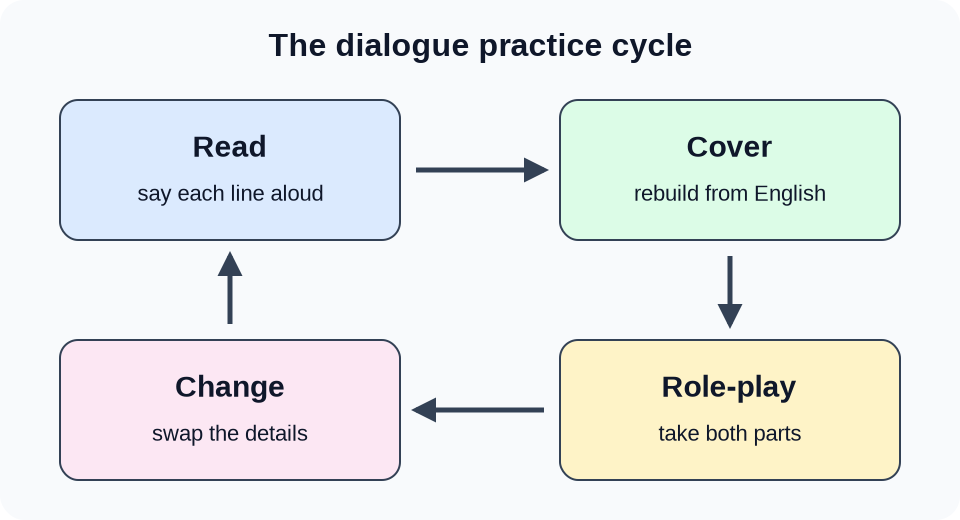
The practice cycle
- Read the Russian and the meaning aloud.
- Cover the Russian and rebuild it from the English.
- Role-play both speakers without looking.
- Change names, places, days and times.
For listening practice, ask a fluent speaker or a teacher to read the lines. You can also record yourself with any recording tool and compare stress.
Choose вы or ты before you start. Adults who do not know each other usually use вы. Friends, family members and children are usually addressed with ты.
Make each dialogue your own
Changing a dialogue is where real learning happens. Here are swaps you can make. Say each new sentence aloud, and check the form.
| Dialogue | Swap | Example |
|---|---|---|
| 1 | the country | Я из Япо́нии. |
| 1 | the city | Сейча́с я живу́ в Москве́. |
| 2 | the day | Что ты де́лаешь в пя́тницу? |
| 2 | the activity | Хо́чешь пойти́ в теа́тр? |
| 3 | the place | Извини́те, где здесь банк? |
When you swap the country, remember the genitive: Япо́ния becomes из Япо́нии. When you swap the city, remember the prepositional: Москва́ becomes в Москве́. A swap often needs a new ending, and that is the point of the exercise.
Handling a surprise
Real people do not follow your script. Suppose you ask for directions and get a long, fast answer. Try this sequence.
- Thank and slow down: Спаси́бо. Ме́дленнее, пожа́луйста.
- Ask for the key point: Пря́мо и́ли напра́во? (Straight or right?)
- Ask to be shown: Покажи́те, пожа́луйста.
- Close politely: Спаси́бо большо́е. До свида́ния!
Short questions with и́ли (or) are useful, because the answer is usually a single word that you already know.
Check your own performance
After a role-play, answer three questions. Could you start the conversation without looking? Did you use ты or вы consistently? Which line made you stop? Practice that line alone five times, then play the whole dialogue again. Progress often comes from repairing one small weak spot at a time.
Practice on your own
Practice talking about yourself with these models.
| Say this in Russian | One good answer |
|---|---|
| My name is Anna. | Меня́ зову́т А́нна. |
| I am from India. | Я из И́ндии. |
| On Friday I will be working. | В пя́тницу я бу́ду рабо́тать. |
Replace the name, country and day with your own details.
Common mistakes
- Mixing ты and вы in one conversation.
- Pretending to understand. Ask Повтори́те, пожа́луйста.
- Memorizing a script without ever changing a detail.
- Using a man's form for a woman: свобо́ден and свобо́дна.
Try it
Check your understanding
Quick check · 4 questions
of 4 answered You scored / 4 · perfect!
-
1. Which phrase asks someone to repeat?
Повторите means repeat. -
2. In "Я из Кана́ды", which case is "Кана́ды"?
The preposition из takes the genitive. -
3. How would a woman say "I am free"?
The short adjective agrees with a female speaker. -
4. Which form do adults who are strangers usually use?
Вы is the polite form.
Summary
- Learn repair phrases before long dialogues.
- Notice the case behind each phrase.
- Practice by reading, covering, role-playing and changing details.
- Keep ты or вы consistent.
Följ dina framsteg
Skapa ett gratis konto för att bocka av lektioner och fortsätta där du slutade, på vilken enhet som helst.