
























Lektion 1 · Getting Started
Guitar Course Map: How to Use This Tutorial
See the whole beginner guitar route, learn how to study each lesson, plan short daily practice, and protect your hands and your hearing from the start.
Learning guitar is a long, friendly project. You do not need talent to start. You need a guitar that works, a few minutes most days, and a clear order of steps. This course gives you that order.
This first lesson is your map. It shows what you will learn, how to use each page, and how to keep your body and your ears safe while you practice.
What you will learn
- The order of the nine chapters and why they come in that order
- How to study one lesson so that the skill reaches your hands
- How to plan short, regular practice sessions
- Basic safety for your fingers, wrists and hearing
The route
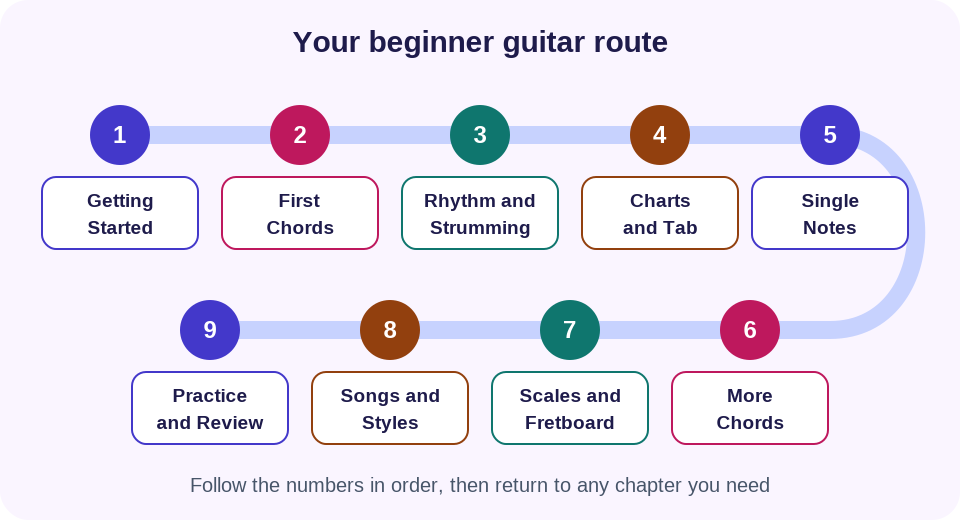
The course has nine chapters. Each one builds on the one before it.
- Getting Started. You learn the parts of the guitar, choose an instrument, tune it and sit with it. Start with the parts of the guitar.
- First Chords. You read chord diagrams and learn the first open chords. Then you practice moving between them.
- Rhythm and Strumming. You count beats, use down and up strums, and play steady patterns.
- Reading Charts and Tab. You learn to read chord charts, guitar tablature and capo directions.
- Single Notes and Picking. You play one note at a time with more control.
- More Chords. You add new shapes to your chord set.
- Scales and the Fretboard. You learn how notes are arranged on the neck.
- Playing Songs and Styles. You put your skills into music.
- Practice and Review. You build a plan and check what you know.
Go in order the first time. Later, jump back to any lesson you need.
What you need
- A guitar: acoustic, classical or electric. All three work for this course.
- A tuner. This can be a clip-on tuner, a tuner pedal or a tuner app on your phone.
- A few picks, if you want to use a pick.
- A chair without arms.
- A notebook for your practice log.
An electric guitar also needs an amplifier or headphones with a suitable device. You can learn the chord shapes without plugging in, but you will hear your mistakes better with sound.
How to study one lesson
A lesson is not finished when you have read it. Reading gives you the idea. Your hands need repetition. Try this method:
- Read the lesson once without the guitar.
- Copy each example slowly with the guitar. Check every string.
- Repeat the hard part in short rounds, not in one long struggle.
- Test yourself with the exercise and the quiz.
- Return after a day or two and play it again from memory.
Slow practice is not weak practice. When you play slowly, your brain has time to notice each finger. Speed comes after accuracy.
Short sessions beat rare long ones
Many beginners get better results from short, frequent sessions than from one long session each week. Your fingertips also adjust more comfortably this way. A first session can be 10 to 20 minutes. You might split it like this:
| Minutes | Activity |
|---|---|
| 2 | Tune the guitar |
| 3 | Gentle warm-up: single strings, slow finger placement |
| 8 | The new skill from your current lesson |
| 5 | Something you can already play, for fun |
Always end with something that sounds good to you. It makes you want to come back.
How to know you are improving
Progress on guitar is often uneven. One week a chord feels hard, and later it feels normal. Do not judge yourself by a single session. Instead, check small and clear things. Can you tune faster than before? Do more strings ring cleanly? Can you count to four while you play? Can you start a chord change with less looking? Write down these answers. You can also make a short recording once in a while with your own device and compare it with an older one. Listen for steadiness and clear notes, not for perfection.
Hands and hearing come first
New players often feel sore fingertips. The skin gets tougher with time. Some tenderness is normal. Sharp pain, numbness, tingling, or pain in the wrist, arm or shoulder is different. Stop playing and rest. If it continues or returns, ask a doctor or another health professional.
Sound matters too. Loud sound over a long time can damage your hearing, and the damage can be permanent. Keep amplifier and headphone volume at a comfortable level. Take breaks. If your ears ring after playing, it was too loud or too long. If you play with a loud band, use earplugs made for hearing protection.
Write a one-line practice log after each session: the date, what you practiced, and one thing that improved. After a few weeks, the log shows progress that you may not feel day to day.
Common mistakes
- Skipping tuning. An out-of-tune guitar makes correct playing sound wrong.
- Racing to full songs before single chords sound clean.
- Practicing through sharp pain or numbness. Stop and rest instead.
- Turning up the volume to hide unclear notes.
- Waiting for a free hour. Ten focused minutes are worth doing.
Try it
Use this planner to split your own practice time. Change the total and see a suggested plan.
Check your understanding
Quick check · 4 questions
of 4 answered You scored / 4 · perfect!
-
1. Which chapter teaches chord charts, tablature and the capo?
Chapter four covers how to read chord charts, tab and capo directions. -
2. You feel tingling and numbness in your fretting hand. What should you do?
Numbness and tingling are warning signs. They are not part of normal fingertip soreness. -
3. Which practice habit is the best choice for most beginners?
Short, regular sessions give your hands repeated practice and time to recover. -
4. What should you do if your ears ring after playing?
Ringing is a warning sign. Lower the volume, shorten loud exposure and use hearing protection.
Summary
- The course has nine chapters that build on each other.
- Read, copy slowly, repeat, test and return later.
- Short and regular practice works well for most learners.
- Sore fingertips are common at first; sharp pain or numbness means stop.
- Protect your hearing at all volumes that feel loud.
Next: Parts of the Guitar
Följ dina framsteg
Skapa ett gratis konto för att bocka av lektioner och fortsätta där du slutade, på vilken enhet som helst.