
























Lektion 16 · Collocations
What Are Collocations?
Understand collocations, the natural word partners in English, learn the main types, and find out how to notice, record and practice them.
Why do English speakers say heavy rain but not usually strong rain? Why do they make a mistake but do homework? These are collocations: words that often go together in a way that sounds natural.
Collocations are one of the biggest differences between speech that is correct and speech that sounds natural. Learning them helps you speak with less effort, because you can use a whole phrase at once.
What you will learn
- what a collocation is
- the main patterns of collocation
- how to find and check collocations
- how to practice them
Word partners
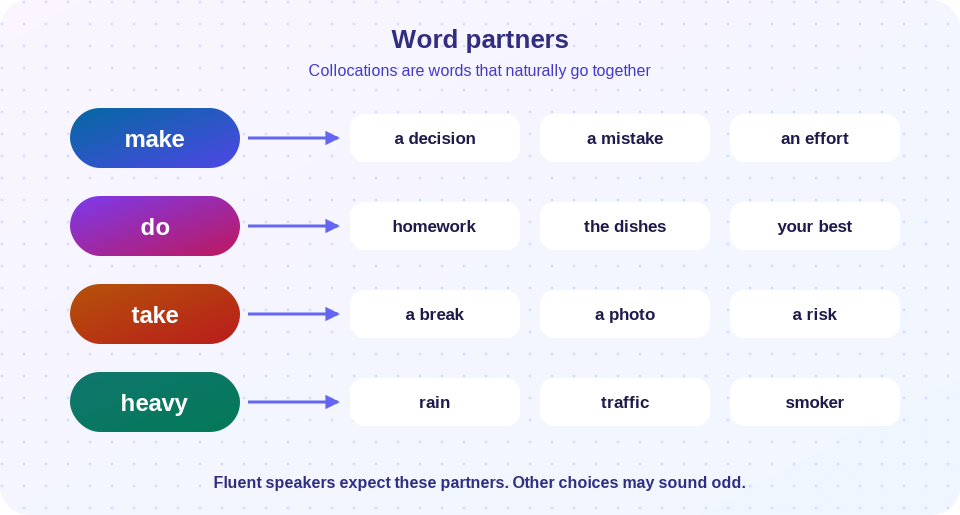
Natural partners
Sounds odd
How to learn
Learn the phrase as one unit.
There is not always a logical reason. The partners are customs that speakers share. A different choice may still be understood, but it can sound strange.
Main patterns
| Pattern | Examples |
|---|---|
| verb + noun | make a decision, take a break, pay attention |
| adjective + noun | heavy traffic, strong tea, a high price |
| adverb + adjective | deeply sorry, highly unlikely, fully aware |
| verb + adverb | argue strongly, listen carefully |
| noun + noun | a round of applause, a bar of soap |
| noun + verb | the phone rings, the sun rises |
Strong and weak partners
Some partners are very tight. If you hear "to commit a ___," you will probably expect crime. Others are loose: a big house, a big mistake and a big dog are all fine, because big combines with many nouns.
You can place collocations on a line.
| Free combination | Collocation | Fixed expression |
|---|---|---|
| a red chair | heavy rain | by and large (meaning "mostly") |
| words combine freely | words prefer each other | the words and order are fixed |
The borders between these groups are not sharp, and experts do not all draw them in the same place.
How to notice them
- Read and listen for pairs. When you meet highly recommend, mark both words.
- Ask a question. "Which verb does this noun usually take?"
- Check a dictionary. Many learner's dictionaries show common partners in example sentences or special boxes.
- Look at real examples. A search can show how people use a phrase, but not every result is correct, so compare several reliable sources.
Recording collocations
Write the word in the middle of a small map in your notebook, with partners around it. For decision:
- verbs: make, reach, take (mostly British)
- adjectives: difficult, final, important
- after it: a decision about something, a decision to do something
Then write one sentence: "It was a difficult decision to move to another city." See the dictionary lesson for a full notebook entry.
Why learn them
- Natural sound: your sentences match what listeners expect.
- Speed: you recall a chunk, not a word at a time.
- Understanding: you can often predict the next word when listening.
- Precision: a strong argument, a weak signal and a slight delay say exactly what you mean.
A mini reading with collocations
"Last week I took a deep breath and made a decision. I would take up running. My friend gave me some advice: start slowly and pay attention to how I feel. The first run was in light rain, and I felt fully awake."
Find the collocations again. Take up is a phrasal verb meaning "start a hobby," a topic of the Phrasal Verbs chapter.
Collocations and variety
English is used in many countries, and partners can differ a little between them. Speakers in the United States usually say take a shower, while many British speakers say have a shower. Both are normal. Partners can also differ between everyday speech and formal writing. In a chat, you might say a price went up a lot. In a formal text, you might read that prices rose sharply.
This is why it helps to notice where you found a phrase. In your notebook, add a short label such as work email, chat with friends or news. Later, the label reminds you where the phrase sounds at home.
A quick test for yourself
Take a noun you learned recently, such as deadline. Can you name a verb that goes before it? (meet a deadline, miss a deadline, set a deadline.) Can you name an adjective? (a tight deadline, a strict deadline.) If you can answer both, you know much more than the meaning of the word. If you cannot, you have found your next study goal.
Common mistakes
Translating word for word from your language. A natural verb in one language may not match English. Learning single words only, so you know decision but not make. Treating one rule as universal. Partners vary by variety and context, so check examples.
Try it
Choose the natural partner.
Check your understanding
Quick check · 4 questions
of 4 answered You scored / 4 · perfect!
-
1. What is a collocation?
Collocations are natural word partners. -
2. Which sounds natural?
Heavy rain is the usual combination. -
3. Which is a verb + noun collocation?
Pay is a verb and attention is a noun. -
4. How should you record a new collocation?
Learning the pair with a sentence shows how it is used.
Summary
- Collocations are natural word partners.
- Common patterns include verb + noun and adjective + noun.
- Notice, check and record them as units.
- They make your English sound natural and help you understand faster.
Följ dina framsteg
Skapa ett gratis konto för att bocka av lektioner och fortsätta där du slutade, på vilken enhet som helst.