
























Lektion 6 · Vowel Sounds
The Vowel Map
Understand the English vowel chart: tongue height, front and back position, lip shape and vowel length, with a clickable map and practice drills.
English has only five vowel letters, A, E, I, O and U, but a Southern British speaker uses about twenty vowel sounds. Many American speakers use somewhat fewer. That mismatch is why vowels cause so many misunderstandings.
The good news is that vowels are not random. You can arrange them on a simple map, based on where your tongue is and what your lips do.
Four vowel controls
Three families
Positions vary from speaker to speaker.
What you will learn
- The four controls that shape a vowel
- How to read the vowel chart
- The difference between single vowels and diphthongs
- Why length alone is not enough
- Which lesson covers each group
The four controls
1. Height. Say "see", then "cat". Your jaw drops for "cat". The vowel in "see" is close (the tongue is high) and the vowel in "cat" is open (the tongue is low).
2. Front or back. Say the vowels of "see" and "too" slowly, one after the other. Part of the change is the lips, but the highest part of your tongue also moves from the front toward the back.
3. Lip shape. For "see", the lips are spread or relaxed. For "too" and "saw", they are usually rounded. English back vowels are often rounded, but not all of them: the "a" in "father" is not.
4. Length and tension. Some vowels tend to be longer and held more firmly, as in "seat". Others are shorter and more relaxed, as in "sit".
Reading the chart
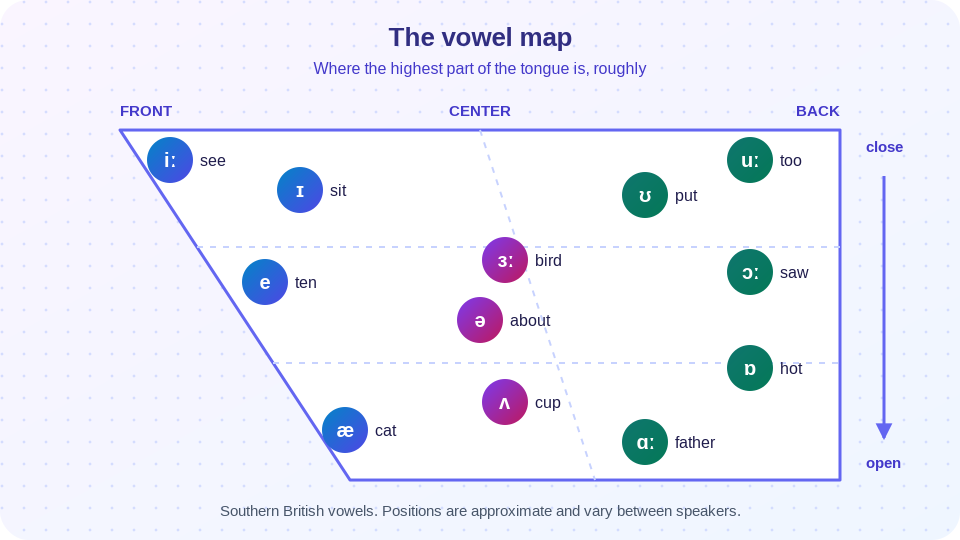
The chart is a simple drawing of the space where the tongue moves. The front of the mouth is on the left. The top is close, and the bottom is open. Each symbol shows roughly where the highest part of the tongue is.
It is an approximation. Real positions change with the speaker, the accent and the neighboring sounds. For instance, many young speakers of both British and American English make the vowel of "too" much farther forward than older descriptions show. Use the chart to compare vowels, not to measure your mouth.
Single vowels and diphthongs
A monophthong is a vowel with one main target. A diphthong moves from one vowel position toward another inside a single syllable. "Bed" has a monophthong. "Bay" has a diphthong.
In the common BrE description there are twelve monophthongs and eight diphthongs:
| Group | Symbols | Lesson |
|---|---|---|
| Front | /iː ɪ e æ/ | Front vowels |
| Central | /ʌ ɜː ə/ | Central vowels and schwa |
| Back | /uː ʊ ɔː ɒ ɑː/ | Back vowels |
| Glides | /eɪ aɪ ɔɪ əʊ aʊ ɪə eə ʊə/ | Diphthongs |
General American lists differ. The vowel of "hot" usually matches the vowel of "father", and vowels before r are often described in a different way.
Length is only one clue
It is tempting to think that "sheep" is just a long "ship". It is not. In most native accents the quality is different too: the tongue is in a different place.
Length also changes with the sounds around the vowel. A vowel is noticeably shorter before a voiceless consonant such as /p t k s/ than before a voiced one such as /b d g z/.
| Shorter vowel | Longer vowel |
|---|---|
| beat | bead |
| bit | bid |
| seat | seed |
| leaf | leave |
So the vowel in "bid" can last about as long as the one in "beat". Listeners use both quality and length. Practice both.
Worked example: describe a new vowel
Compare the vowel in "pen" with the vowel in "pan".
- Height: your jaw is more open for "pan".
- Front or back: both are front vowels.
- Lips: neither is rounded.
- Length: both are traditionally called short, although the "pan" vowel is often fairly long, especially in American speech.
The most useful change to practice is therefore the jaw opening.
Click around the map
This is a simple map for BrE. Positions are approximate. Click a symbol to read about it.
Using a mirror
Your mirror shows two of the four controls: jaw opening and lip shape. Say "see, sit, ten, cat" and watch your chin move down. Then say "too" and "saw" and watch your lips. You cannot see the tongue well, so use words you already say clearly as anchors. If your "see" is good, start from it and open your mouth a little to look for "sit".
Why your vowels may feel crowded
Many languages use only five or so vowel qualities. English reference accents use many more, so two or three English vowels may fall inside one familiar category for you. For example, a learner with one "i" vowel may use it for both "seat" and "sit".
You do not need to learn all of them in one step. A practical order is:
- Find your overlaps. Say the key words in the table above and ask a listener which ones sound alike.
- Choose one pair. Pick the pair that causes the most confusion in your daily speech.
- Anchor one side. Find the vowel that is already close to your own language, and move away from it to find the new one.
- Add words. Practice the new vowel in at least five common words, not only the pair you began with.
When one pair is stable, move to the next. Old pairs may slip for a while when you learn new ones, so review them from time to time.
Common mistakes
- Matching one vowel letter to one sound. The letter "a" has many pronunciations.
- Relying on length only for pairs like "ship" and "sheep".
- Treating chart positions as exact. They are guides for comparison.
- Mixing BrE and AmE vowel lists without noticing.
Try it
Check your understanding
Quick check · 4 questions
of 4 answered You scored / 4 · perfect!
-
1. What does the top of the vowel chart show?
Vertical position shows tongue height. -
2. What is a diphthong?
The sound moves from one target toward another. -
3. In which word is the vowel shortened by the following consonant?
The voiceless /t/ shortens the vowel. -
4. How exact are the chart positions?
Accent and context change them.
Summary
- Vowels are shaped by height, front or back position, lips and length.
- A monophthong has one target and a diphthong glides.
- The chart gives approximate positions.
- Vowels are shorter before voiceless consonants, and quality matters as well as length.
Följ dina framsteg
Skapa ett gratis konto för att bocka av lektioner och fortsätta där du slutade, på vilken enhet som helst.