
























Урок 15 · Nouns and Gender
Noun gender: masculine, feminine, neuter
Learn how to tell if a Russian noun is masculine, feminine or neuter from its ending, plus soft sign nouns, key exceptions and the pronouns that follow.
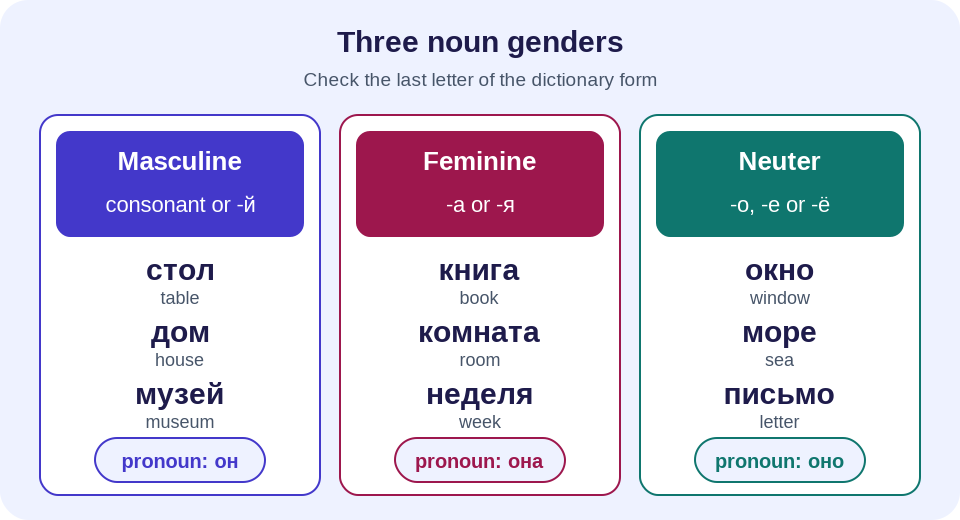
Every Russian noun has a gender: masculine, feminine or neuter. A noun is a word for a person, thing, place or idea. Gender is a grammar category. A table is masculine and a book is feminine, but this says nothing about the objects themselves.
Gender matters because other words, such as "my", "new" and "he or it", change to match it.
What you will learn
- how to find gender from the last letter
- what to do with nouns ending in Ь
- the main exceptions
- which pronoun replaces each noun
The basic rule
Look at the dictionary form of the noun, the form for one thing, as it appears in a dictionary.
| Gender | Usual ending | Examples |
|---|---|---|
| masculine | a consonant or -й | стол (table), дом (house), музе́й (museum), чай (tea) |
| feminine | -а or -я | кни́га (book), ко́мната (room), неде́ля (week), семья́ (family) |
| neuter | -о, -е or -ё | окно́ (window), мо́ре (sea), ружьё (rifle), письмо́ (letter) |
This rule covers most nouns you will meet at the start.
Pronouns that replace nouns
| Gender | Pronoun | Meaning |
|---|---|---|
| masculine | он | he, or it |
| feminine | она́ | she, or it |
| neuter | оно́ | it |
| any, plural | они́ | they |
Russian uses он and она for objects too:
- Где стол? Он там. "Where is the table? It is there."
- Где кни́га? Она́ тут. "Where is the book? It is here."
- Где окно́? Оно́ тут. "Where is the window? It is here."
Nouns ending in the soft sign
A noun ending in Ь can be masculine or feminine. You need to learn each one.
| Masculine | Meaning | Feminine | Meaning |
|---|---|---|---|
| день | day | ночь | night |
| слова́рь | dictionary | дверь | door |
| рубль | ruble | тетра́дь | notebook |
| учи́тель | teacher | мать | mother |
| гость | guest | пло́щадь | square (in a town) |
Some patterns help:
- Nouns ending in -тель that name people, such as учи́тель and води́тель (driver), are masculine.
- Month names ending in Ь, such as янва́рь (January), are masculine.
- Nouns ending in -ость are usually feminine, such as но́вость (news item). Гость is an important exception.
- Nouns ending in -жь, -чь, -шь, -щь are generally feminine, such as ночь, мышь (mouse) and вещь (thing).
Exceptions for people
Some nouns end in -а or -я but are masculine because they name male people.
- па́па (dad)
- дя́дя (uncle)
- де́душка (grandfather)
- мужчи́на (man)
So you say мой папа and refer to him with он. Many short male names, such as Саша or Дима (for a man), work the same way.
Other cases
- Ко́фе (coffee) is traditionally masculine, although neuter use is also common today. A beginner can say мой кофе safely.
- Most borrowed words that end in a vowel and never change their form are neuter, such as такси́, метро́, кино́ (cinema) and ра́дио.
- A small group ending in -мя, such as вре́мя (time) and и́мя (name), is neuter.
Words for jobs
Some job words are grammatically masculine even when they describe a woman. Врач (doctor) is one. You can say Она врач. "She is a doctor." Many other jobs have separate male and female forms, such as учи́тель and учи́тельница.
How to remember gender
Learn each noun with a small word that shows its gender, such as "my": мой стол, моя́ кни́га, моё окно́. You will practice this soon. For Ь nouns, this trick is especially useful: мой день, моя ночь.
Worked example: deciding step by step
Take five words and test them one at a time.
- портфе́ль (briefcase): it ends in Ь, so you must check. It is masculine.
- дя́дя: it ends in -я, but it names a man. It is masculine.
- земля́ (earth, land): it ends in -я and does not name a man. It is feminine.
- ме́сто (place): it ends in -о. It is neuter.
- трамва́й (tram): it ends in -й. It is masculine.
Ask yourself the questions in this order: Does the word name a male person? Does it end in Ь? Does it end in -мя or never change? If none of these applies, use the basic ending rule.
Short sentences with pronouns
Practice by asking where something is, then answer with the right pronoun.
| Question | Answer |
|---|---|
| Где чай? | Он тут. |
| Где музей? | Он там. |
| Где ручка? | Она тут. |
| Где площадь? | Она там. |
| Где молоко? | Оно тут. |
| Где метро? | Оно там. |
Say both lines aloud. If you hesitate before the pronoun, stop and name the gender first.
Why gender is worth the effort
Gender affects possessive words, adjectives, some past tense verb forms and many case endings that you will meet later. A noun learned with the wrong gender leads to mistakes in all of these places. A few extra seconds now save you a lot of correction later.
Common mistakes
Thinking gender follows the object's nature. It is a grammar feature. Learn it with the word.
Assuming every -а word is feminine. Папа and мужчина are masculine.
Guessing the gender of Ь nouns. Check a dictionary and learn each one.
Try it
Choose the gender of each noun.
Match each noun with the pronoun that replaces it.
Check your understanding
Quick check · 5 questions
of 5 answered You scored / 5 · perfect!
-
1. Which gender is a noun ending in a consonant, usually?
Nouns such as стол and дом are masculine. -
2. Which noun is masculine although it ends in -а?
Папа names a male person. -
3. Which noun ending in Ь is feminine?
Дверь is feminine. День and учитель are masculine. -
4. What pronoun replaces окно?
Окно is neuter. -
5. What is the gender of метро?
Метро is a borrowed word that does not change, and it is neuter.
Summary
- Consonant or -й usually means masculine.
- -а or -я usually means feminine, and -о, -е or -ё means neuter.
- Learn the gender of Ь nouns one by one.
- Папа, дядя, дедушка and мужчина are masculine.
- Он, она, оно and они replace nouns.
Отслеживайте прогресс
Создайте бесплатный аккаунт, чтобы отмечать пройденные уроки и продолжать с того места, где остановились, на любом устройстве.