
























Урок 10 · Communication and Patient-Centered Care
Communication Basics for Nurses
Learn how nurses communicate through words, tone and body language, recognize common barriers, and check that a message was understood the way you meant it.
Nurses talk with people all day: patients, families and colleagues. A short, clear sentence can calm someone who is afraid. A confusing one can lead to a missed step.
Communication is not only what you say. It also includes your voice, your face, your posture and how well you listen.
What you will learn
- The parts of a communication exchange
- Verbal and nonverbal communication
- Common barriers and ways to reduce them
- How to use plain language
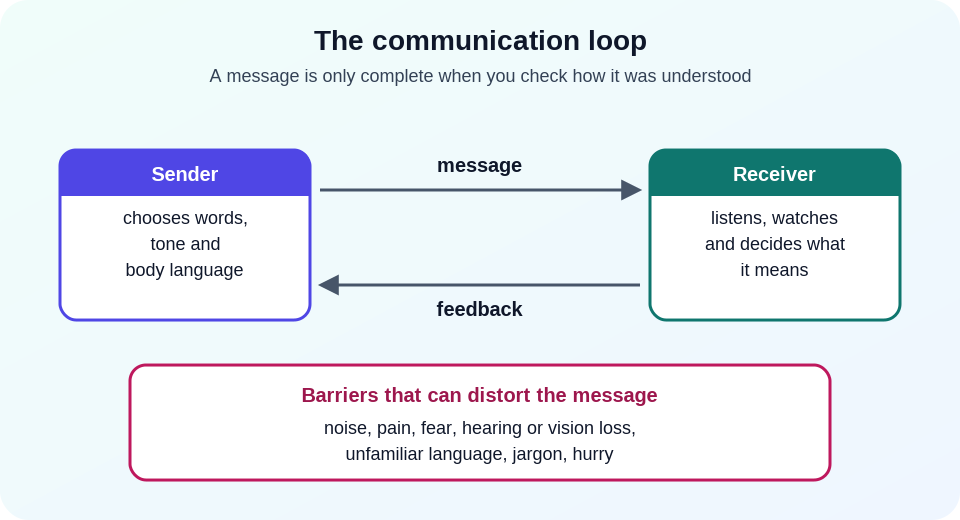
The communication loop
A simple model has these parts:
- A sender forms a message.
- The message travels through a channel, such as speech, writing or gesture.
- A receiver interprets it.
- The receiver gives feedback.
- The context, such as noise, stress and culture, affects every part.
Feedback is how you find out whether the message arrived as you meant it.
Verbal communication
Verbal communication uses words. Consider:
- Word choice: Use everyday words. Say "swelling" instead of "edema" with most patients, or explain the term.
- Pace: Slow down, especially for new information.
- Tone: The same words can sound caring or annoyed.
- Length: Give small pieces and pause.
- Clarity: Say what will happen and when.
Before and after
Jargon: "You'll be NPO after midnight."
Plain: "Please do not eat or drink anything after midnight, unless your care team tells you something different. Do you have questions about this?"
Real fasting instructions vary, so always give the exact instructions from the care team.
Nonverbal communication
Nonverbal signals include facial expression, eye contact, gestures, posture, distance, touch and silence.
- Sitting at eye level often feels less rushed than standing over someone.
- An open posture and attention suggest you are listening.
- Looking at a screen the whole time may suggest you are not.
Meanings differ between cultures and individuals. Direct eye contact is comfortable for some people and disrespectful or stressful for others. Ask and watch, instead of assuming. Ask before touching.
When words and body language disagree, people often trust the body language. A nurse who says "Take your time" while checking the clock sends a mixed message.
Reading the patient's signals
Watch the person too. They may say "I'm fine" while frowning and holding their side. You can gently name what you see: "You say you're fine, but you look uncomfortable. Can you tell me more?"
Common barriers
| Barrier | Possible response |
|---|---|
| Noise and interruptions | Move somewhere quieter, if safe |
| Hearing loss | Face the person, use their hearing aid, write key points |
| Vision loss | Say who you are, describe what you do, use large print |
| Different language | Use a qualified interpreter |
| Pain or tiredness | Keep it short, and return later |
| Fear or strong emotion | Pause, acknowledge the feeling |
| Medical jargon | Use plain words |
| Assumptions | Ask open questions |
When you use an interpreter, speak to the patient directly, use short sentences and pause often. Using family members, especially children, as interpreters can cause errors and privacy problems. Follow your local policy.
Adapting to the person
A child may understand a simple picture. A person with memory problems may need one idea at a time. An adult who works in health care may still feel scared and need plain words. Ask, "How do you like to receive information?"
Avoid "elderspeak": talking to older adults in a baby-like voice or using pet names they did not ask for. It can feel disrespectful.
A worked example
Fictional situation: Mr. Diaz seems upset before a test.
- Weak: "Don't worry. It's nothing. Just sign here."
- Better: The nurse sits down and says, "You look worried. What is on your mind?" Mr. Diaz says he is afraid it will hurt. The nurse listens, shares what is within their role to explain, and asks the appropriate clinician to answer the remaining questions.
The better response collects information and respects the feeling.
Written and electronic messages
Much communication in health care is written: notes, whiteboards, messages and instruction sheets. Written words have no tone of voice, so people can read them differently than you meant.
- Use full, clear sentences for important information.
- Avoid abbreviations that are not approved in your workplace.
- Check that the message is going to the correct person.
- Use only approved systems for patient information.
- Do not assume an urgent message has been read. Follow up by an approved direct method.
Checking your own state
Your feelings also affect communication. When you are tired or rushed, your voice may sound sharp even if you do not intend it. A short pause and one slow breath before you enter a room can help. If you speak in a way you regret, a simple repair helps: "I'm sorry I sounded rushed. I want to hear your question." An honest repair can help rebuild trust. Nobody communicates perfectly, and noticing a problem is the first step to improving.
Common mistakes
- Assuming a nod means understanding.
- Using jargon or abbreviations with patients.
- Talking about a patient as if they are not in the room.
- Saying "Don't worry" instead of listening.
- Relying on a child to interpret health information.
Try it
Translate each phrase into plain language by choosing the best option.
Check your understanding
Quick check · 4 questions
of 4 answered You scored / 4 · perfect!
-
1. What is the role of feedback?
Feedback lets you check and correct understanding. -
2. Which is a nonverbal signal?
Posture communicates without words. -
3. A patient speaks a different language from the nurse. What is usually the best choice?
Qualified interpreters reduce errors and protect privacy. -
4. A patient says "I'm fine" but looks in pain. What should the nurse do?
Naming the difference invites the person to share more.
Summary
- Communication includes words, tone, body language and listening.
- Feedback shows whether a message was understood.
- Reduce barriers and use plain language.
- Cultures and people differ, so ask and observe.
Отслеживайте прогресс
Создайте бесплатный аккаунт, чтобы отмечать пройденные уроки и продолжать с того места, где остановились, на любом устройстве.