
























Урок 32 · Confusing Words
Words that look or sound alike
Sort out affect and effect, their and there, its and it's and more, with simple tests, example sentences and gap-fill practice you can check yourself.
Some English words sound the same but are spelled differently. Others look almost the same but sound or mean something different. Even fluent writers mix them up, especially when they type quickly. A spelling checker may not help, because each word is spelled correctly on its own.
Chapter 8 deals with these traps. You will learn quick tests that you can use while you write.
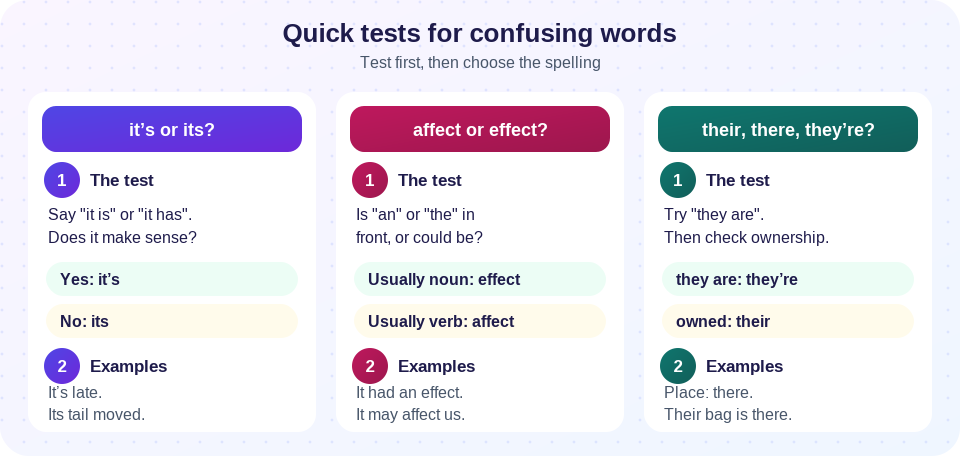
What you will learn
- The difference between homophones (same sound) and look-alike words.
- Tests for common pairs such as affect/effect.
- Pairs of noun and verb forms such as advice/advise.
- A proofreading habit that catches mistakes.
Same sound
Quick tests
Test, then choose
Apostrophe pairs
An apostrophe in it's and you're shows missing letters.
| Word | Meaning | Test | Example |
|---|---|---|---|
| it's | it is or it has | Can you say it is? | It's cold today. |
| its | belonging to it | Does it is fail? | The dog wagged its tail. |
| you're | you are | Can you say you are? | You're early. |
| your | belonging to you | Does you are fail? | Is this your bag? |
| they're | they are | Can you say they are? | They're at home. |
| their | belonging to them | Shows ownership | Their car is red. |
| there | in that place; there is | Points or introduces | Put it over there. |
Its without an apostrophe is the possessive. This feels unusual because we write Sara's with an apostrophe, but possessive pronouns such as his, its and hers have none.
affect and effect
Usually, affect is a verb and effect is a noun.
- Noise can affect your sleep.
- Noise has an effect on sleep.
A helpful test: if you can put an or the before the word, you probably need the noun effect. There are less common uses. To effect change means "to bring about change", and affect is a noun in psychology. In everyday writing, the first rule covers almost every case.
to, too and two
- to: direction or infinitive. I go to school. I want to learn.
- too: also, or more than needed. I want one too. It is too hot.
- two: the number 2. I have two sisters.
than and then
- than compares: She is taller than me.
- then is about time or order: We ate, and then we left.
lose and loose
- lose (verb) rhymes with choose: Don't lose your ticket.
- loose (adjective) rhymes with goose and means not tight: This button is loose.
accept and except
- accept means receive or agree to: I accept your offer.
- except means not including: Everyone came except Jo.
More pairs to know
| Pair | Difference |
|---|---|
| advice / advise | advice is a noun; advise is a verb |
| compliment / complement | praise / something that completes |
| principal / principle | head of a school, or main / basic rule or belief |
| stationary / stationery | not moving / paper and pens |
| desert / dessert | dry land (or to leave) / sweet food after a meal |
| breath / breathe | noun / verb |
| quiet / quite | not noisy / fairly or completely |
| passed / past | past form of pass / time before now |
| weather / whether | rain and sun / if |
| peace / piece | no war / part of something |
Memory tricks can help. Stationery with an e includes envelopes. Dessert has two s letters, and you may want seconds.
British and American spelling
In American English, practice is both the noun and the verb. In British English, practice is the noun and practise is the verb. Similarly, American English uses license for both, while British English uses licence (noun) and license (verb). This tutorial uses American spelling.
Proofreading habit
After you write, search for your usual mistakes one at a time. First check every its and it's. Then check there, their and they're. Reading slowly aloud also helps you notice a word that does not fit the grammar.
The next lesson looks at words with similar meanings, and later false friends explains traps for learners of other languages.
Worked example: find the mistakes
Read this message: Its too late too chance there plan, so we should except the delay and than move on. Work through it one word at a time.
- Its should be It's, because we can say it is.
- too late is correct, since it means more than needed.
- too chance should be to change: the word to introduces the verb, and chance is a different word from change.
- there plan should be their plan, because the plan belongs to them.
- except should be accept, meaning agree to.
- and than should be and then, because it shows order.
The corrected sentence is: It's too late to change their plan, so we should accept the delay and then move on.
A spelling checker may miss several of these errors, because most of the wrong words are real words. This is why a careful second reading matters.
Make your own error list
Keep a short list of the pairs that you mix up. For each, write the test in your own words and one true sentence. Before you send important writing, search for only those pairs. A personal list is shorter and more useful than a very long general list.
Common mistakes
- Writing "it's" for possession. The cat licked its paw.
- Using "then" to compare. Write bigger than.
- Writing "loose" for "lose". We might lose the game.
- Trusting the spell checker only. It may accept the wrong real word.
Try it
Check your understanding
Quick check · 4 questions
of 4 answered You scored / 4 · perfect!
-
1. Which test works for it's?
It's is a short form of it is or it has. -
2. Which is usually a noun?
Effect is usually the noun. -
3. Which word compares two things?
Than is used in comparisons. -
4. In American spelling, how is the verb practice written?
American English uses practice for noun and verb.
Summary
- Use expansion and swap tests for it's, you're and they're.
- Affect is usually a verb and effect usually a noun.
- Check pairs such as than/then and lose/loose as you proofread.
- Spell checkers may miss a wrong real word.
Отслеживайте прогресс
Создайте бесплатный аккаунт, чтобы отмечать пройденные уроки и продолжать с того места, где остановились, на любом устройстве.