
























Lecția 15 · Pacing and Story
Story Structure for Video
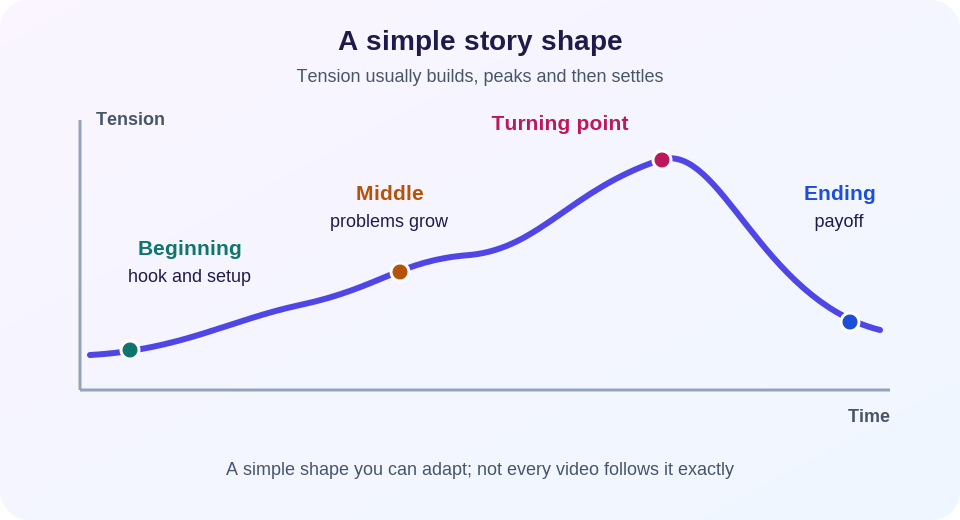
Shape any video with a clear beginning, middle and end: write a one-line story, plan an honest hook, build tension and end with a satisfying payoff.
Good cuts help each moment work. Story structure helps all the moments work together. Even short videos need a sense of direction: why should the viewer keep watching, and where are they going?
You do not need a movie plot. A recipe, a product demonstration or a travel clip can all have a clear shape.
What you will learn
- How to write your story in one sentence
- The beginning, middle and end of a video
- How to create an honest hook and a payoff
- Different structures for different kinds of video
The one-sentence story
Before you build or rebuild a structure, write one sentence:
"This video shows [who or what] doing [something] so that [the viewer gains something or learns something]."
Examples:
- "This video shows Maria watering young plants so that new members can avoid common mistakes."
- "This video follows a baker's first morning in a new shop so that we feel the pressure and the relief."
If you cannot write this sentence, your edit may be trying to do too many things.
Beginning, middle and end
Beginning: hook and setup
The beginning has two jobs:
- Hook: give a reason to keep watching.
- Setup: give just enough information to understand.
A hook can be a question ("Why do so many seedlings die in the first week?"), a surprising image, a problem, a strong moment or a glimpse of the result.
Make the hook honest. If the video promises something, deliver it. A misleading opening may get attention for a moment, but viewers feel cheated.
Avoid long introductions before anything happens. A long logo animation or a long greeting delays the story.
Middle: development
The middle moves toward the answer or goal. It often contains:
- Steps, in a logical order
- Obstacles or problems
- New information that changes what we understand
- Small moments of progress
A strong test: between two parts, can you say "but" or "so" instead of only "and then"? For example, "She waters the plants, but the water runs off, so she loosens the soil." Cause and effect keep viewers involved. This is a helpful tool, not a strict rule. Some videos, such as calm observational pieces, work differently.
End: payoff
The ending should answer the question or promise from the beginning. This is the payoff. After it, finish soon. Possible endings:
- The result: the finished dish, the fixed bike
- A change: how the person or place is different
- A summary of the key point
- A clear next step for the viewer
Different structures
| Structure | Good for | Shape |
|---|---|---|
| Problem and solution | Tutorials, explainers | Problem, attempts, solution, result |
| Chronological | Events, journeys | In the order things happened |
| Before and after | Makeovers, repairs | Old state, process, new state |
| Question and answer | Interviews, explainers | Question, evidence, answer |
| List | Tips and comparisons | Promise, items, strongest item or summary |
You can mix them. For example, a chronological travel video may start with a short glimpse of a high point and then jump back to the start.
Order creates meaning
Viewers connect shots that sit next to each other. An experiment usually credited to the Soviet filmmaker Lev Kuleshov is often described like this: the same neutral face, shown next to different images, seemed to express different feelings. The exact details of the original experiment are debated and not all preserved, but the idea is familiar to editors: context changes meaning.
Try it yourself: put a person looking down next to a bowl of food, then next to an old photo. The same look may feel like hunger in one version and memory in the other.
This power also brings responsibility. In factual work, do not arrange shots so that viewers believe something happened that did not.
Finding structure in real footage
For documentary-style or event videos, you often find the story during editing:
- List the strongest moments on cards.
- Ask what changes from the first to the last moment.
- Choose a central question.
- Order cards so the question is clear early and answered late.
- Remove cards that do not connect to the question, even if you love them.
Worked example
Cards: "empty garden bed", "volunteers arrive", "first planting", "rain ruins a tray", "group laughs and starts over", "green shoots after two weeks", "someone eats a fresh bean".
Possible structure: hook with the bean (a glimpse of success), jump back to the empty bed, then follow planting, the problem with the rain, the new start, the green shoots, and return to the bean as a payoff. Be sure the viewer can follow the jump in time, for example with a title like "Two months earlier" if that is true.
Test your structure
Before you polish, write one short line for each section of your video. Read only these lines from top to bottom. Does the order make sense? Can you tell what question starts the video and where it is answered?
Then ask a friend to watch the rough cut without pauses. Afterward, ask them to tell the story back to you in two or three sentences. Their version shows what really came through. If they remember a small detail but miss the main point, give the main point more space, place it earlier or remove material that competes with it.
Common mistakes
- Starting with a long introduction before anything interesting happens.
- Promising something in the hook that the video never delivers.
- Adding a second ending after the story has already ended.
- Reordering factual footage in a way that creates a false impression.
Try it
Check your understanding
Quick check · 4 questions
of 4 answered You scored / 4 · perfect!
-
1. What is the job of a hook?
A hook creates interest at the start. -
2. What is a payoff?
A payoff delivers what the opening promised. -
3. Which link between two parts usually creates more momentum?
Cause and effect make viewers want to know what happens next. -
4. What does the idea often linked to Kuleshov suggest?
Context from other shots shapes meaning.
Summary
- Write your story in one sentence.
- Open with an honest hook and a short setup.
- Build the middle with progress, problems and cause and effect.
- End with a payoff and stop soon after it.
- Shot order creates meaning, so use it honestly.
Next: Pacing and Rhythm
Urmărește-ți progresul
Creează un cont gratuit ca să bifezi lecțiile și să reiei de unde ai rămas, pe orice dispozitiv.