
























Lecția 19 · Writing
The TOEFL Writing section at a glance
See the three TOEFL iBT writing tasks in the 2026 format, their timings and item points, how scores are reported, and how to prepare for each one.
The Writing section asks you to do three different jobs: put sentences together correctly, send a clear message to a person, and add your opinion to a class discussion. Each job needs its own habits. This chapter teaches them one by one.
The format changed on January 21, 2026. Many older books and videos still describe a long task where you read, listen, and then write, so check the date of any material you use. This tutorial is independent. It is not connected to or endorsed by ETS, the organization that owns the test. Before you book, confirm the current details on the official TOEFL pages at ets.org.
What you will learn
- The three writing tasks and what each one tests
- The published timings and item points
- How the writing score fits into your results
- How to divide your practice time
The three tasks
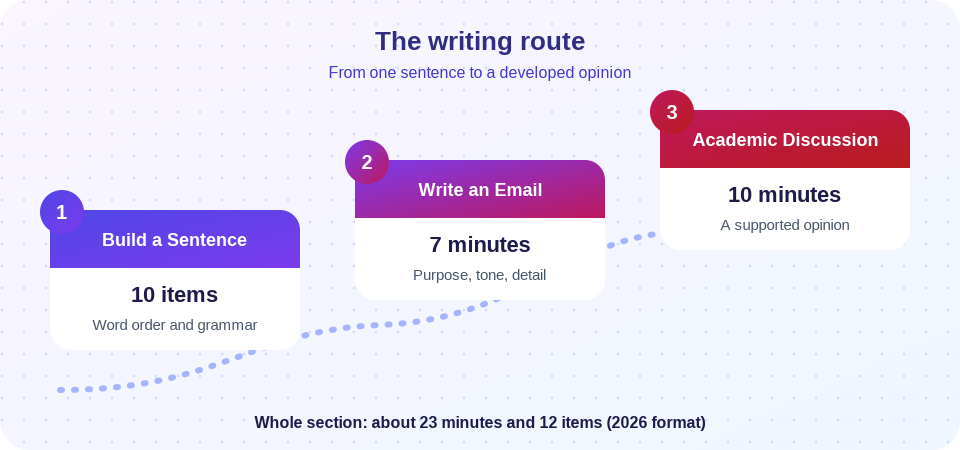
ETS published these figures for the 2026 format. The section has about 23 minutes and 12 items. Test specifications can be revised, so treat the official site as the final word.
| Task | Items | Time | Maximum points per item | Main skill |
|---|---|---|---|---|
| Build a Sentence | 10 | Part of the section time | 1 | Word order and grammar |
| Write an Email | 1 | 7 minutes | 5 | Purpose, politeness, clear detail |
| Write for an Academic Discussion | 1 | 10 minutes | 5 | A supported opinion |
If you subtract the 7 and 10 minutes from about 23, roughly 6 minutes remain for the sentence items. That is our arithmetic, not a separately published limit. Follow the clock that you see on the screen.
What the ladder means for you
The tasks grow in size. In the first one, almost everything is given to you, and you arrange it. In the second, you get a situation and must decide what to say. In the third, you must have an idea of your own and defend it.
Compare these three kinds of work on one campus topic, a library that closes early.
- Sentence level:
Could you tell me when the library closes? - Message level: You email a librarian, explain that your evening class ends late, and ask for longer hours during exams.
- Argument level: You tell your class whether a university should spend money on longer library hours, and why.
How writing is scored
Since January 2026, each of the four test sections is reported on a scale from 1 to 6 in half-point steps. The overall score uses the same scale: it is the average of the four section scores, rounded to the nearest half. For example, section scores of 5, 5, 4.5 and 5.5 average exactly 5.
ETS also states that, through January 2028, score reports include a comparable overall score on the older 0 to 120 scale. A university may list its requirement either way, so read each requirement carefully.
The points in the table above are item points. They are not your band score, and you should not try to convert them yourself. ETS's test blueprint classes the two longer writing tasks as AI-scored items. Its published writing guides describe each level from 0 to 5. In plain words, the top levels look for:
- a response that does the job the task asks for
- details that really support your purpose or opinion
- a range of sentence patterns and precise words
- very few errors beyond small slips that happen under time pressure
A blank response, a response copied entirely from the prompt, or one unconnected to the prompt receives 0.
How to share your practice time
Do not split your time equally out of habit. First, find out where you lose the most.
- Try one timed task of each type.
- Mark your own errors with the editing checklist.
- Name your biggest problem: word order, politeness, ideas, or accuracy.
- Give that problem the most sessions this week.
For example, Mina writes good opinions but her emails sound like text messages. She should practice the email task three times this week and the discussion task once. Omar writes politely but runs out of ideas, so he does the opposite and works on academic discussion posts.
Common mistakes
Do not prepare from out-of-date material. Do not memorize a whole essay to paste into a task: it will not fit the prompt. Learn flexible sentence patterns instead.
Another common mistake is to ignore typing. Your writing is typed, so practice on a keyboard, with spelling correction switched off.
Try it
Match each situation to the writing task that trains the same skill.
Check your understanding
Quick check · 4 questions
of 4 answered You scored / 4 · perfect!
-
1. How many writing items does the 2026 blueprint list?
It lists ten Build a Sentence items, one email and one discussion post. -
2. How long do you get for Write an Email?
The email has 7 minutes and the discussion post has 10. -
3. Section scores of 4, 4.5, 4 and 3.5 give what average?
The four scores add to 16, and 16 divided by 4 is 4. -
4. What do 5 points on the email task mean?
Item points and the reported 1 to 6 section score are different things.
Summary
- The 2026 Writing section has Build a Sentence, Write an Email, and Write for an Academic Discussion.
- It lasts about 23 minutes. The email has 7 minutes and the discussion post has 10.
- Sections and the overall result use a 1 to 6 scale in half steps.
- Practice your weakest skill most, and check current details with ETS.
Urmărește-ți progresul
Creează un cont gratuit ca să bifezi lecțiile și să reiei de unde ai rămas, pe orice dispozitiv.