
























Lecția 10 · Structuring a Talk
The Talk Blueprint: Opening, Body and Closing
Plan a clear presentation with an opening, a body of a few key points and a closing, build a one-page outline and turn it into short, useful speaking notes.
Listeners cannot scroll back or look at a table of contents. Structure is how they keep their place. When they know where they are, they can give their attention to your ideas.
Structure helps you too. If you forget a sentence, you still know what job the current part of the talk must do.
What you will learn
- The jobs of the opening, body and closing
- How to build each key point
- How to divide your time
- How to write a one-page outline
- How to turn an outline into speaking notes
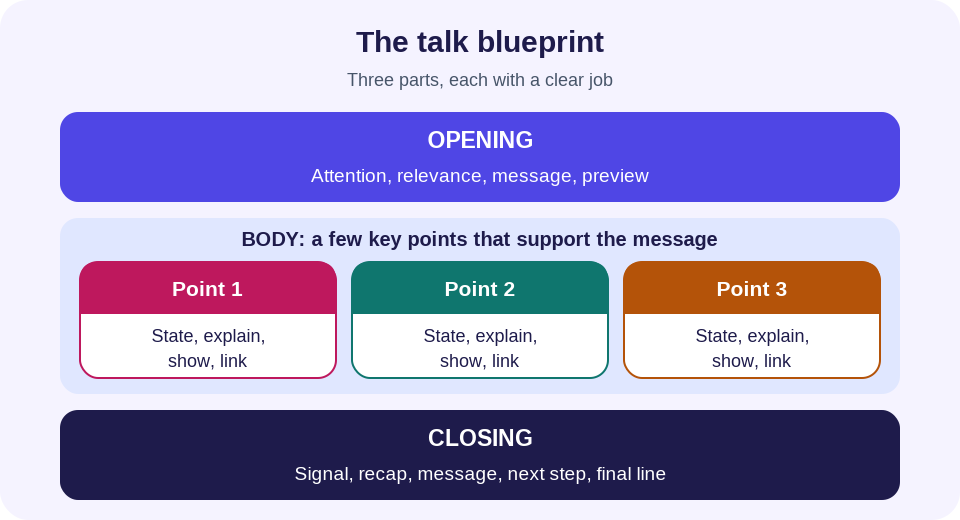
Three parts, three jobs
| Part | Main jobs |
|---|---|
| Opening | Get attention, show why the topic matters, give your message and preview the path |
| Body | Explain and support your message with a few key points |
| Closing | Signal the end, return to the message and say what happens next |
A familiar summary is "Tell them what you will tell them, tell them, then tell them what you told them." It is a helpful reminder about repetition. Do not follow it word for word, or your talk may sound dull.
Build the body first
Many speakers try to write the opening first and get stuck. Try building the body first. Once you know what you are introducing, the opening is easier to write.
Start with your core message. Then choose a few key points. Two to four is a practical range for many short talks. Each point should:
- connect directly to the core message;
- be different from the other points;
- be stated in one plain sentence.
If you have eight points, look for groups. If two points say almost the same thing, join them.
The shape of one key point
You can build each point in four steps:
- State the point in one sentence.
- Explain what you mean.
- Show it with an example, a fact you have checked or a short story.
- Link it back to your message.
Here is an example for the core message "A shared calendar can reduce booking confusion at our club."
- State: "First, everyone can see which times are taken."
- Explain: "Bookings appear in one place instead of in separate chats."
- Show: "If you want the hall on Thursday, you open the calendar and check Thursday."
- Link: "That means fewer chances for two groups to plan for the same time."
Divide your time
The body usually gets most of the time. As a flexible starting point, you might give the opening about 10 to 15 percent, the body about 70 to 80 percent and the closing about 10 percent. These are planning guides, not rules.
For a seven-minute talk, one plan is:
- Opening: 1 minute
- Point 1: 1 minute 45 seconds
- Point 2: 1 minute 45 seconds
- Point 3: 1 minute 45 seconds
- Closing: 45 seconds
Points do not need equal time. If one point is harder or matters more, give it more.
Write a one-page outline
An outline shows the structure without every word. Here is a complete example.
PURPOSE: Club members will use the shared calendar to book the hall.
CORE MESSAGE: One shared calendar can reduce booking confusion.

OPENING
- Story: two groups arrive for the same room
- Message
- Preview: see, book, change

BODY
1. See what is free
   Example: checking Thursday evening
2. Make a booking
   Show: the three details to enter
3. Change or cancel early
   Reason: another group can use the time

CLOSING
- Recap: see, book, change
- Action: add your next booking by Friday
- Final line: check first, then invite your group
The story in this outline must be a real one, told with permission, or clearly introduced as imagined: "Picture two groups arriving for the same room."
Test the logic
Read only the main lines of your outline and ask:
- Does every point support the message?
- Is the order sensible?
- Is anything important missing?
- Does the closing match what the opening promised?
- Can someone else repeat the three points after hearing them once?
From outline to notes
A full script can help you think, but reading it aloud often reduces eye contact and makes your voice flat. Many speakers prefer key-word notes.
- Write key words, not paragraphs.
- Use large text and leave space.
- Number your cards or pages, so you can recover if they fall.
- Mark exact details, such as dates, names or numbers.
- Add small cues such as PAUSE or SHOW MAP.
It is often useful to know your opening and closing lines very well, while the body stays more flexible. Some settings, such as a formal statement, may call for a script. In that case, write it in spoken language, practice it well and mark places to look up.
Worked example: Fixing a messy talk
Elena's draft about joining the school garden goes like this: watering, a funny story about worms, how to join, why she likes it, tools, meeting time, soil, how to join again.
She writes a message: "Anyone can help in the school garden, even for one hour." Then she sorts her material into three points: what volunteers do, what they need and how to join. The worm story becomes part of her opening. The long details about soil move to a handout.
Her new draft has the same energy, but listeners can now follow it.
Common mistakes
- Writing a long opening and leaving too little time for the body.
- Listing many small points with no groups.
- Adding a brand-new main idea in the closing.
- Putting whole paragraphs in tiny text on note cards.
Try it
Fill in this one-page blueprint with a talk of your own. Check the word count and say the result aloud.
Under each point, add one example on paper.
Check your understanding
Quick check · 4 questions
of 4 answered You scored / 4 · perfect!
-
1. Which is a main job of the opening?
The opening prepares listeners for what follows. -
2. Why might you build the body before the opening?
When the body is clear, you know what the opening needs to set up. -
3. What are the four steps for building a key point in this lesson?
The steps make each point clear, supported and connected. -
4. Which notes are usually the easiest to use while keeping eye contact?
Short, large notes can be read at a glance.
Summary
- Use an opening, a body and a closing, each with clear jobs.
- Build the body around a few distinct points.
- State, explain, show and link each point.
- Give most of your time to the body.
- Test a one-page outline, then turn it into short notes.
Urmărește-ți progresul
Creează un cont gratuit ca să bifezi lecțiile și să reiei de unde ai rămas, pe orice dispozitiv.