
























Lecția 34 · Practice and Review
Practice Clinical Scenarios
Apply infection prevention, safety, comfort, ethics and communication ideas to realistic made-up scenarios and explain your reasoning.
Knowing facts is a start. In care, you must also decide what matters first. This lesson gives you made-up scenarios that mix ideas from the course.
These scenarios are for learning only. They are not clinical protocols. Real decisions depend on assessment by qualified people, local rules and your scope of practice.
What you will learn
- A four-step method for thinking through a scenario
- How to spot urgent signs
- How to stay within your role
- How to explain your choices
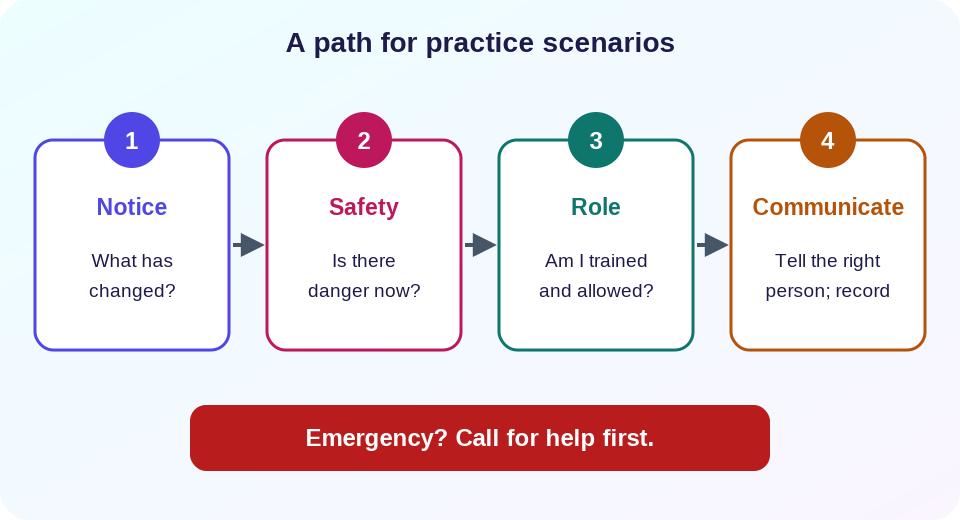
A four-step method
- Notice: What has changed? What does the person say?
- Check safety: Is anyone in immediate danger? Do you need emergency help now?
- Act within your role: What are you trained and allowed to do?
- Communicate and record: Whom will you tell, using which facts?
A quick memory phrase is "notice, safety, role, report". If an emergency appears, calling for help comes before everything else.
Priority thinking
Problems with the airway, breathing and circulation, and sudden changes in responsiveness, usually come first. Examples include a person who cannot breathe well, is choking, has heavy bleeding or is suddenly hard to wake. Many courses use the ABC (airway, breathing, circulation) idea. Your first aid or life support training explains what to do, and some protocols use a different order in special situations.
Scenario 1: The breakfast cough
You bring tea to Mr. Lindqvist. After two sips, he coughs and his voice sounds wet.
Think: This may be a swallowing problem. He can still speak and cough.
Good response: Stop offering drinks, stay with him, call the nurse, and watch his breathing. If he cannot breathe, speak or cough effectively, call for emergency help and use your trained first aid.
Weak response: Encouraging another sip "to clear it".
Scenario 2: The unplanned walk
Mrs. Mensah is standing alone. Her care plan says she needs one person and a walker. The walker is across the room.
Think: She is at risk of falling now.
Good response: Use the call system and speak calmly. Stay close and follow your training for supporting her safely. Bring the walker only if you can do so without leaving her unsafe. Afterward, tell the nurse why she got up, such as needing the toilet.
Weak response: Telling her off.
Scenario 3: The phone call
A caller says, "I'm her brother. Tell me her test results."
Think: You cannot assume identity or permission.
Good response: Say politely that you cannot share information and pass the call to the nurse in charge, who follows policy.
Scenario 4: The red heel
While helping with washing, you find a color change on a heel that stays after pressure is relieved. The skin feels warm.
Think: This could be early pressure damage.
Good response: Do not rub it. Relieve pressure as the plan allows, tell the nurse promptly, and record what you saw and when.
Scenario 5: The sign on the door
A sign shows contact precautions. You need to take a blood pressure, which you are trained to do. The shared cuff is in your hand.
Think: Shared equipment can carry germs.
Good response: Check the sign and plan. Use dedicated equipment if provided. Otherwise clean the shared item as policy says. Use the required PPE and hand hygiene.
Scenario 6: The quiet change
An older woman who usually chats is now sleepy and does not make sense.
Think: This is a sudden change and may be serious.
Good response: Get help immediately and stay with her. Do not assume she is only tired.
Explaining your choice
In exams and in practice, explain your reasoning with facts: "I stopped the drink because he coughed and his voice became wet. These can be signs that fluid is near or in the airway, so he needs assessment." Clear reasons help others check your thinking.
Make your own scenarios
Change one detail and ask how the answer changes. What if Mr. Lindqvist cannot cough at all? What if Mrs. Mensah says she feels faint? Practice with a study partner, and compare with your course materials and local policy.
Scenario 7: Two requests at once
While you are helping one person choose clothes, you hear a loud thud from the next room.
Think: Someone may have fallen. The first person must also stay safe.
Good response: Quickly make sure the first person is safe to leave, for example seated securely with the call bell. Then go to check and call for help. If you find a person on the floor, stay with them and do not rush to move them.
Weak response: Finishing the clothing choice first.
Reflect after practice
After each scenario, write three short lines: what you noticed first, what you almost missed, and what you would ask your instructor. This turns a wrong answer into a useful study note.
Common mistakes
- Choosing an action outside your role to "save time".
- Missing an urgent sign while finishing a routine task.
- Reassuring someone before checking what is wrong.
- Forgetting to tell anyone or record the event.
Try it
Check your understanding
Quick check · 4 questions
of 4 answered You scored / 4 · perfect!
-
1. What comes first when a person may be in immediate danger?
Immediate safety is the top priority. -
2. In the red heel scenario, which action should you avoid?
Rubbing may add damage. -
3. How should you answer a caller asking for results?
Identity and permission must be checked under policy. -
4. Why explain your reasoning with facts?
Clear reasons support safe teamwork.
Summary
- Use notice, safety, role and report for any scenario.
- Airway, breathing, circulation and sudden changes in responsiveness usually come first.
- Stay within your role and tell the right people.
- Change scenario details to practice flexible thinking.
Next: Nursing Math Practice
Urmărește-ți progresul
Creează un cont gratuit ca să bifezi lecțiile și să reiei de unde ai rămas, pe orice dispozitiv.