Discover why natural English sounds fast: words run together, small words shrink, stress creates strong and weak parts, and the page does not show any of it.
You read a sentence and know every word. Then you hear it at natural speed and catch almost nothing. It is easy to think the speaker was simply too fast.
Speed is part of the story. The other part is that spoken words change when they meet each other. This chapter shows how.
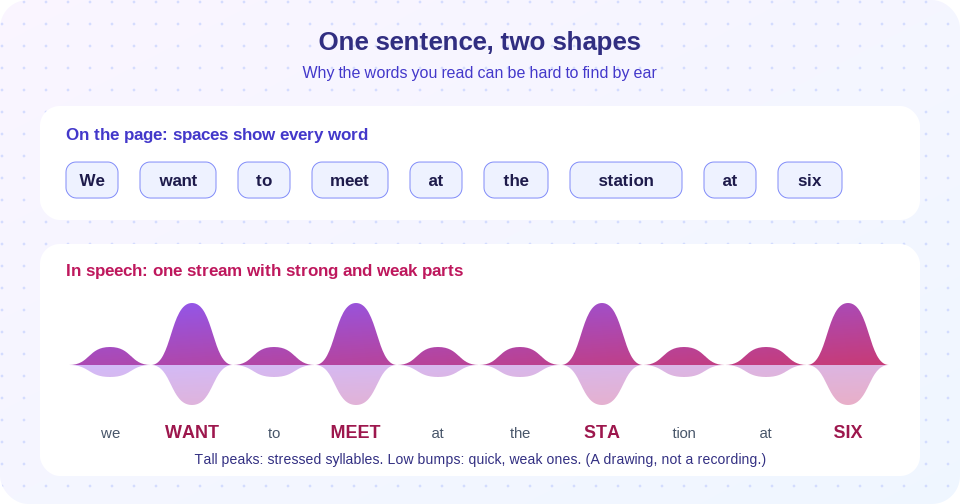
Writing separates words with spaces, while speech is a stream with louder peaks and quieter stretches.
On a page, white space separates words. In speech, people usually do not pause between words. They pause between larger groups, to breathe, to think, or to make a point.
So your ear has to find the word edges. You do this easily in your first language. In English, you are still building that skill.
For example, "an aim" and "a name" can sound the same or very nearly the same in natural speech. Context usually tells you which one is meant. The same is true of "ice cream" and "I scream", although careful speakers may make a small difference.
English has a rhythm of stronger and weaker syllables. A syllable is a beat in a word: "table" has two.
In a typical statement, content words get more stress. These are mostly nouns, main verbs, adjectives, adverbs and numbers. Function words are often weaker: articles, many prepositions, pronouns and helping verbs.
We WANT to MEET at the STATion at SIX.
The strong parts carry a lot of the meaning: want, meet, station, six. The other parts are quick and quiet.
This is not a fixed rule. A speaker can stress any word to make a point: "I said at the station, not in it."
These changes are a normal part of fluent speech, including careful and educated speech. They are not a sign of laziness. How much they happen depends on the speaker, the speed and the situation.
Many learners first meet words in writing, or one at a time in careful speech. The careful, alone version of a word is often called its citation form or dictionary form. If that is the only version you know, you may not recognize the quick version.
The solution is to learn both. You do not need to speak with every change yourself in order to understand it.
A transcript is a written copy of what is said. Use a short clip, even ten or twenty seconds, with a transcript that you trust. Automatic captions can contain errors.
Listen two or three times without the text.
Write what you hear, leaving gaps where you need to.
Compare with the transcript.
Mark each miss: unknown word, joined sound, weak word, or other.
Many players let you slow audio down. Slow playback can help you find a tricky boundary, but it may also distort the sound. Use it as a tool, and always finish by listening at normal speed.
Expecting every word to sound like the dictionary recording.Blaming speed for everything. Check whether you knew the words and the sound changes. Working with a long clip. Close study works better with a few seconds at a time.
<!doctypehtml><htmllang="en"><head><metacharset="utf-8"><style>body{margin:0;padding:14px;font-family:system-ui,sans-serif;color:#1e1b4b;background:linear-gradient(135deg,#faf5ff,#eff6ff)}.card{background:#fff;border-radius:14px;padding:12px 14px;margin-bottom:10px;box-shadow:0 4px 14px rgba(67,56,202,.12)}button{font:inherit;border:1px solid #c7d2fe;background:#eef2ff;color:#1e1b4b;border-radius:10px;padding:6px 12px;margin:4px 6px 0 0;cursor:pointer}button.go{background:#4f46e5;color:#fff;border:0}button.ok{background:#d1fae5;color:#064e3b;border-color:#10b981}button.no{background:#fee2e2;color:#7f1d1d;border-color:#ef4444}input{font:inherit;border:2px solid #c7d2fe;border-radius:8px;padding:3px 8px;width:9em;max-width:100%}input.ok{border-color:#10b981;background:#ecfdf5}input.no{border-color:#ef4444;background:#fef2f2}.why{color:#475569;margin:8px 0 0}p{line-height:1.55;margin:4px 0}</style></head><body><divid="app"></div><pid="total">Pick an answer in each card.</p><script>const items =[{"q":"In speech, where can you usually count on a pause?","o":["Nowhere in particular between single words, because pauses depend on the speaker","Between every pair of words","After every second word"],"a":0,"why":"Speakers pause between groups when they need to, not after each word."},{"q":"In a typical statement, which word is most likely to be stressed?","o":["\"of\"","\"station\"","\"the\""],"a":1,"why":"Content words such as nouns usually get more stress."},{"q":"What is a good use of slow playback?","o":["Replacing normal-speed practice for good","Finding a tricky part, then returning to normal speed","Learning new spellings"],"a":1,"why":"Slow audio helps you analyze, but your goal is normal speech."}];functionel(tag, text, parent, cls){const node = document.createElement(tag);if(text) node.textContent = text;if(cls) node.className = cls;
parent.appendChild(node);return node;}const app = document.getElementById('app');const total = document.getElementById('total');let done =0, right =0;
items.forEach(function(item, n){const card =el('div','', app,'card');el('p',(n +1)+'. '+ item.q, card);const buttons = item.o.map(function(label){returnel('button', label, card);});const why =el('p','', card,'why');let answered =false;
buttons.forEach(function(b, i){
b.onclick=function(){if(answered)return;
answered =true;
done++;const match = i === item.a;if(match) right++;else b.className ='no';
buttons[item.a].className ='ok';
why.textContent =(match ?'Yes. ':'Not this one. ')+ item.why;
total.textContent ='Matched the answer key: '+ right +' of '+ done +' answered.';};});});</script></body></html>
Use the Listen buttons if they work. The computer voice does not copy natural speech well, so use these lines as a warm-up. Then try the same method with a real recording.
Find the word edges
<!doctypehtml><htmllang="en"><head><metacharset="utf-8"><style>body{margin:0;padding:14px;font-family:system-ui,sans-serif;color:#1e1b4b;background:linear-gradient(135deg,#faf5ff,#eff6ff)}.card{background:#fff;border-radius:14px;padding:12px 14px;margin-bottom:10px;box-shadow:0 4px 14px rgba(67,56,202,.12)}button{font:inherit;border:1px solid #c7d2fe;background:#eef2ff;color:#1e1b4b;border-radius:10px;padding:6px 12px;margin:4px 6px 0 0;cursor:pointer}button.go{background:#4f46e5;color:#fff;border:0}button.ok{background:#d1fae5;color:#064e3b;border-color:#10b981}button.no{background:#fee2e2;color:#7f1d1d;border-color:#ef4444}input{font:inherit;border:2px solid #c7d2fe;border-radius:8px;padding:3px 8px;width:9em;max-width:100%}input.ok{border-color:#10b981;background:#ecfdf5}input.no{border-color:#ef4444;background:#fef2f2}.why{color:#475569;margin:8px 0 0}p{line-height:1.55;margin:4px 0}</style></head><body><pid="msg"class="why">Press Listen. The voice is made by your browser, so it is clearer than most real speech. If you hear nothing, ask a partner to read from Show text, or study the line yourself.</p><divid="app"></div><script>const items =[{"text":"We want to meet at the station at six.","note":"strong parts: want, meet, station, six"},{"text":"Can you turn it off for a minute?","note":"listen for the join in \"turn it off\""},{"text":"There's a cup of tea on the table.","note":"\"of\" is usually weak in natural speech"}];functionel(tag, text, parent, cls){const node = document.createElement(tag);if(text) node.textContent = text;if(cls) node.className = cls;
parent.appendChild(node);return node;}const app = document.getElementById('app');const msg = document.getElementById('msg');constfail=function(){ msg.textContent ='Audio does not work in this browser. Ask a partner to read each line aloud, or use Show text.';};functionsay(text, rate){if(!('speechSynthesis'in window)||!window.SpeechSynthesisUtterance){fail();return;}try{
speechSynthesis.cancel();const voice =newSpeechSynthesisUtterance(text);
voice.lang ='en-US';
voice.rate = rate;
voice.onerror=function(e){if(e.error !=='interrupted'&& e.error !=='canceled')fail();};
speechSynthesis.speak(voice);}catch(e){fail();}}
items.forEach(function(item, n){const card =el('div','', app,'card');el('p','Line '+(n +1)+': listen, write what you hear on paper, then compare.', card);const normal =el('button','Listen', card,'go');const slow =el('button','Listen slowly', card);const show =el('button','Show text', card);const answer =el('p','', card,'why');
normal.onclick=function(){say(item.text,1);};
slow.onclick=function(){say(item.text,0.75);};
show.onclick=function(){ answer.textContent = item.text +' ('+ item.note +')';};});</script></body></html>