
























Lição 24 · Verbs
Present Tense: First Conjugation Verbs
Conjugate common Russian first conjugation verbs in the present tense, learn the six personal endings, and practice stem changes and sya verbs.
Verbs make your sentences move. In the present tense, a Russian verb changes its ending to match who is doing the action. Most verbs follow one of two ending patterns, called conjugations. This lesson covers the first one.
What you will learn
- The infinitive and the present tense stem
- The first conjugation endings
- Common verbs with stem changes
- How verbs ending in -ся work
The personal pronouns
| Russian | English |
|---|---|
| я | I |
| ты | you (one person, informal) |
| он, она́, оно́ | he, she, it |
| мы | we |
| вы | you (plural, or polite singular) |
| они́ | they |
The infinitive
The dictionary form is the infinitive. It often ends in -ть: чита́ть (to read). Russian has only one present tense. Я чита́ю can mean "I read" or "I am reading".
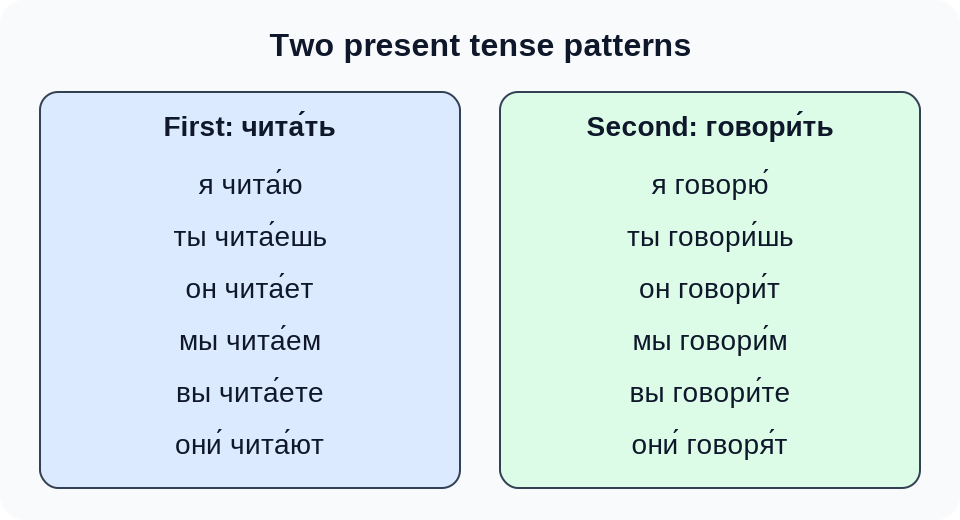
The pattern: чита́ть
Remove -ть, then add the endings.
| Person | Ending | Form |
|---|---|---|
| я | -ю | чита́ю |
| ты | -ешь | чита́ешь |
| он, она́ | -ет | чита́ет |
| мы | -ем | чита́ем |
| вы | -ете | чита́ете |
| они́ | -ют | чита́ют |
These verbs work the same way:
| Infinitive | Meaning | я | они́ |
|---|---|---|---|
| знать | to know | зна́ю | зна́ют |
| де́лать | to do, make | де́лаю | де́лают |
| рабо́тать | to work | рабо́таю | рабо́тают |
| ду́мать | to think | ду́маю | ду́мают |
| понима́ть | to understand | понима́ю | понима́ют |
| слу́шать | to listen | слу́шаю | слу́шают |
| игра́ть | to play | игра́ю | игра́ют |
| гуля́ть | to take a walk | гуля́ю | гуля́ют |
- Что ты де́лаешь? (What are you doing?)
- Я не понима́ю. (I don't understand.)
- Они́ рабо́тают в ба́нке. (They work at a bank.)
- Вы зна́ете, где метро́? (Do you know where the subway is?)
To make a verb negative, put не before it.
-у and -ут after many consonants
When the present stem ends in a consonant, you often see -у and -ут instead of -ю and -ют. When the ending is stressed, е becomes ё.
| Person | жить (to live) | идти́ (to go on foot) | писа́ть (to write) |
|---|---|---|---|
| я | живу́ | иду́ | пишу́ |
| ты | живёшь | идёшь | пи́шешь |
| он, она́ | живёт | идёт | пи́шет |
| мы | живём | идём | пи́шем |
| вы | живёте | идёте | пи́шете |
| они́ | живу́т | иду́т | пи́шут |
The stem of these verbs changes: жить gets a в, and писа́ть changes с to ш. Learn three forms of each new verb: the infinitive, the я form and the ты form. They usually let you build the rest.
More stem changes
| Infinitive | я | ты | они́ |
|---|---|---|---|
| е́хать (to go by vehicle) | е́ду | е́дешь | е́дут |
| пить (to drink) | пью | пьёшь | пьют |
| рисова́ть (to draw) | рису́ю | рису́ешь | рису́ют |
| танцева́ть (to dance) | танцу́ю | танцу́ешь | танцу́ют |
Verbs like рисова́ть drop -ова- or -ева- and use -у- in the present.
Verbs with -ся
Some verbs end in -ся. Often the action stays with the subject. Conjugate the verb as usual, then add -ся after a consonant or a soft sign, and -сь after a vowel.
| Person | занима́ться (to study, be busy with) |
|---|---|
| я | занима́юсь |
| ты | занима́ешься |
| он, она́ | занима́ется |
| мы | занима́емся |
| вы | занима́етесь |
| они́ | занима́ются |
Pronouns can sometimes drop
The ending already shows the person, so in conversation people sometimes leave out the pronoun: Понима́ю. (I understand.) As a beginner, keeping the pronoun is a good habit.
Worked example: build a verb from two forms
You meet a new verb: отдыха́ть (to rest). Here is how to build all six forms.
- Remove -ть: you have отдыха-.
- The verb follows the чита́ть pattern. Add -ю for я: отдыха́ю.
- Add -ешь for ты: отдыха́ешь.
- Continue: отдыха́ет, отдыха́ем, отдыха́ете, отдыха́ют.
Now try a verb with a changed stem. For писа́ть, removing -ть is not enough. You need пиш-. The first two forms, пишу́ and пи́шешь, show you both the new stem and the stress movement. That is why they are worth memorizing.
A day in the present tense
Read this short description aloud. Then change я to он and adjust each verb.
Я живу́ в Каза́ни. У́тром я пью чай и слу́шаю ра́дио. Пото́м я иду́ на рабо́ту. Я рабо́таю в музе́е. Ве́чером я отдыха́ю.
(I live in Kazan. In the morning I drink tea and listen to the radio. Then I walk to work. I work at a museum. In the evening I rest.)
With он, you get живёт, пьёт, слу́шает, идёт, рабо́тает and отдыха́ет. Notice how regular the changes are.
Questions with no extra words
Russian does not need a helper like "do". A statement becomes a yes-or-no question through your voice, or through a question mark in writing.
- Ты рабо́таешь. (You work.)
- Ты рабо́таешь? (Do you work?)
Raise your voice on the word you are asking about. To answer, you can repeat the verb: Да, рабо́таю. (Yes, I do.) or Нет, не рабо́таю. (No, I don't.)
Practice on your own
Cover the right column. Say each sentence, then compare.
| Say this in Russian | One good answer |
|---|---|
| We are listening. | Мы слу́шаем. |
| Do you understand? (polite) | Вы понима́ете? |
| They live in Moscow. | Они́ живу́т в Москве́. |
| I am writing a letter. | Я пишу́ письмо́. |
Afterwards, change the subject in each sentence and say it again.
Common mistakes
- Adding a word for "am". "I am reading" is just я чита́ю.
- Mixing up ты and вы endings: ты зна́ешь, вы зна́ете.
- Building "жи́ю" from жить. The correct form is живу́.
- Using вы forms with ты, or the other way around, in one conversation.
Try it
Check your understanding
Quick check · 4 questions
of 4 answered You scored / 4 · perfect!
-
1. Which ending goes with "ты" in the first conjugation?
Ты takes -ешь, or -ёшь when the ending is stressed. -
2. How do you say "We live"?
Жить has the stem жив-, and the stressed ending is -ём. -
3. "Они́ рису́ют" comes from which infinitive?
Verbs in -овать use -у- in the present tense. -
4. Which form is correct?
After a vowel, -ся becomes -сь.
Summary
- Russian has one present tense.
- Typical first conjugation endings are -ю, -ешь, -ет, -ем, -ете, -ют.
- Many consonant stems use -у and -ут, and stressed е becomes ё.
- Learn the я and ты forms of each new verb.
- Add -ся after consonants and -ь, and -сь after vowels.
Acompanhe seu progresso
Crie uma conta gratuita para marcar lições como concluídas e retomar de onde parou em qualquer dispositivo.