
























Lição 22 · Patient Safety and Mobility
Patient Safety Basics
Learn how errors happen in care, how identification checks and speaking up protect patients, and why a fair safety culture helps teams learn.
Patient safety means preventing avoidable harm to people during health care. Skilled and caring people can still make mistakes. Care is complex, people get tired, and information can be lost between shifts.
Good safety does not depend on anyone being perfect. It depends on habits and systems that catch problems early.
What you will learn
- How errors, near misses and harm differ
- Why identification checks matter
- How to speak up clearly
- What a fair safety culture looks like
Words you will meet
- A hazard is something that could cause harm, such as a wet floor.
- An error is a planned action that does not happen as intended, or the use of a wrong plan.
- A near miss is a problem that was caught, or happened by chance not to reach the person.
- An adverse event is harm linked to health care rather than only to the person's illness. Not every adverse event comes from an error.
Definitions vary between organizations. Learn the words your workplace uses.
Why mistakes happen
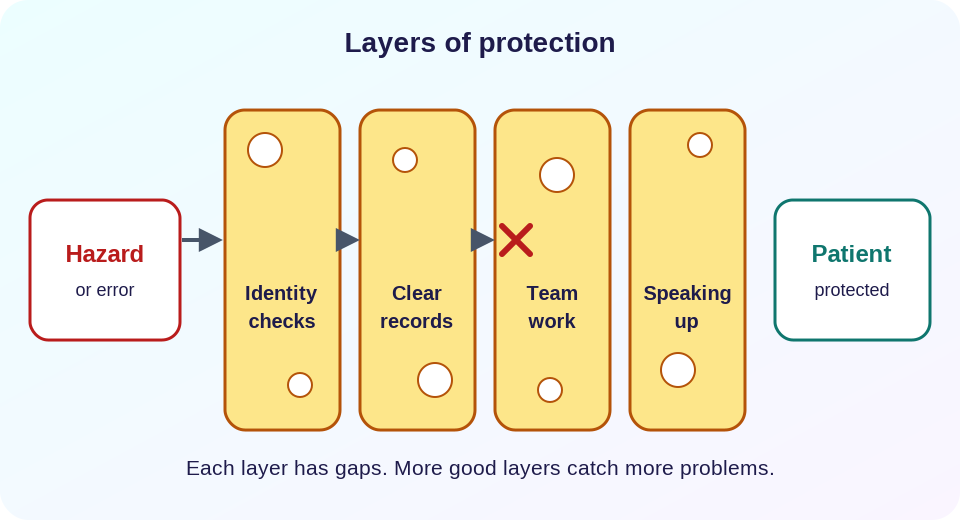
Common contributing factors include interruptions, tiredness, high workload, unclear writing or speech, similar-looking names or packaging, missing equipment, unfamiliar tasks and poor handoffs. One popular picture is the Swiss cheese model. Each layer of protection has gaps, like holes in slices of cheese. Harm happens when the gaps line up. More good layers, with fewer gaps, make this less likely.
Check identity
Wrong-person errors can affect tests, treatment, food and records. Many organizations require at least two identifiers, such as full name and date of birth, before care. A room or bed number should not be used as an identifier, because people move.
When possible, ask an open question: "Please tell me your full name and date of birth." Compare the answer with the identity band or record. Avoid "Are you Mr. Lee?" because a tired, confused or hard-of-hearing person may simply say yes. If a person cannot answer, or details do not match, follow your policy and tell the responsible nurse. Do not guess.
Allergies and alerts
Check for recorded allergies and other alerts before relevant care. An allergy can involve a medicine, a food, latex, adhesive or another substance. If a person tells you about an allergy that is not recorded, tell the responsible nurse promptly.
Work within your scope
Your scope of practice is what you are legally allowed and trained to do in your role. It differs by country, role and employer. If a task is new or outside your role, say so. "I have not been checked as competent to do that. Can someone show me, or can I help in another way?" is a safe and professional sentence.
Speaking up
If something seems wrong, say so, even if you are the most junior person. A simple structure helps:
- Say what you see: "I notice the name on this form does not match the wristband."
- Say your concern: "I am worried it may belong to another person."
- Ask for action: "Can we pause and check before going on?"
If the concern is not addressed and the person is at risk, take it higher, to the nurse in charge or another route your workplace provides. In an emergency, call for help using the local emergency system.
Patients and families as partners
People often know their own body and routine very well. Invite them to speak up: "Please tell us if anything seems different from what you expected." When a family member says, "She is not acting like herself", take it seriously and pass it on.
A fair safety culture
If people are punished for every honest mistake, they may hide problems, and the system never learns. A just culture tries to treat honest errors as chances to learn and improve, while still holding people responsible for reckless choices. After harm, organizations usually have processes for caring for the person, telling them honestly what happened and reviewing the event. Leave those steps to the authorized people, and follow local policy.
A worked example
A student is asked to take a meal tray to "bed 4". Before leaving it, the student asks the woman in bed 4 for her name and date of birth. The name does not match the tray card. The student takes the tray to the nurse. The nurse discovers that the patient moved rooms an hour earlier, and that the tray was meant for a person on a modified texture diet. This near miss shows that a bed number is not an identity check.
Interruptions
An interruption can make you forget a step. When you are doing a safety-critical task, finish it if you can, or stop at a clear point and restart your checks from the beginning when you return. Try not to interrupt coworkers during these tasks. If your workplace uses signs or quiet zones for this, respect them.
Common mistakes
- Asking a yes-or-no question to confirm identity.
- Using a shortcut because "we have always done it this way".
- Staying silent because someone senior seems sure.
- Not reporting a near miss because nobody was hurt.
Try it
Check your understanding
Quick check · 4 questions
of 4 answered You scored / 4 · perfect!
-
1. Which is the best way to confirm identity?
Open questions with at least two identifiers reduce wrong-person errors. -
2. What is a near miss?
Near misses reveal weak points before someone is harmed. -
3. You are asked to do a task you have not been trained for. What should you do?
Working within your scope and competence protects patients and you. -
4. What is a goal of a just culture?
A fair culture encourages reporting and still addresses reckless behavior.
Summary
- Safety relies on layers of protection and good habits.
- Check identity with at least two identifiers where your policy requires, never with a bed number.
- Work within your scope and speak up clearly.
- Report hazards and near misses so the team can learn.
Next: Preventing Falls
Acompanhe seu progresso
Crie uma conta gratuita para marcar lições como concluídas e retomar de onde parou em qualquer dispositivo.