
























Lição 15 · Basic Sentences and Particles
Korean Word Order
Learn Korean subject-object-verb word order, why the verb comes last, how particles mark words, and why subjects are often left out.
You know many phrases. Now you will start making your own sentences. The first step is to change where you expect the verb.
In English, you say "I drink water." In Korean, you say, in effect, "I water drink."
What you will learn
- The basic Korean sentence order
- Why the verb comes at the end
- What particles do
- How to ask questions and leave words out
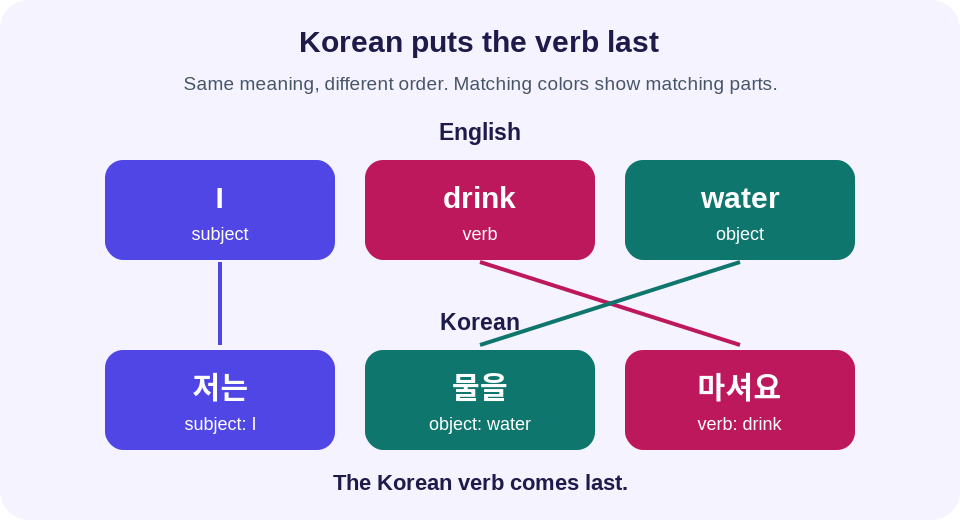
Subject, object, verb
The basic pattern is subject + object + verb.
| Subject | Object | Verb |
|---|---|---|
| 저는 (I) | 물을 (water) | 마셔요 (drink) |
| 민수는 (Minsu) | 책을 (a book) | 읽어요 (reads) |
| 동생이 (my younger sibling) | 빵을 (bread) | 먹어요 (eats) |
Words that describe states also come at the end. In Korean, words such as "to be big" work much like verbs. They do not need a separate "is."
- 집이 커요. The house is big.
- 날씨가 좋아요. The weather is good.
Particles are labels
A particle is a short marker attached after a noun. It shows the noun's job or adds meaning. There is no space between the noun and its particle.
| Particle | Basic job |
|---|---|
| 은 / 는 | topic |
| 이 / 가 | subject |
| 을 / 를 | object |
| 에 | to, in, at, on (place or time) |
| 에서 | at (where an action happens), from |
You will study each one in the next lessons. For now, notice that they travel with their nouns.
Flexible, but not free
Because particles label nouns, parts before the verb can sometimes move.
- 저는 오늘 커피를 마셔요.
- 오늘 저는 커피를 마셔요.
Both mean roughly "I am drinking coffee today." The focus feels slightly different. The verb normally stays last in standard writing. Keep the particle with its noun when you move it.
Describing words come first
A word that describes a noun comes before that noun.
| Korean | Meaning |
|---|---|
| 이 책 | this book |
| 새 가방 | a new bag |
| 큰 집 | a big house |
| 제 친구 | my friend |
Many time and manner words come before the verb:
- 지금 공부해요. I am studying now.
- 천천히 말해요. I speak slowly.
Verbs for practice
Treat these polite forms as whole words for now. A later chapter explains how to make them.
| Korean | Romanization | Meaning |
|---|---|---|
| 가요 | gayo | go |
| 와요 | wayo | come |
| 먹어요 | meogeoyo | eat |
| 마셔요 | masyeoyo | drink |
| 봐요 | bwayo | see, watch |
| 읽어요 | ilgeoyo | read |
| 사요 | sayo | buy |
| 공부해요 | gongbuhaeyo | study |
The same present form can often mean "I eat" or "I am eating." The context tells you which.
Leaving words out
Korean speakers often drop a subject or object when both people know it.
- A: 커피 마셔요? (Do you drink coffee?)
- B: 네, 마셔요. (Yes, I do.)
The answer contains only 네 and the verb. It is complete and natural.
In speech, some particles are also often dropped, as in 커피 마셔요? Learn the full forms first, so you can recognize what has been left out.
Questions keep the same order
You do not move words to make a question. In the polite 요 style, rise at the end.
| Statement | Question |
|---|---|
| 학교에 가요. I go to school. | 학교에 가요? Do you go to school? |
Question words often stay where the answer would go.
- 뭐 먹어요? What are you eating?
- 어디 가요? Where are you going?
- 누구를 만나요? Who are you meeting?
- 언제 와요? When are you coming?
Compare 빵을 먹어요 (I eat bread) with 뭐를 먹어요? (What do you eat?).
No articles
Korean has no words like "a" or "the." Nouns also do not need a plural mark. 책을 사요 can mean buying a book or books. The marker 들 can show a plural, but it is often left out.
Build a sentence step by step
Start with only the verb and add one piece at a time.
| Step | Korean | Meaning |
|---|---|---|
| 1 | 마셔요. | (I) drink. |
| 2 | 커피를 마셔요. | (I) drink coffee. |
| 3 | 아침에 커피를 마셔요. | (I) drink coffee in the morning. |
| 4 | 저는 아침에 커피를 마셔요. | As for me, I drink coffee in the morning. |
Notice that the verb never moves. Each new piece goes in front of it. This is a good way to speak when you are unsure: choose your verb first in your head, then add the other parts before it.
Reading from the end
When you read a long Korean sentence, look at the last word early. It tells you the action or state, and whether the sentence is a statement or a question. Then go back and use the particles to find who did it and to what. With practice you will hold the earlier pieces in your memory until the verb arrives.
Say it three ways
Take one short sentence, such as 저는 책을 읽어요. Say it as a statement. Say it as a question with a rising voice. Then answer the question with 네 and the verb only: 네, 읽어요.
Do the same with two more sentences from this lesson. Keep the verb at the end each time, and notice that the question needs no new word order.
Common mistakes
Do not put the verb in the English position. In careful speech, say 저는 물을 마셔요, with the verb last. Do not put a particle before its noun. And do not search for a Korean word for every English "a," "the" or "is."
Try it
Check your understanding
Quick check · 4 questions
of 4 answered You scored / 4 · perfect!
-
1. What is the basic Korean word order?
The verb comes at the end. -
2. Where does a particle go?
Particles follow nouns directly. -
3. How do you ask Do you go to school in the 요 style?
The word order stays the same. -
4. Which statement is true?
Known information is often left out.
Summary
- Basic order is subject, object, verb.
- Particles follow nouns and show their roles.
- Describing words come before what they describe.
- Questions keep the same order, and clear information can be left out.
Acompanhe seu progresso
Crie uma conta gratuita para marcar lições como concluídas e retomar de onde parou em qualquer dispositivo.