
























Lição 20 · Syllables and Word Stress
Syllables in English: the beats inside words
Learn what a syllable is, how to count syllables by sound instead of spelling, and when -ed and -s endings add an extra beat to an English word.
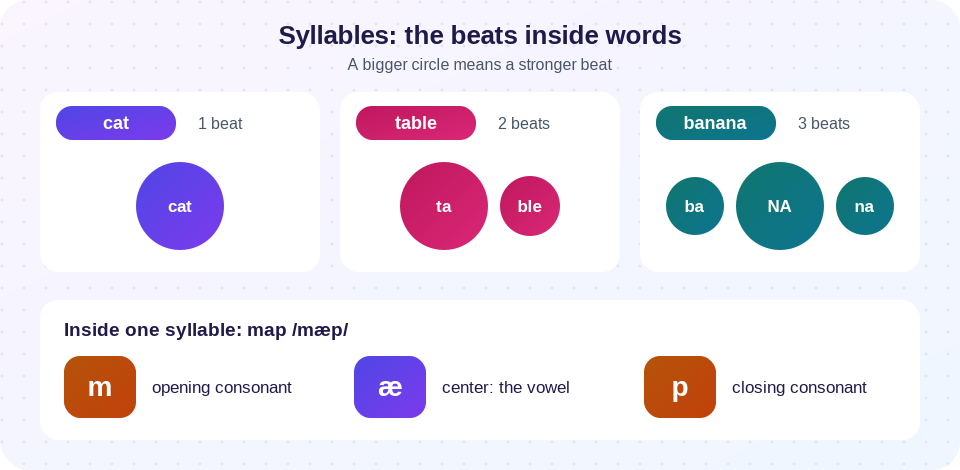
When you say an English word, your voice moves in small pulses. "Cat" has one pulse. "Table" has two. "Banana" has three. Each pulse is a syllable, and syllables are the building blocks of stress and rhythm, the two things that make speech easy to follow.
This matters because many learners count syllables from the spelling. English spelling often has more vowel letters, or fewer, than the spoken word has beats. If you add or drop a beat, listeners may struggle to recognize a word even when every single sound is nearly right.
What you will learn
- What a syllable is and what goes inside it
- How to count syllables by sound
- When the endings -ed and -s add a syllable
- Why some words lose a syllable in everyday speech
- How to avoid adding extra vowels around consonant groups
What is inside a syllable
A syllable has a center, usually a vowel sound. Consonants may come before it, after it, both or neither.
| Pattern | Word | Sounds | Notes |
|---|---|---|---|
| vowel only | eye | /aɪ/ | no consonants at all |
| consonant + vowel | go | /ɡəʊ/ | one consonant first |
| vowel + consonant | at | /æt/ | one consonant last |
| consonant + vowel + consonant | map | /mæp/ | the most familiar shape |
| consonant groups | strengths | /streŋθs/ | three before the vowel, three after |
The IPA in this chapter mostly follows a southern British model. American speakers use some different vowels, for example /ɡoʊ/ for "go". The number of syllables is usually the same.
A few syllables are built around a consonant instead. At the end of "button" or "little", many speakers go straight from one consonant into /n/ or /l/ with no clear vowel. These are syllabic consonants. You may see "little" written /ˈlɪtəl/ or /ˈlɪtl̩/. Both show two syllables.
Count sounds, not letters
Count the vowel sounds you say. A two-letter vowel spelling is often one sound, and a final silent "e" is usually no sound at all.
| Word | Vowel letters | Syllables | Why |
|---|---|---|---|
| make | 2 | 1 | the final e is silent |
| boat | 2 | 1 | "oa" spells one vowel sound |
| queue | 4 | 1 | the whole word is /kjuː/ |
| idea | 3 | 2 or 3 | speakers differ in how they join the last vowels |
| create | 3 | 2 | cre-ate |
| rhythm | 0 | 2 | /ˈrɪðəm/, with y as the first vowel |
A diphthong, such as the vowel in "my" or "boy", glides from one position to another but counts as one syllable.
A simple test is to hum the word with your mouth closed, one hum for each beat. Clapping or tapping a finger also works. If you are not sure, a dictionary that shows IPA often marks syllable breaks with dots.
Endings that add a beat
The -ed ending
The past ending -ed adds a new syllable only when the base verb ends in the sound /t/ or /d/.
| Base | Past | Extra syllable? |
|---|---|---|
| want | wanted /ˈwɒntɪd/ | yes |
| need | needed /ˈniːdɪd/ | yes |
| walk | walked /wɔːkt/ | no |
| play | played /pleɪd/ | no |
| watch | watched /wɒtʃt/ | no |
So "walked" is one beat. Saying "walk-ed" with two beats is one of the most common errors. Some adjectives are exceptions, such as "naked", "wicked" and "a learned professor", where the ending is a full syllable.
The -s and -es ending
Plurals, third person verbs and possessives add a syllable after the hissing and buzzing sounds /s, z, ʃ, ʒ, tʃ, dʒ/.
- bus, buses /ˈbʌsɪz/: two beats
- wish, wishes /ˈwɪʃɪz/: two beats
- page, pages /ˈpeɪdʒɪz/: two beats
- cat, cats /kæts/: still one beat
- make, makes /meɪks/: still one beat
Words that shrink
Some common words are usually said with fewer syllables than the spelling suggests, because a weak vowel disappears.
| Word | Common spoken form | Syllables |
|---|---|---|
| every | /ˈevri/ | 2 |
| chocolate | /ˈtʃɒklət/ | 2 |
| different | /ˈdɪfrənt/ | 2 |
| interesting | /ˈɪntrəstɪŋ/ | 3 |
| vegetable | /ˈvedʒtəbəl/ | 3 |
You will also hear longer versions of some of these words, especially in slow, careful speech. Other words, such as "fire", "hour" and "real", sit on a border: some speakers say one syllable and others two.
Consonant groups without extra vowels
Many languages do not allow long groups of consonants. Speakers may then add a small vowel, which creates a new syllable. "School" becomes "es-cool", "street" becomes "su-to-reet", or "asked" becomes "as-ked".
To practice, stretch the first sound and move straight into the next one. For "street", hold /sssss/ and then add "treet" without opening your mouth for a vowel in between. For final groups, build backward: "k", "sk", then "ask". It is also a mistake to drop all the final consonants, because "guess" and "guest" then sound the same. Some simplification is normal in fluent speech, as you will see in dropping sounds in connected speech.
Common mistakes
- Giving a silent "e" its own beat, as in "tim-e" for "time".
- Saying every -ed as a separate syllable. "Stopped" has one beat.
- Adding a vowel before "sp", "st" or "sk" at the start of a word.
- Counting vowel letters and not vowel sounds.
Try it
First, decide how many syllables each word has. Say the word aloud before you choose.
Next, tap every verb whose past form gains a new syllable.
Check your understanding
Quick check · 4 questions
of 4 answered You scored / 4 · perfect!
-
1. What is usually at the center of a syllable?
A vowel sound forms the center, although /n/ or /l/ can sometimes do the job. -
2. Which past form has two syllables?
"Wait" ends in /t/, so -ed adds a syllable. -
3. Which plural adds a syllable?
"Box" ends in /s/, so the ending becomes a separate beat. -
4. How is "chocolate" often said?
A weak vowel usually disappears, giving /ˈtʃɒklət/.
Summary
- A syllable is one beat of speech, usually built around a vowel sound.
- Count the sounds you say, not the letters you see.
- -ed adds a syllable only after /t/ or /d/.
- -s and -es add a syllable after /s, z, ʃ, ʒ, tʃ, dʒ/.
- Some common words lose a weak syllable, and consonant groups need no extra vowels.
Acompanhe seu progresso
Crie uma conta gratuita para marcar lições como concluídas e retomar de onde parou em qualquer dispositivo.