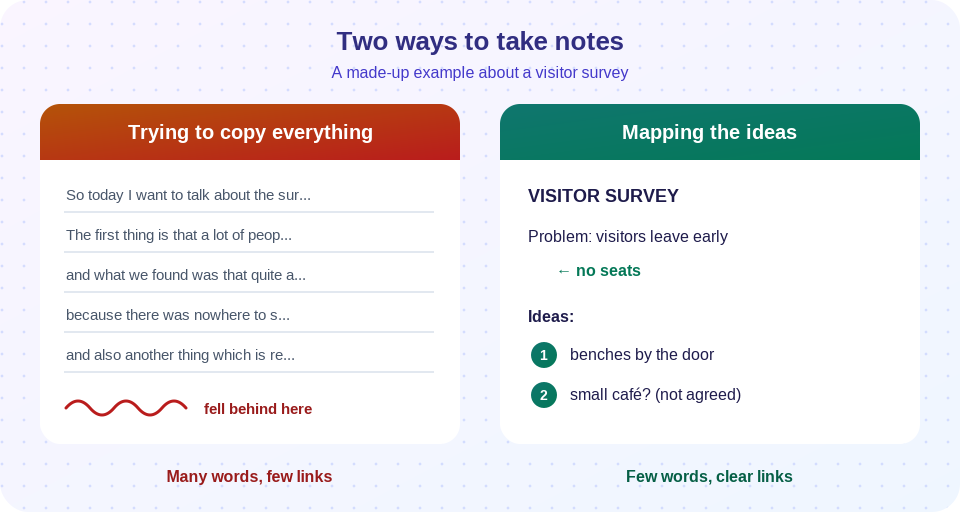
Start taking useful notes in English by choosing what matters, writing key words instead of sentences, and showing how ideas connect while you keep listening.
You cannot write as fast as most people speak. If you try to copy every word, you fall behind and stop thinking. Good notes are not a copy. They are a map of the ideas that you can use later.
This chapter shows what to write, how to write it fast, how to lay it out, and what to do afterward.
Short notes that show how ideas connect are easier to make and to use than half-copied sentences.
it is a name, number or date that you cannot work out later
it shows structure: "The second reason is..."
You can usually leave out greetings, fillers, jokes, and extra examples once you have the point. Keep one example if it helps you understand a hard idea.
"Next month the sports hall closes for two weeks, from the third to the sixteenth. The floor needs repair. Evening classes will move to the school gym, except yoga, which is canceled. If you've paid for yoga, you can ask for a refund."
TEXT
Sports hall CLOSED 3rd–16th next month (floor repair)
- eve classes → school gym
- EXCEPT yoga = canceled
  paid? → can ask refund
The notes keep "except", and "can ask". They do not claim that the refund is automatic.
Both can work. Paper makes drawing arrows and symbols easy. A device makes searching and sharing easy, and a fast typist may be tempted to copy every word. Try both with the same kind of material and see which notes you can use better a day later. Before you record anyone, ask for permission and follow the rules that apply.
Do not start with a long lecture. Start with thirty seconds of clear speech and write only after you pause the recording. When that feels easy, write while it plays. Then use longer clips. After each round, explain your notes aloud. If you cannot, decide whether you wrote too little, too much, or words with no links between them.
Copying slides or sentences without thinking.Dropping "not" or "may".Filling every space, so there is no room to add. Spending so long on one line that you miss the next point.
<!doctypehtml><htmllang="en"><head><metacharset="utf-8"><style>body{margin:0;padding:14px;font-family:system-ui,sans-serif;color:#1e1b4b;background:linear-gradient(135deg,#faf5ff,#eff6ff)}.card{background:#fff;border-radius:14px;padding:12px 14px;margin-bottom:10px;box-shadow:0 4px 14px rgba(67,56,202,.12)}button{font:inherit;border:1px solid #c7d2fe;background:#eef2ff;color:#1e1b4b;border-radius:10px;padding:6px 12px;margin:4px 6px 0 0;cursor:pointer}button.go{background:#4f46e5;color:#fff;border:0}button.ok{background:#d1fae5;color:#064e3b;border-color:#10b981}button.no{background:#fee2e2;color:#7f1d1d;border-color:#ef4444}input{font:inherit;border:2px solid #c7d2fe;border-radius:8px;padding:3px 8px;width:9em;max-width:100%}input.ok{border-color:#10b981;background:#ecfdf5}input.no{border-color:#ef4444;background:#fef2f2}.why{color:#475569;margin:8px 0 0}p{line-height:1.55;margin:4px 0}</style></head><body><divid="app"></div><pid="total">Pick an answer in each card.</p><script>const items =[{"q":"Heard: \"The new system may save time, but it has not been tested yet.\"","o":["new system: may save time BUT not tested","new system saves time, tested","the new system may save time but it has not"],"a":0,"why":"It is short and keeps both \"may\" and \"not\"."},{"q":"Heard: \"Send your form by Friday, not Monday as we said before.\"","o":["send form Mon or Fri","we said something about forms before","form due FRI (not Mon)"],"a":2,"why":"The correct deadline is clear."},{"q":"Heard: \"There are two reasons. One is cost and the other is safety.\"","o":["2 reasons: 1 cost, 2 safety","reasons are important","cost safety two one other"],"a":0,"why":"The numbering shows the structure."},{"q":"You miss a name during a talk. What should you write?","o":["A guessed name written as fact","A mark such as ?? with a space","Nothing, and stop taking notes"],"a":1,"why":"The mark reminds you to check without making up information."}];functionel(tag, text, parent, cls){const node = document.createElement(tag);if(text) node.textContent = text;if(cls) node.className = cls;
parent.appendChild(node);return node;}const app = document.getElementById('app');const total = document.getElementById('total');let done =0, right =0;
items.forEach(function(item, n){const card =el('div','', app,'card');el('p',(n +1)+'. '+ item.q, card);const buttons = item.o.map(function(label){returnel('button', label, card);});const why =el('p','', card,'why');let answered =false;
buttons.forEach(function(b, i){
b.onclick=function(){if(answered)return;
answered =true;
done++;const match = i === item.a;if(match) right++;else b.className ='no';
buttons[item.a].className ='ok';
why.textContent =(match ?'Yes. ':'Not this one. ')+ item.why;
total.textContent ='Matched the answer key: '+ right +' of '+ done +' answered.';};});});</script></body></html>
Now take notes under time pressure. Write on paper before the text hides, then use your notes to answer.
Note it before it hides
<!doctypehtml><htmllang="en"><head><metacharset="utf-8"><style>body{margin:0;padding:14px;font-family:system-ui,sans-serif;color:#1e1b4b;background:linear-gradient(135deg,#faf5ff,#eff6ff)}.card{background:#fff;border-radius:14px;padding:12px 14px;margin-bottom:10px;box-shadow:0 4px 14px rgba(67,56,202,.12)}button{font:inherit;border:1px solid #c7d2fe;background:#eef2ff;color:#1e1b4b;border-radius:10px;padding:6px 12px;margin:4px 6px 0 0;cursor:pointer}button.go{background:#4f46e5;color:#fff;border:0}button.ok{background:#d1fae5;color:#064e3b;border-color:#10b981}button.no{background:#fee2e2;color:#7f1d1d;border-color:#ef4444}input{font:inherit;border:2px solid #c7d2fe;border-radius:8px;padding:3px 8px;width:9em;max-width:100%}input.ok{border-color:#10b981;background:#ecfdf5}input.no{border-color:#ef4444;background:#fef2f2}.why{color:#475569;margin:8px 0 0}p{line-height:1.55;margin:4px 0}</style></head><body><divclass="card"id="intro"><p>You have 40 seconds to see the text. Then it hides and the questions appear.</p><buttonclass="go"id="start">Show the text</button></div><divclass="card"id="text"hidden><p>The Saturday cleanup starts at nine at the north gate of the park. Gloves and bags are provided, but bring your own water.</p><p>Children under twelve may join only with an adult. If there is heavy rain, the event moves to the following Saturday.</p><pid="clock"class="why"></p><buttonid="skip">I have finished</button></div><divid="app"hidden></div><pid="total"></p><script>const items =[{"q":"Where does the event start?","o":["At the south gate","At the north gate","In the car park"],"a":1,"why":"The first sentence names the north gate."},{"q":"What must people bring?","o":["Gloves","Bags","Water"],"a":2,"why":"Gloves and bags are provided."},{"q":"What is the rule for children under twelve?","o":["They may join only with an adult","They cannot join","They may come alone if it is dry"],"a":0,"why":"The word \"only\" sets the condition."},{"q":"What happens in heavy rain?","o":["The event is canceled for the year","It starts later the same day","It moves to the following Saturday"],"a":2,"why":"The last sentence gives the new date."}];functionel(tag, text, parent, cls){const node = document.createElement(tag);if(text) node.textContent = text;if(cls) node.className = cls;
parent.appendChild(node);return node;}const app = document.getElementById('app');const total = document.getElementById('total');let done =0, right =0;
items.forEach(function(item, n){const card =el('div','', app,'card');el('p',(n +1)+'. '+ item.q, card);const buttons = item.o.map(function(label){returnel('button', label, card);});const why =el('p','', card,'why');let answered =false;
buttons.forEach(function(b, i){
b.onclick=function(){if(answered)return;
answered =true;
done++;const match = i === item.a;if(match) right++;else b.className ='no';
buttons[item.a].className ='ok';
why.textContent =(match ?'Yes. ':'Not this one. ')+ item.why;
total.textContent ='Matched the answer key: '+ right +' of '+ done +' answered.';};});});const$=function(id){return document.getElementById(id);};let left =40, timer;functionfinish(){clearInterval(timer);$('text').hidden =true;$('app').hidden =false;}$('start').onclick=function(){$('intro').hidden =true;$('text').hidden =false;$('clock').textContent = left +' seconds left';
timer =setInterval(function(){
left--;$('clock').textContent = left +' seconds left';if(left <=0)finish();},1000);};$('skip').onclick = finish;</script></body></html>