
























Lekcja 32 · Mastering and Release
What Mastering Does
Learn what mastering can and cannot do, how to prepare a final mix, how to use reference tracks and a gentle chain, and when to ask another engineer.
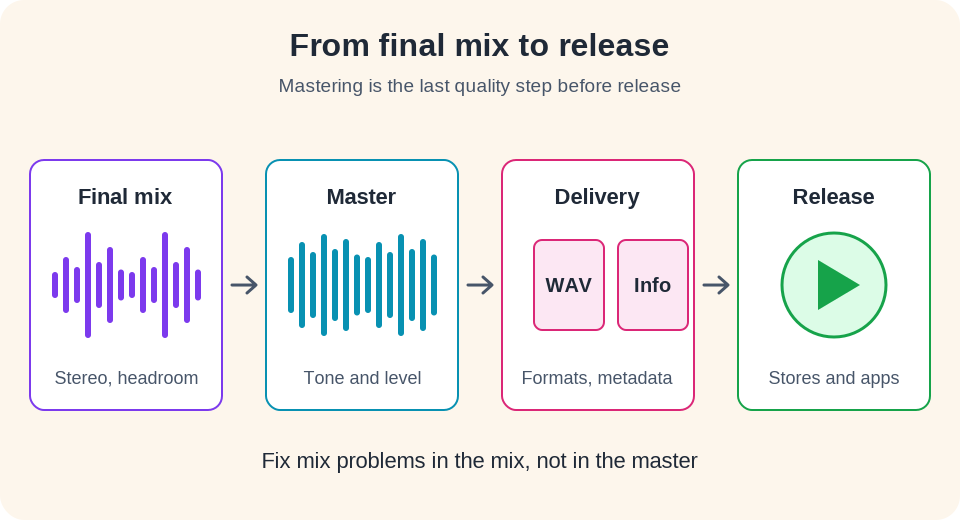
Mastering is the last stage of audio work before release. You take the finished mix, usually one stereo file, and prepare it for listeners. You also check that a group of songs works together.
Mastering is often described as mysterious. In practice, it is careful listening, small changes and good quality control.
What you will learn
- The goals of mastering
- What belongs in the mix instead
- How to export a mix for mastering
- A cautious approach to a mastering chain
The goals
- Tonal balance: gentle changes so the track is not much too dull, bright, boomy or thin.
- Dynamics and level: suitable loudness and controlled peaks.
- Consistency: songs on an EP or album should feel like they belong together.
- Translation: the track should work on many systems, such as headphones, car speakers and phones.
- Quality control: finding clicks, cut-off endings, unwanted noise and wrong files.
- Delivery: the right formats, track order, spacing and information.
What belongs in the mix
A master processes everything at once. If the vocal is too quiet, a mastering change will also affect other things in the same frequency range or at the same moments. If you have the mix project, go back and fix it there.
| Problem | Best place to fix |
|---|---|
| Lead vocal too quiet | Mix |
| Kick and bass fighting | Mix or arrangement |
| One cymbal too harsh | Mix |
| Whole track a bit dull | Mix or mastering |
| Songs on an EP differ in level | Mastering |
Exporting a mix for mastering
If another engineer will master your track, ask what they want. Common good practice:
- Export at the project sample rate. Do not convert upward just to get a bigger number.
- Use a high bit depth, such as 24-bit or 32-bit float.
- Use a lossless format, such as WAV or AIFF, not MP3.
- Avoid clipping. Leave some headroom.
- Remove any limiter on the master bus that is there only to make the mix loud. Keep processing that is an important part of the sound, and tell the engineer.
- Leave a little space before the start and after the end, so reverb tails are not cut off.
Listen to the exported file from start to end before you send it.
Your ears after a long mix
If you master your own song, you have heard it hundreds of times. That makes it hard to hear it fresh. Wait at least a day if you can. Then listen once without touching anything and take notes. Another engineer brings fresh ears, a different room and experience. That is a major reason to hire one for an important release.
Reference tracks
Choose a few finished songs in a similar style. Compare tonal balance, low end, width and dynamics. Match the loudness first, usually by turning the reference down. A released track is often much louder than your unfinished mix, and louder tends to seem better.
A gentle chain
There is no required chain. One possible order is:
- Corrective EQ, only if needed
- Gentle compression, only if needed
- Broad tone shaping
- A limiter at the end to control peaks and set level
Small changes matter more here than in a single track, because they affect everything. If you find yourself making large changes, check the mix again.
Meters help: level and loudness meters, a spectrum analyzer and a correlation meter. They give information, but they cannot judge whether the song feels right.
Albums and EPs
For a collection, listen to the songs in order. Check:
- Does one song jump out as much louder or much brighter?
- Do the gaps feel natural?
- Do fades and endings sound clean?
Not every song needs the same measured level. A quiet ballad may feel best a bit quieter than a loud dance track.
Automated mastering services can be a quick way to hear a possible result. Compare carefully at matched loudness, and read their terms before uploading unreleased music.
Worked example: listening notes
Before you add any processing, play your exported mix from start to end and write notes with times. For example:
- 0:00, the first sound starts very suddenly
- 0:48, the chorus feels harsher than the reference
- 2:10, a click in a quiet moment
- 3:05, the reverb tail stops too early
Now sort the notes. The click and the cut tail are quality control problems: go back to the project and export again. The harsh chorus may come from one part, so check the mix first. If the whole track is slightly harsher than your matched reference, a small change in mastering may be enough.
After processing, play the master from start to end again and check each note. Then compare it with the unprocessed mix at matched loudness. If you cannot say why the master is better, reduce the processing. Doing very little can be the right result for a mix that already works.
Common mistakes
- Trying to repair a weak mix with heavy master processing.
- Comparing your master with references without matching loudness.
- Sending a clipped or lossy file to a mastering engineer.
- Skipping a full listen to the final file.
Try it
Sort each problem: should you fix it in the mix, or can it reasonably be handled in mastering?
Check your understanding
Quick check · 4 questions
of 4 answered You scored / 4 · perfect!
-
1. The lead vocal is too quiet and you have the project. What should you do?
In the mix you can change the vocal without changing everything else. -
2. Which file is a good choice to send for mastering?
Lossless files with headroom give the engineer the best material. -
3. What should you do before comparing with a reference track?
Matched loudness gives a fair comparison. -
4. Which is part of mastering an EP?
Consistency across songs is a key mastering goal.
Summary
- Mastering prepares the final mix for listeners and delivery.
- Fix mix problems in the mix.
- Export lossless files with headroom and complete endings.
- Compare at matched loudness and use gentle changes.
Śledź swoje postępy
Załóż darmowe konto, aby odhaczać lekcje i wracać do miejsca, w którym skończyłeś, na dowolnym urządzeniu.