
























Lekcja 33 · Projects and Practice
Critique and Feedback
Give and receive useful design critique: set the goal, describe before you judge, link comments to the brief, rank problems and turn notes into a revision plan.
Every designer misses things. After hours with a layout, you know what it should say, so you stop seeing what it really shows. Critique is a focused discussion about how well a design meets its goal. It is a skill that you can practice.
What you will learn
- How critique differs from opinion
- A simple structure for giving feedback
- How to ask for and receive feedback
- How to turn notes into a plan
Opinion and critique
"I don't like the green" is an opinion. It may be honest, but it does not help much. A critique comment connects an observation to an effect and a goal:
"The date is in pale green on cream. I almost missed it. For a poster about one event, the date needs to be easy to find."
Now the designer knows what you saw, what happened and why it matters. The designer can then choose how to fix it.
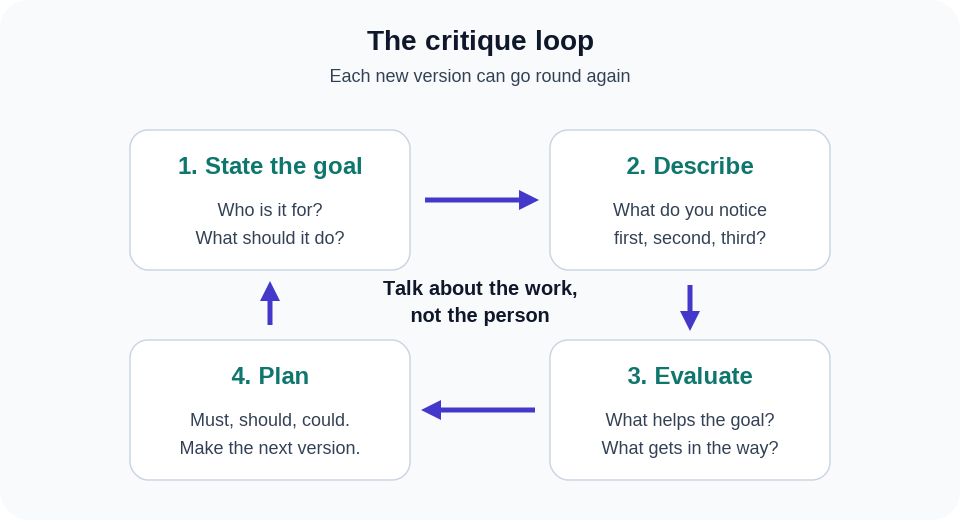
A simple structure
- Goal. What is the piece for? Who will see it, where and for how long?
- Describe. What do you notice first, second and third? Do not judge yet.
- Evaluate. What works for the goal? What gets in the way?
- Suggest or ask. Offer a possible direction, or ask a question.
The first-glance test
Show the design for a few seconds, then hide it. Ask:
- What do you remember?
- What do you think it is about?
- What would you do next?
If viewers remember a decoration but not the event, the hierarchy needs work. This quick test works only with people who have not seen the design before.
Asking for feedback
When you share work, give context and a focus:
- "This is an A3 poster seen in a hallway."
- "The goal is to get people to sign up."
- "I need feedback on hierarchy and readability. The photo is final."
Choose the right moment. Early, ask about ideas and structure. Late, ask about details and errors.
Receiving feedback
- Listen fully before you reply.
- Take notes in the person's own words.
- Ask questions: "Where did you look first?"
- Do not explain the design away. Real viewers will not have your explanation.
- Remember that the comment is about the work, not about your worth.
You do not have to follow every suggestion. People often suggest a solution when the real value is the problem they noticed. "Make the logo bigger" might mean "I couldn't tell who is organizing this."
Giving feedback kindly
- Name specific strengths, so they are kept.
- Be honest about problems, and talk about the effect.
- Focus on the most important issues first.
- Use "I noticed" and "I expected".
- Do not redesign the whole piece in your own style.
Sorting the notes
After a critique, rank each note:
| Priority | Meaning | Example |
|---|---|---|
| Must fix | Blocks the goal or is wrong | Wrong date, unreadable text |
| Should fix | Weakens the result | Uneven alignment |
| Could try | Taste or a possible improvement | A different accent color |
Fix the must-fix items first. If two notes conflict, return to the brief and the audience. If needed, test both options.
A worked example
A flyer for a free language exchange gets these comments:
- "I like the speech bubbles."
- "I didn't know it was free."
- "The address is hard to read over the photo."
- "Maybe use blue."
The designer keeps the speech bubbles. "Free" moves near the headline: the goal is attendance, and price is likely to matter, so this is a must-fix. The address moves to a solid panel, also a must-fix. "Maybe use blue" goes into "could try", because no problem was named.
Self-critique
When nobody is available:
- Step away, then return later.
- View the design very small.
- Flip it horizontally to check balance. The text will be unreadable, which helps you see shapes.
- Print it and view it from the real distance.
- Read all text aloud to find errors.
- Compare it with the brief, point by point.
Running a group critique
A short structure keeps a group useful and fair:
- The designer states the goal and the focus in about a minute.
- Everyone looks quietly and writes notes first, so the first speaker does not shape all opinions.
- People describe what they notice.
- People name what works, and then what gets in the way.
- The designer asks follow-up questions.
- Someone sums up the main problems.
Agree on a time limit. If the talk moves to personal taste, bring it back to the audience and the goal. Invite quieter people to share, but do not force anyone.
Rewriting weak comments
| Weak comment | Stronger comment |
|---|---|
| "Too busy." | "I saw five bright items at once and did not know where to start." |
| "It looks old." | "The effects feel heavy for an audience that expects a calm, clear service." |
| "Great job!" | "The large date and open space made the schedule easy to find." |
| "Change the font." | "The small thin letters were hard for me to read on a phone." |
Practice this with your own comments. Each stronger version names something visible and says what happened to the viewer.
Common mistakes
- Asking only "What do you think?" You may get vague answers.
- Defending every choice. You lose the information you asked for.
- Treating all notes as equal. Rank them by their effect on the goal.
- Judging the designer. Talk about the work and its effect.
Try it
Choose the most useful comment in each situation.
Check your understanding
Quick check · 4 questions
of 4 answered You scored / 4 · perfect!
-
1. What makes a comment useful critique?
Linking what you saw to the goal gives the designer something to act on. -
2. What should you do before evaluating?
Description shows how the design really reads before judgment starts. -
3. A viewer suggests a specific fix. What is often most valuable?
The suggestion points to a problem that you may solve in a better way. -
4. Which note is most likely a must-fix?
Wrong information blocks the purpose of the design.
Summary
- Critique measures a design against its goal.
- Describe first, then evaluate and suggest.
- Share context and focus when you ask.
- Look for the problem behind each suggestion.
- Rank notes and fix what blocks the goal first.
Śledź swoje postępy
Załóż darmowe konto, aby odhaczać lekcje i wracać do miejsca, w którym skończyłeś, na dowolnym urządzeniu.