
























Lekcja 7 · Word Building
Roots, Prefixes and Suffixes
Break English words into prefixes, base words, roots and suffixes so you can work out meanings, spot patterns and learn new words faster.
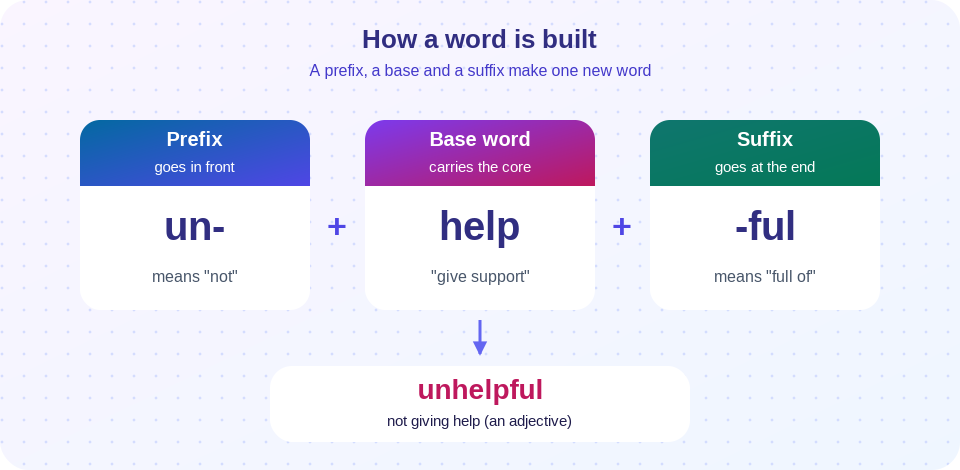
Many long English words are made of smaller pieces. Once you know the pieces, a long word looks less frightening. Unhelpful is not a new puzzle. It is un- plus help plus -ful.
Word building will not explain every word, but it gives you a strong tool for guessing and remembering.
What you will learn
- what a base word, a root, a prefix and a suffix are
- how the pieces combine
- some common roots that come from Latin and Greek
- why word parts can sometimes mislead you
The building blocks
| Part | Where it goes | What it often does | Example |
|---|---|---|---|
| prefix | before | changes the meaning | rewrite, unhappy |
| base word | the middle | a word that works by itself | write, happy |
| suffix | after | often changes the word class | happy → happiness |
| root | the core | carries meaning but may not stand alone | struct in structure |
A base word is a complete English word, such as help. A root is a core piece that often cannot stand alone in modern English, such as spect ("look") in inspect.
Start with the base
Add a suffix
Add a prefix
Add another suffix
Each step builds on the one before.
Splitting a word: worked examples
disagreement = dis- (not, opposite) + agree + -ment (makes a noun). Meaning: a state of not agreeing.
preview = pre- (before) + view. Meaning: a look at something before it is generally shown.
careless = care + -less (without). Meaning: without care.
rebuilding = re- (again) + build + -ing.
Common roots
These roots appear in many English words. Their meanings are a starting point, not a fixed rule.
| Root | Rough meaning | Examples |
|---|---|---|
| port | carry | transport, portable |
| spect | look | inspect, spectator |
| dict | say | predict, dictate |
| struct | build | structure, construct |
| scrib or script | write | describe, manuscript |
| vis or vid | see | visible, video |
| aud | hear | audience, audio |
| bio | life | biology, biography |
| graph | write or record | photograph, biography |
| tele | far | telephone, television |
Combine them: bio (life) + graphy (writing) gives biography, the written story of a person's life. Port (carry) + -able (can be done) gives portable: easy to carry.
Spelling changes at the joins
Sometimes the spelling changes when parts meet.
- happy + -ness = happiness (the y becomes i)
- make + -ing = making (the silent e is dropped)
- run + -er = runner (the final consonant is doubled)
- in- + possible = impossible (the n changes to m before p)
The next two lessons study prefixes and suffixes in detail.
From one root to many words
One root can open a whole group of words. Take port, "carry."
- To transport goods is to carry them from one place to another. The prefix trans- means across.
- To import goods is to bring them into a country. To export them is to send them out.
- A portable heater is one you can carry around.
- A porter is a person whose job is to carry bags.
Now try spect, "look." To inspect a car is to look at it carefully. A spectator watches a game. A spectacle is an impressive sight. You do not need to know Latin to use this. You only need to notice the shared piece and the shared idea.
Be careful with look-alikes. Sport and portrait contain the letters port, but you cannot explain them with "carry" in modern English. The letters alone are not proof. A useful test is to ask whether the meaning of the part really fits the meaning of the whole word.
A small routine for long words
- Underline any prefix you recognize.
- Circle the suffix, if there is one.
- Look at what is left. Do you know it as a word or a root?
- Put the meanings together in plain English.
- Check the sentence. Does your meaning fit?
Try it with unpredictable: un- (not), predict (say before it happens, from pre- and dict) and -able (can be done). The result is "not able to be predicted." In a sentence such as "The weather here is unpredictable," that meaning fits well.
When parts mislead
Word history can surprise you. Understand does not mean "stand under" in modern English. Some words only look as if they have a prefix: the re in real and the un in uncle are not prefixes. Treat word parts as clues, then check the meaning.
When you meet a new long word, cover the ends and find the middle first. Ask what the base or root means, then add the prefix, then the suffix.
A strategy you can use tomorrow
When you read, choose one long word per page. Split it, guess the meaning, then check a dictionary. If your guess was close, note the pattern in your word notebook. If it was not, write down why. Maybe the word had changed its meaning over time, or maybe one part was not really a prefix.
Common mistakes
Seeing a prefix that is not there, as in uncle. Assuming one meaning for a root in every word. Meanings drift over time. Forgetting spelling changes, so you write happyness or makeing.
Try it
Choose the meaning of each word from its parts.
This tool splits words using a short list of parts that you give it. It is a simple teaching aid, not a real dictionary, and it will not work for every word.
Press Run (or Ctrl + Enter) to see the console output here.
No output.
Notice what happens to uncle and reading. A machine rule can guess wrong, so your judgment still matters.
Check your understanding
Quick check · 4 questions
of 4 answered You scored / 4 · perfect!
-
1. Which part comes before the base word?
A prefix goes at the start of a word. -
2. What does the suffix -less usually mean?
Careless means without care. -
3. Which root means 'look'?
Spect appears in inspect and spectator. -
4. Which spelling is correct?
The y changes to i before -ness.
Summary
- Prefixes go before the base, and suffixes go after it.
- A root carries meaning but may not stand alone.
- Spelling often changes where parts join.
- Word parts are strong clues, but check the meaning.
Śledź swoje postępy
Załóż darmowe konto, aby odhaczać lekcje i wracać do miejsca, w którym skończyłeś, na dowolnym urządzeniu.