
























Lekcja 1 · Sounds and the Phonetic Alphabet
English Pronunciation: Your Course Map
See how this English pronunciation course is built, which accents it describes, how to practice on your own, and what to learn first, second and third.
You can know thousands of English words and still be asked to repeat yourself. Often the reason is not grammar or vocabulary. It is one vowel that sounds like another, a stress on the wrong syllable, or a consonant that disappears at the end of a word.
This course teaches you how English sounds work, one piece at a time. You learn what your mouth does, how to write sounds down, and how to practice so that listeners understand you more easily.
What you will learn
- What the goal of pronunciation practice is
- How the chapters of this course fit together
- Which accents the examples describe
- A simple practice routine that you can repeat
- What this website can and cannot do for you
The goal is to be understood
You do not need to sound like you were born in London or Chicago. Huge numbers of people speak English clearly with an accent from somewhere else. A good goal is intelligibility: listeners understand your words without extra effort.
Some features matter more for intelligibility than others. Compare these problems:
| Problem | Example | What a listener may notice |
|---|---|---|
| Two vowels sound the same | "sheep" said like "ship" | A different word |
| A final consonant is dropped | "card" said like "car" | A different word |
| Stress moves | "hoTEL" said as "HOtel" | A word that takes time to recognize |
| A different kind of r | a tapped or rolled r in "red" | Usually the same word, with an accent |
The first three can change or hide a word. The last one usually only tells people where you might be from. Spend most of your energy on differences that affect meaning.
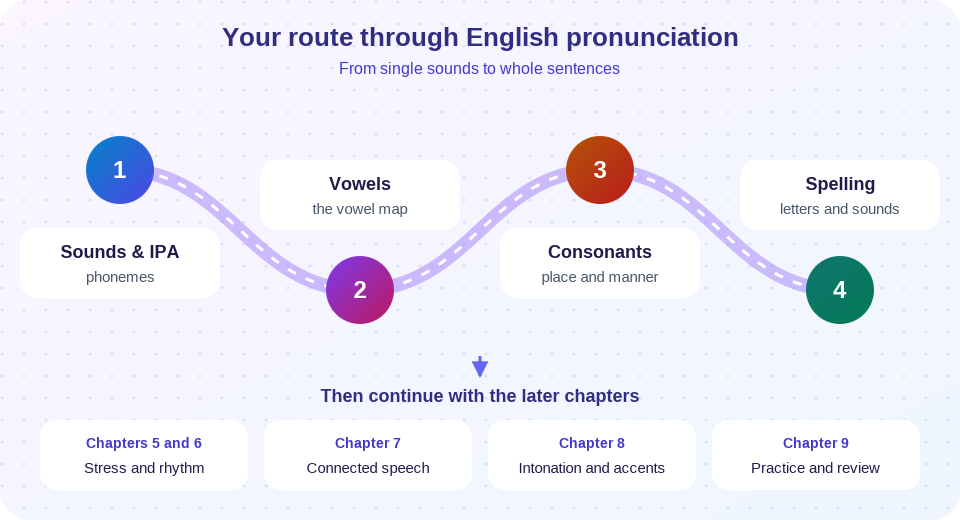
The path through the course
The course goes from small units to large ones.
| Chapter | Topic | The question it answers |
|---|---|---|
| 1 | Sounds and the phonetic alphabet | How can I name and write a sound? |
| 2 | Vowel sounds | What are the differences between English vowels? |
| 3 | Consonant sounds | Where and how is each consonant made? |
| 4 | Spelling and sound | Why does spelling mislead me? |
| 5 | Syllables and word stress | Which part of a word is strong? |
| 6 | Sentence stress and rhythm | Which words are strong and which are weak? |
| 7 | Connected speech | Why does fast speech sound so different? |
| 8 | Intonation and accents | What does the melody of my voice say? |
| 9 | Practice and review | How do I put it all together? |
After this page, read Sounds, Phonemes and Minimal Pairs. Then the phonetic alphabet gives you symbols that you will meet in the later lessons.
Which accents do the examples use?
English has many accents, and none of them is the only correct one. To keep lessons clear, this course describes two widely taught reference accents:
- Southern British English, often shown in British dictionaries. You may see it called RP or Standard Southern British. We write BrE for short.
- General American English, a broad label for common American speech without strong regional features. We write AmE.
When the two differ in an important way, the lesson says so. For example, many BrE speakers do not pronounce the "r" in "car", while most AmE speakers do. Pick one model as your main target and learn to understand both. A mix of a few features is common among learners and usually causes no problems.
How to practice
Reading about a sound does not change how you say it. Your mouth needs repetition. Use this short loop:
- Notice. Learn what makes the sound different from its neighbor.
- Listen. Find the word in a dictionary with audio, or ask a clear speaker.
- Say it slowly. Watch your lips in a mirror or your phone camera.
- Put it in a phrase. Move from "sheep" to "three white sheep".
- Record and compare. Use your phone's recorder. Play your version next to a model.
Short, regular sessions are easier to keep up than one long session once in a while. Ten focused minutes is a good size to start with.
This website cannot hear you, grade you or score your pronunciation. The exercises check only what you click and type. To check your speaking, record yourself or ask a teacher or a patient friend. This is an independent tutorial.
Worked example: planning one week
Suppose Mina often hears "Sorry, did you say live or leave?" Her target is the vowel difference in "live" and "leave". Her week could look like this:
| Day | Task (about 10 minutes) |
|---|---|
| 1 | Read the lesson on front vowels. Learn the two mouth positions. |
| 2 | Listen to five word pairs in a dictionary and repeat each one. |
| 3 | Say the pairs in short sentences. |
| 4 | Record ten sentences. Mark the ones that sound unclear. |
| 5 | Say one word of a pair to a friend. The friend points to the word they heard. |
Day 5 is a strong test, because the listener does not know which word she chose.
Common mistakes
- Trying to fix every sound at once. Choose one or two targets.
- Trusting spelling. The letters "ea" sound different in "heat", "head" and "great".
- Practicing only single words. Sounds can change inside sentences.
- Only listening. You also need to say the sound and compare.
Try it
Choose the best advice in each situation.
Check your understanding
Quick check · 4 questions
of 4 answered You scored / 4 · perfect!
-
1. What is a useful main goal for most learners?
Clear, intelligible speech is the practical goal. -
2. Which problem is most likely to change the meaning of a word?
When two vowels merge, listeners may hear another word. -
3. What do the reference accents in this course do?
They are models for explanation, and other accents are valid. -
4. What can the exercises on this site check?
The site cannot hear you.
Summary
- Aim to be easy to understand. You can keep your accent.
- Work from single sounds to words, sentences and melody.
- Examples describe Southern British (BrE) and General American (AmE) speech.
- Practice with a loop: notice, listen, say, use in phrases, record and compare.
- The site checks clicks and typing only. It cannot hear you.
Śledź swoje postępy
Załóż darmowe konto, aby odhaczać lekcje i wracać do miejsca, w którym skończyłeś, na dowolnym urządzeniu.