
























Lekcja 5 · Active Listening
What Active Listening Is
Learn what active listening is, how it differs from passive hearing, and the habits of attention, understanding and response that help others feel heard.
Hearing happens by itself when sound reaches you. Listening is something you do. Active listening means giving your attention on purpose, working to understand the speaker's meaning, and showing that understanding so it can be checked.
It matters because many misunderstandings start before anyone replies. If you miss the point, even a clever answer will miss too. Good listening also helps people explain more, which gives you better information.
What you will learn
- How active listening differs from hearing and from waiting to talk
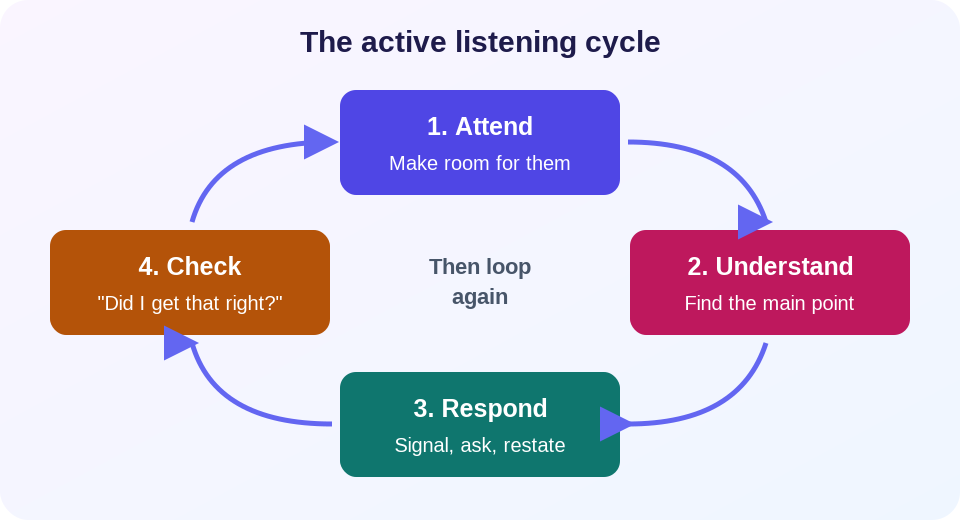
- A simple cycle: attend, understand, respond and check
- Ways to show attention without acting
- How to match your listening to what the speaker needs
Three ways to be present
Compare these three listeners while Tariq explains a problem with his schedule.
- The half listener types while Tariq talks. Later they ask something he already answered.
- The waiting talker is quiet but is building a reply. As soon as Tariq pauses, they tell their own schedule story.
- The active listener puts the phone face down, lets Tariq finish, asks what part worries him most, and checks: "So the late shift clashes with your class. Is that right?"
Only the third listener finds out what the real problem is.
The listening cycle
- Attend. Make room for the person. Stop other tasks if you can. If you cannot, say so and suggest a time: "I want to hear this properly. Can we talk at three?"
- Understand. Listen for the main point, the facts, and what seems to matter to the speaker.
- Respond. Use short signals, questions or a summary.
- Check. Invite correction: "Did I get that right?"
The loop repeats. Each check gives the speaker a chance to fix your picture.
Listen for more than words
Speakers often give you several layers at once.
| Layer | Question to ask yourself |
|---|---|
| Content | What happened? What are the facts? |
| Feeling | How does the speaker seem to feel about it? |
| Need | What do they want: help, information, a decision or just to be heard? |
Treat feelings and needs as guesses. Tone and faces are not read the same way by everyone. A person may speak calmly about something very important, especially in some cultures or when speaking a second language. Check gently instead of assuming.
Show attention
Useful signals show that you are following. You might face the speaker, nod at times, say "I see" or "go on," and take brief notes if you explain why. On a call, short sounds or a "yes, I'm with you" help, because the speaker cannot see you.
Eye contact varies. In some places steady eye contact shows interest. In others it can feel intense or disrespectful. Some people concentrate better when they look away. What matters is that your attention is real and the speaker is comfortable.
If your attention drifts, do not pretend. Say, "Sorry, I lost the last part. Could you say it again?" Most people prefer that to a false nod.
What does the speaker want?
A common problem is solving when someone wants to be heard, or only sympathizing when they need a decision. If it is unclear, ask: "Would it help more if I listened, or if we looked for options?"
Listening is also not agreeing. You can understand a view well and still disagree with it. In fact, a fair summary of the other view often makes your disagreement easier to hear.
Worked example
Meera says, "I've redone this chart four times, and the client still isn't happy."
A weak reply is "Just ask them what they want." The advice may be sensible, but it comes too early.
A stronger reply is "Four versions is a lot of work. What did they say about the last one?" Meera explains that the comments keep changing. Now you can see that the issue may be unclear goals, not the chart. You might then say, "It sounds like the target keeps moving. Is that how it feels?" She can confirm it or correct you.
Limits
Active listening takes energy. You cannot give deep attention at every moment. You may also set limits when a conversation is abusive or when you are not able to help. If someone talks about being in danger or harming themselves, listening alone is not enough. Contact local emergency services or a suitable professional, and follow your organization's rules.
Try a two-minute listening drill
Ask a friend to talk for two minutes about something ordinary, such as their weekend plans or a hobby. Your only job is to listen. Do not give advice and do not tell your own story. Use small signals if they feel natural.
When the time is up, say back the main point in two or three sentences. Then ask, "What did I miss or get wrong?" Swap roles.
Afterward, talk about what each of you noticed. Many people find that the hardest part is not the silence. It is the pull to add something of their own. Notice when that pull arrives. That moment is where your practice is.
Listening in daily work does not need to look this formal. A single short check, such as "So the main problem is the timing?", can be enough in a busy moment.
Common mistakes
- Copying listening signals, such as constant nodding, without actually following.
- Preparing your reply while the other person is still talking.
- Turning the topic to your own story.
- Giving advice before you know what the person wants.
- Believing that you already know how the sentence will end.
Try it
Check your understanding
Quick check · 4 questions
of 4 answered You scored / 4 · perfect!
-
1. What makes listening "active"?
It combines attention, understanding, response and checking. -
2. You cannot give full attention right now. What is a good choice?
Honesty and a specific time respect the speaker. -
3. Which statement about listening and agreement is accurate?
Understanding and agreement are separate things. -
4. How should you treat your guess about a speaker's feelings?
Signals vary between people, so check instead of assuming.
Summary
- Listening is deliberate. It is more than hearing or waiting to speak.
- Use the cycle: attend, understand, respond and check.
- Listen for content, possible feelings and needs.
- Attention signals differ between people and cultures.
- Find out whether the speaker wants help or wants to be heard.
Next: Asking Good Questions
Śledź swoje postępy
Załóż darmowe konto, aby odhaczać lekcje i wracać do miejsca, w którym skończyłeś, na dowolnym urządzeniu.