
























Les 15 · Speaking
TOEFL Speaking Overview
Understand the two TOEFL iBT Speaking tasks, Listen and Repeat and Take an Interview, what the scoring guides value and how to practice.
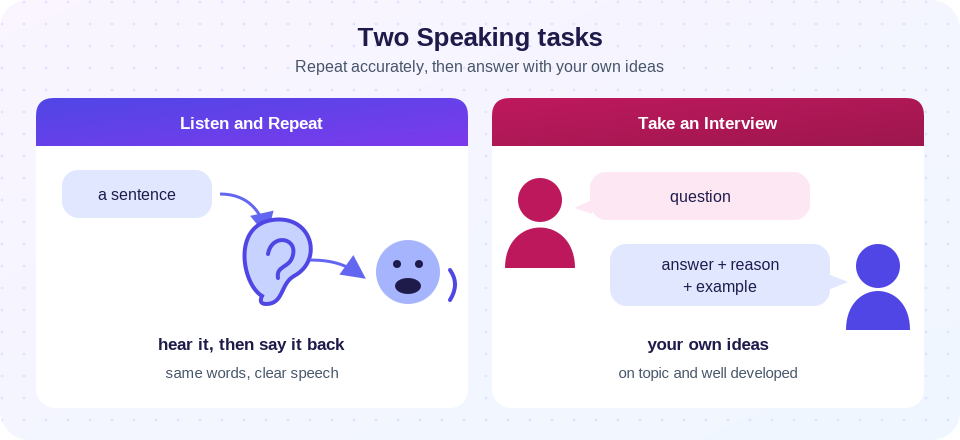
Speaking is the last section. You speak into a microphone, and your responses are recorded. The 2026 format has two tasks: Listen and Repeat and Take an Interview. One checks how well you can take in a sentence and say it clearly. The other checks how you answer questions in a simulated interview.
What you will learn
- the two speaking tasks
- what the ETS scoring guides pay attention to
- how responses are scored
- how to practice when no one is grading you
The two tasks
ETS lists 11 items and an approximate base time of 8 minutes. The section is linear: it does not adapt to your answers.
| Task | Items in the ETS blueprint | What you do |
|---|---|---|
| Listen and Repeat | 7 | Hear a sentence and repeat it |
| Take an Interview | 4 | Answer a simulated interviewer's questions |
ETS sets these tasks in academic and campus-related situations that need no specialist knowledge. Each task starts with a short introduction to the situation, given both in audio and in print, and the screen may show pictures or other visual support.
Listen and Repeat
Take an Interview
Timing details
Follow the on-screen timer and directions. We are not listing the number of seconds for each response here, because the ETS pages we could check did not state them all clearly. Before your test, look at the current official sample questions on ets.org/toefl and practice with the response times shown there. In this tutorial, the timer lengths are practice settings that you can change.
How responses are scored
ETS says speaking responses are scored with its automated scoring engine, which is trained on human ratings, and that human rating remains part of the overall scoring process. The published scoring guide rates each Listen and Repeat and Take an Interview item from 0 to 5.
In plain words, the guide pays attention to the following.
| Task | Main things the guide describes |
|---|---|
| Listen and Repeat | How exactly you repeat the sentence, whether the meaning is kept and how easy you are to understand |
| Take an Interview | Whether you address the question, how well you develop the answer, pace and pauses, pronunciation and rhythm, grammar and vocabulary |
Read the full official guide for the exact wording at each level. Your reported Speaking score is on the 1 to 6 scale after conversion; you cannot work it out by adding your own ratings.
Intelligibility
Intelligibility means how easily a listener can understand your words. It is not the same as sounding like a particular native speaker. An accent is normal. Work on what affects understanding:
- individual sounds that change meaning, such as ship and sheep
- word stress, such as PHOtograph and phoTOGraphy
- sentence stress, which makes key words stand out
- word endings, such as past -ed and plural -s
- thought groups, which are short chunks that belong together, with tiny pauses between them
Practice without a grader
This website cannot hear you or score your speech. Instead:
- Use a timer.
- Record yourself on your own device, outside this website.
- Listen once for content: did you do the task?
- Listen again for delivery: pauses, clarity, endings and stress.
- Choose one thing to improve and try again.
If you can, ask a teacher or a fluent speaker to listen. Other listeners notice problems that you may miss in your own voice.
Prepare your setup
Practice speaking aloud in a quiet room at a normal volume. If you will test at home, read the current official rules for your room, computer and microphone well before test day. At a test center, other people may be speaking near you, so it helps to practice staying focused with some background sound.
A weekly rhythm
| Session | Focus |
|---|---|
| 1 | Repetition practice with new sentences |
| 2 | Interview answers about your experiences |
| 3 | Interview answers that give opinions |
| 4 | Listen to your recordings and repeat your weakest item |
Short, frequent sessions are often easier to keep than one long session.
Build confidence in small steps
Many people find that hearing their own voice feels strange at first. That is normal, and the feeling often becomes weaker with practice. Start with a single sentence, record it and listen once without judging your voice. Next, listen again with one clear question, such as "Could I hear the last word?" When one sentence is comfortable, try a short answer of three sentences. Increase the length only when the previous step feels manageable. Keep your first recording. Later, it can show you changes that are hard to notice from day to day.
Do not wait until your English feels perfect before you start. Speaking improves through speaking, and an early recording with mistakes gives you something real to work on. A short answer today teaches you more than a long answer that you only plan.
Common mistakes
- Practicing speaking only in your head.
- Trying to speak very fast to sound fluent.
- Memorizing long answers that may not fit the question.
- Using old preparation for speaking tasks that are no longer in the format.
Try it
Match each habit to the skill it trains.
Use the timer for a quick warm-up. The seconds are only your practice setting.
Check your understanding
Quick check · 4 questions
of 4 answered You scored / 4 · perfect!
-
1. What are the two speaking tasks?
These are the two tasks in the 2026 format. -
2. What does intelligibility mean?
Clear speech matters more than copying one accent. -
3. Can this website score your speaking?
The site cannot hear you. -
4. Where should you find official response times?
Our timer values are only practice settings.
Summary
- Speaking has Listen and Repeat and Take an Interview.
- Clear, understandable speech matters, with any accent.
- Check official sources for response times and scoring guides.
- Record, listen, improve one thing and repeat.
Next: Listen and Repeat
Volg je voortgang
Maak een gratis account om lessen af te vinken en op elk apparaat verder te gaan waar je gebleven was.