
























Les 34 · Practice and Review
Build a Rehearsal Plan
Turn practice into a plan: rehearse aloud in stages, work on weak spots, test real conditions and know when to stop changing your talk.
Many people "practice" by reading their notes silently. This helps you remember the content, but it does not train your voice, your timing or your transitions. Speaking is something you do, so you need to practice doing it.
A rehearsal plan spreads your practice over time and gives each session a goal.
What you will learn
- Why practicing aloud matters
- Five stages of rehearsal
- How to work on weak spots
- How much to memorize
- How to plan around your own schedule
Practice aloud
When you speak aloud, you discover things that silent reading hides: a sentence that is too long, a word that is hard to say, a missing link between two ideas or a talk that runs over time.
Spreading practice over several days is often more useful than doing all of it the night before. You get time to rest, to think and to improve between sessions.
Five stages
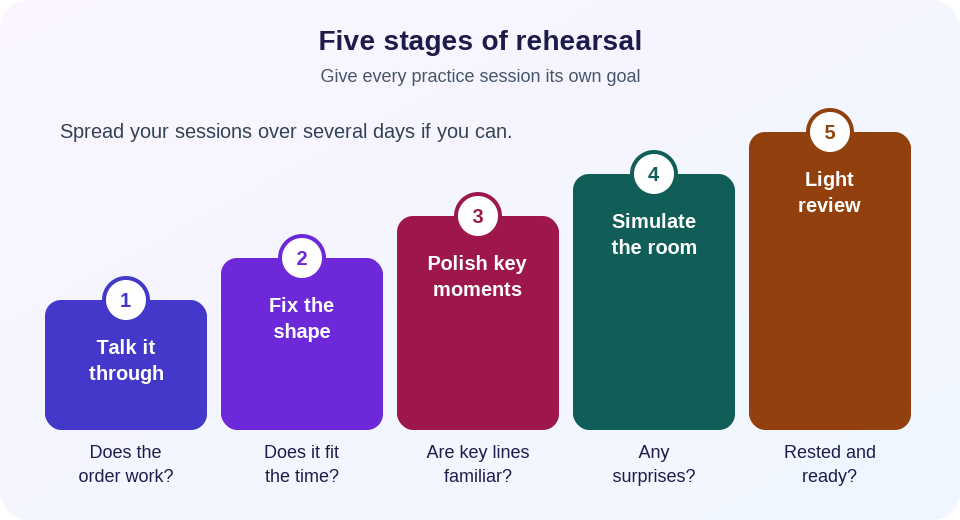
Stage 1: Talk it through. Explain your talk aloud using only your outline. Expect pauses and rough sentences. Goal: find out whether the ideas make sense in order.
Stage 2: Fix the shape. Cut, move and add material. Work on transitions. Time a full run. Goal: a clear structure that fits the time.
Stage 3: Polish key moments. Practice your opening, your main message, difficult parts and your ending many times. Goal: these lines feel familiar.
Stage 4: Simulate the real event. Stand or sit as you will on the day. Use your slides, remote and notes. Speak at real volume. Ask someone to watch and ask questions. If you can, practice in the real room. Goal: no major surprises.
Stage 5: Light review. On the last day, review your outline and key lines, check your materials and rest. Goal: arrive fresh. Avoid big changes at the last moment unless something is wrong.
Run it without stopping
In some sessions, stop and repair problems as you find them. In full runs, do not stop. If you make a mistake, recover as you would on the day. This trains your recovery skills and gives you a true time.
Mix both kinds of practice.
Work on weak spots
Do not always start from the beginning. Speakers who do this often know their opening very well and their ending badly.
- Mark the parts where you stumble.
- Practice each weak part on its own.
- Then practice it together with the sentence before and after, so the join is smooth.
- Sometimes start from the middle.
- Practice your ending on its own several times.
How much to memorize
| Approach | Strength | Risk |
|---|---|---|
| Read a full script | Exact wording | Flat voice, little eye contact |
| Memorize everything | Eye contact, exact wording | Getting stuck if you lose one line |
| Notes or outline | Natural and flexible | Wording changes each time |
For many talks, know your structure well, use brief notes and learn a few key lines closely: the first lines, your main message and the last lines. Some situations need exact wording, such as a formal statement. Then a well-practiced script is a sensible choice.
A sample schedule
This is one example for a short talk one week away. Adjust it to your life.
| Day | Task | Session goal |
|---|---|---|
| 1 | Talk through the outline twice | Check the logic |
| 2 | Cut and time | Fit the limit with spare time |
| 3 | Practice the opening, ending and hard parts | Smooth key moments |
| 4 | Record a full run and review it | Choose one or two changes |
| 5 | Rehearse with a listener and questions | Test understanding |
| 6 | Full run with equipment | Test real conditions |
| Event day | Review the card, warm up gently | Stay calm and ready |
If you have only an hour, spend a little time on the structure, then speak the whole talk aloud at least once and practice the opening and ending a few extra times.
Practice different conditions
- Start without warm-up once, to test your first lines.
- Practice with a little background noise.
- Practice without slides.
- Run your short version.
- For online talks, rehearse with the camera and screen sharing.
- In a second language, practice difficult words more and plan a few ways to rephrase key ideas.
Look after your voice. Many short sessions can be kinder to it than one long loud one. Stop if speaking hurts.
When is it enough?
You do not need perfection. You are often ready when you can give the talk within the time, say your main message without notes, recover after a stumble and answer your likely questions. If more practice only makes you change small words back and forth, it is time to rest.
A worked example
Ines has four evenings before a five-minute club talk. On the first, she explains it aloud and finds that two points overlap. On the second, she merges them and times it. On the third, she practices the opening, ending and one tricky transition. On the fourth, she gives it to a friend, who asks two questions. She changes one unclear example and then stops.
Common mistakes
Do not practice only in your head. Do not always start again from the top. Do not leave the first full run until the last day. Do not rewrite large parts just before you speak. Do not trade all your sleep for extra practice.
Try it
Choose how many days you have. The planner shows a suggested rehearsal order. Treat it as a starting point.
Check your understanding
Quick check · 4 questions
of 4 answered You scored / 4 · perfect!
-
1. Why should you practice aloud?
You rehearse the actual action of speaking. -
2. What is the point of a full run without stopping?
It copies the conditions of the real talk. -
3. Which parts are often worth learning closely?
These key moments matter a lot, while the rest can stay flexible. -
4. You always restart from the beginning. What may happen?
Start from different places to balance practice.
Summary
- Rehearse aloud, spread over time if you can.
- Move from talking it through to simulating the event.
- Mix full runs with work on weak spots.
- Know your structure and a few key lines.
- Stop when you are ready, and rest.
Next: Feedback and Self-Review
Volg je voortgang
Maak een gratis account om lessen af te vinken en op elk apparaat verder te gaan waar je gebleven was.