
























Les 20 · Numbers and Time
Sino-Korean Numbers
Learn Sino-Korean numbers with Hangul and romanization, build large numbers up to millions, and see when Koreans use this system every day.
Korean has two sets of numbers. One set comes from Chinese roots, so it is called Sino-Korean. The other set is called native Korean. You need both, and each has its own jobs.
This lesson covers the Sino-Korean set. It is a good one to learn first, because large numbers are built from a few small blocks in a regular way. You will use it for money, minutes, dates, phone numbers and much more.
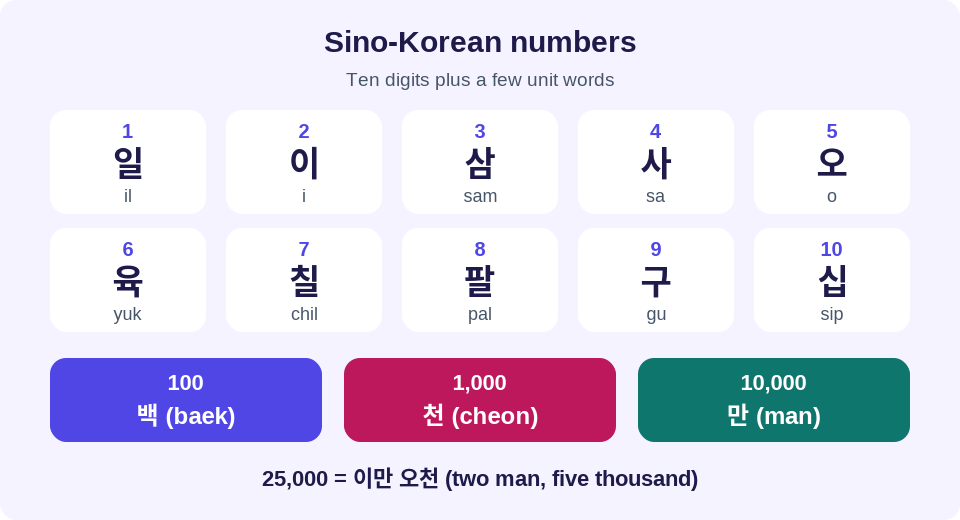
What you will learn
- The Sino-Korean numbers from zero to ten
- How to build any number up to the millions
- How Korean groups large numbers in ten thousands
- When this number system is used
The basic numbers
| Number | Korean | Romanization |
|---|---|---|
| 0 | 영 / 공 | yeong / gong |
| 1 | 일 | il |
| 2 | 이 | i |
| 3 | 삼 | sam |
| 4 | 사 | sa |
| 5 | 오 | o |
| 6 | 육 | yuk |
| 7 | 칠 | chil |
| 8 | 팔 | pal |
| 9 | 구 | gu |
| 10 | 십 | sip |
There are two words for zero. You will often hear 공 when people read phone numbers one digit at a time. You will hear 영 in contexts such as math, scores and temperature.
Say the numbers in order a few times. Then say them backward. Counting backward forces you to remember each word on its own, not only as part of a chant.
Tens: multiply, then add
To make tens, put a digit before 십. To add ones, put a digit after it.
| Number | Korean | How it works |
|---|---|---|
| 11 | 십일 (sibil) | ten + one |
| 15 | 십오 (sibo) | ten + five |
| 20 | 이십 (isip) | two tens |
| 34 | 삼십사 (samsipsa) | three tens + four |
| 99 | 구십구 (gusipgu) | nine tens + nine |
Notice that you do not say "one ten" for 10. It is just 십. The same is normally true for 100 and 1,000.
Hundreds and thousands
You need two more unit words: 백 (baek, hundred) and 천 (cheon, thousand). They follow the same pattern.
- 100 is 백
- 250 is 이백오십
- 1,000 is 천
- 1,984 is 천구백팔십사
- 7,006 is 칠천육
When a place has a zero, you simply skip it. In 7,006 there are no hundreds and no tens, so you say nothing for them.
The big step: ten thousand
English groups large numbers in threes: thousand, million, billion. Korean groups them in fours. The key word is 만 (man), which means 10,000.
So 20,000 is not "twenty thousand" in Korean. It is "two ten-thousands": 이만.
| Number | Korean | Think of it as |
|---|---|---|
| 10,000 | 만 | one man |
| 25,000 | 이만 오천 | 2 man + 5,000 |
| 100,000 | 십만 | 10 man |
| 500,000 | 오십만 | 50 man |
| 1,000,000 | 백만 | 100 man |
| 3,450,000 | 삼백사십오만 | 345 man |
A useful trick: write the number, then put a mark before the last four digits. For 3,450,000 you get 345 and 0000. Read the left part, add 만, then read the right part.
Sounds can change when you say numbers quickly. For example, 십육 (16) sounds like simnyuk, and 백만 sounds like baengman. You do not need to force this. Listen to native speakers and copy what you hear.
Where Sino-Korean numbers are used
You will normally hear this system for:
- Money: 오천 원 (ocheon won), 5,000 won
- Minutes and seconds: 십 분 (sip bun), 10 minutes
- Dates: 삼월 오 일 (samwol o il), March 5
- Years: 이천이십육 년, the year 2026
- Floors: 삼 층 (sam cheung), third floor
- Bus numbers: 백이 번 (baegi beon), number 102
Phone numbers are read digit by digit. For a made-up number such as 010-1234-5678, you can say 공일공, 일이삼사, 오육칠팔. Many speakers say 에 (e) where the hyphen is.
Worked examples
Read each number in parts, from the largest unit to the smallest.
- 48: 사십 and 팔 give 사십팔.
- 605: 육백 and 오 give 육백오.
- 3,500: 삼천 and 오백 give 삼천오백.
- 12,800: split off the last four digits (1 and 2800), so say 만 이천팔백.
- 64,000: split into 6 and 4000, so say 육만 사천.
Practice with things you see: bus numbers, page numbers and prices. A few seconds many times a day works better than one long session.
Reading numbers in real life
Numbers rarely come alone. They arrive with a unit word, and the unit tells you what the number means. Read these slowly, then faster.
- 삼백 원 (sambaek won): 300 won
- 이십 분 (isip bun): 20 minutes
- 십이 층 (sibi cheung): twelfth floor
- 오백일 호 (obaegil ho): room 501
- 칠십 쪽 (chilsip jjok): page 70
When you hear a long number, do not try to catch every sound at once. First listen for the unit words 만, 천, 백 and 십. They work like signposts that split the number into parts. The word just before each signpost tells you how many of that unit there are. If no digit comes before a unit, you have one of that unit.
Writing helps too. Write five random numbers on paper, read them aloud in Korean, and come back an hour later to read them again. Then reverse the task: write five Korean readings and turn them back into digits. The second direction is closer to what you need when someone speaks to you.
Common mistakes
- Saying 일십 for 10 or 일백 for 100 in everyday speech. Say 십 and 백.
- Saying 일만 for 10,000 in normal talk. People usually say 만.
- Translating "thirty thousand" word for word as 삼십천. The correct form is 삼만.
- Using this system to count objects such as cups or people. Small counts like these usually need native numbers.
Try it
Check your understanding
Quick check · 4 questions
of 4 answered You scored / 4 · perfect!
-
1. How do you say 47 in Sino-Korean?
Say the tens first: four tens (사십), then seven (칠). -
2. Which word means 10,000?
만 is ten thousand. 천 is a thousand and 백 is a hundred. -
3. How do you say 40,000?
40,000 is four ten-thousands, so it is 사만. -
4. Which one usually takes Sino-Korean numbers?
Money uses Sino-Korean numbers. Cups and friends are usually counted with native numbers.
Summary
- Sino-Korean numbers use digits plus unit words such as 십, 백, 천 and 만.
- Put a digit before a unit to multiply and after it to add.
- Large numbers are grouped by four digits around 만.
- Use this system for money, minutes, dates, floors and phone numbers.
Volg je voortgang
Maak een gratis account om lessen af te vinken en op elk apparaat verder te gaan waar je gebleven was.