
























Les 20 · Single Notes and Picking
Holding and Using a Pick
Learn how to hold a guitar pick, strike a single string cleanly with downstrokes and upstrokes, and relax your hand so your notes sound even.
So far, strumming has let you play many strings at once. Single-note playing is different. You aim at one string, play it, and leave the others quiet. This is how melodies, riffs and solos work.
In this lesson you will set up your picking hand. A good setup now saves you from tension and uneven sound later.
What you will learn
- How to hold a pick without squeezing it
- How much of the pick should touch the string
- How to play clean downstrokes and upstrokes
- How to find a string without looking
The basic grip
Make a loose fist with your picking hand, with the thumb resting on the side of your index finger. Slide the pick between the thumb pad and the side of the index finger. The pointed tip should stick out and aim roughly toward the strings.
Hold it firmly enough that it does not fall, and no harder. If your thumb turns pale or your forearm feels tight, you are squeezing too much. Many players choose a slightly different grip, and that is fine if it is relaxed and gives a clear sound.
Choosing a pick
Picks come in different thicknesses. A thin pick bends easily and can feel forgiving for strumming. A thicker pick bends less and often gives more control on single notes. A medium pick is a sensible place to start. Try a few, because comfort matters more than the number printed on the pick.
How deep to go
Let only a small part of the tip pass the string. A pick that goes deep gets stuck, makes a harsh click and slows you down. Think of brushing past the string, not digging under it.
A slight angle can also help. If the flat face meets the string exactly head-on, it may catch. Tilt the pick a little so it slides off smoothly.
Where to move from
For single notes, most of the motion is small. It can come from the wrist, with a little help from the forearm. Keep your shoulder quiet. Many beginners rest the side of the palm lightly near the bridge or touch the guitar body for reference. Light contact is helpful. Pressing hard is not, and resting on the strings will mute them.
Your first single notes
Play the open high E string (string 1, the thinnest).
- Place the pick just above the string.
- Push it down through the string with a small movement. This is a downstroke.
- Stop just below the string. Do not swing far away.
- Bring it back up through the string. This is an upstroke.
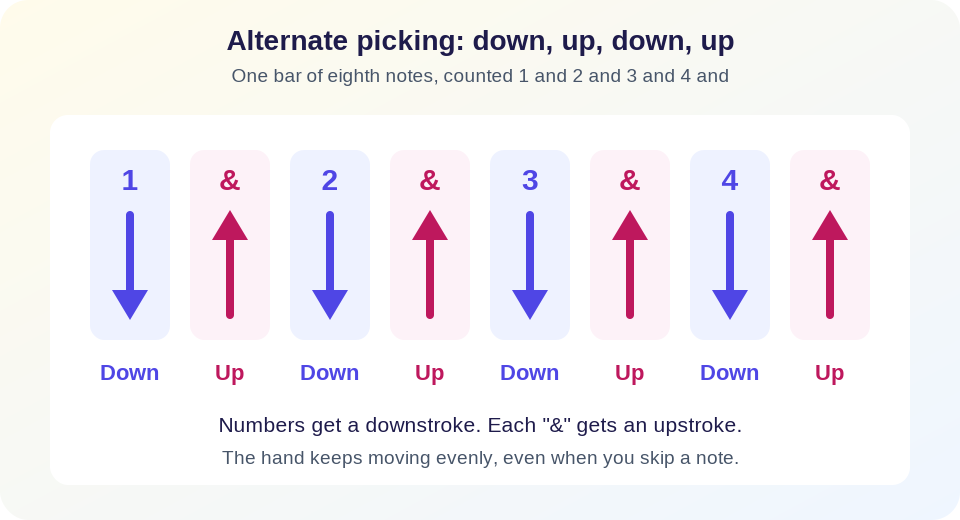
Repeat four downstrokes, then four upstrokes. Then alternate them. Listen for notes with a similar volume and tone.
Finding other strings
Now move to the B string, then the G string, and so on. At first you may look at your hand. That is normal. Over time, practice looking away for a few notes. Your hand learns the distance between strings, just as your fingers learn where keys are on a keyboard.
Try this pattern slowly, one note for each count:
Count:   1  2  3  4  |  1  2  3  4
String:  6  6  5  5  |  4  4  3  3
All notes are open strings. Say the string number out loud as you play.
A worked example: the open-string ladder
Start on string 6 and play each open string once, moving to string 1. Then go back. Use only downstrokes the first time. The second time, alternate down and up.
If one note sounds louder than the others, check how deep the pick went on that note. If a neighboring string rings by accident, make your movement smaller and aim more precisely.
If the pick keeps turning in your fingers, wipe it dry, or try a pick with a textured grip. Let your fingers correct it between notes, not by squeezing harder.
Staying comfortable
Pain is not part of learning to pick. If your wrist, forearm or hand hurts, tingles or feels numb, stop and rest. Check that your wrist is not sharply bent. If symptoms continue, ask a health professional.
A ten-minute first session
Here is a calm way to spend your first session with a pick. Treat the times as a guide, not a rule.
- Two minutes: form your grip, then let your hand go loose. Repeat this five times. You are teaching your hand what a relaxed grip feels like.
- Three minutes: play downstrokes on string 1. After every four notes, check your thumb and shoulder for tension.
- Three minutes: play upstrokes, then alternate down and up. Close your eyes for a few notes and listen.
- Two minutes: play the open-string ladder once slowly.
How to judge your sound
Your ears are the best teacher here. Ask three questions after a short exercise.
- Is each note clear? A scratchy click often means the pick is too deep or too flat against the string.
- Are the notes equally loud? Large differences usually come from changes in depth or swing size.
- Does anything else ring? Extra ringing may mean you touched a neighboring string.
Strings you are not playing may also vibrate a little on their own. You can quiet them by letting the edge of your picking hand or an unused fretting finger rest lightly on them. You will practice muting more with power chords.
Acoustic and electric
The basic grip is the same on both. Steel acoustic strings often feel stiffer to strike, so a very thin pick may flap. On an electric guitar, the amplifier can make small noises louder, so clean, small movements matter even more.
Common mistakes
- Gripping the pick as hard as you can. It makes the arm stiff and the tone harsh.
- Letting a large part of the pick go past the string.
- Making large swings, which waste time between notes.
- Only practicing downstrokes, so upstrokes stay weak.
Try it
Use this random string caller. Read the number, play that open string once, then press the button again.
Check your understanding
Quick check · 4 questions
of 4 answered You scored / 4 · perfect!
-
1. How firmly should you hold a pick?
A relaxed but secure grip gives control without tension. -
2. What is a downstroke?
In normal playing position, a downstroke moves the pick toward the floor. -
3. Why use only a little of the pick tip?
A shallow stroke is smoother and faster. -
4. What should you do if your wrist starts to hurt?
Pain is a signal to stop. Get professional advice if it continues.
Summary
- Hold the pick between your thumb and the side of your index finger, with a relaxed grip.
- Use a small amount of the tip and small movements.
- Practice both downstrokes and upstrokes.
- Learn the distance between strings by playing slow open-string patterns.
- Stop if you feel pain or numbness.
Next: Alternate Picking
Volg je voortgang
Maak een gratis account om lessen af te vinken en op elk apparaat verder te gaan waar je gebleven was.