
























Les 20 · Phrasal Verbs
How phrasal verbs work
Learn what phrasal verbs are, the four grammar types, where the object goes with pronouns, and how to record each new one so you can really use it.
A phrasal verb is a verb plus one or two small words that work together as one unit, such as give up, look after or run out of. The small word is called a particle. It may look like a preposition (on, after) or an adverb (up, away). Together, the words often mean something that you cannot guess from the parts.
English speakers use phrasal verbs all the time, especially in conversation and informal writing. If you only learn single verbs such as continue or postpone, you may understand a textbook but miss what people say around you. This chapter shows how the grammar works first, because the grammar decides where you put the other words.
What you will learn
- What a phrasal verb is and how its meaning can differ from the plain verb.
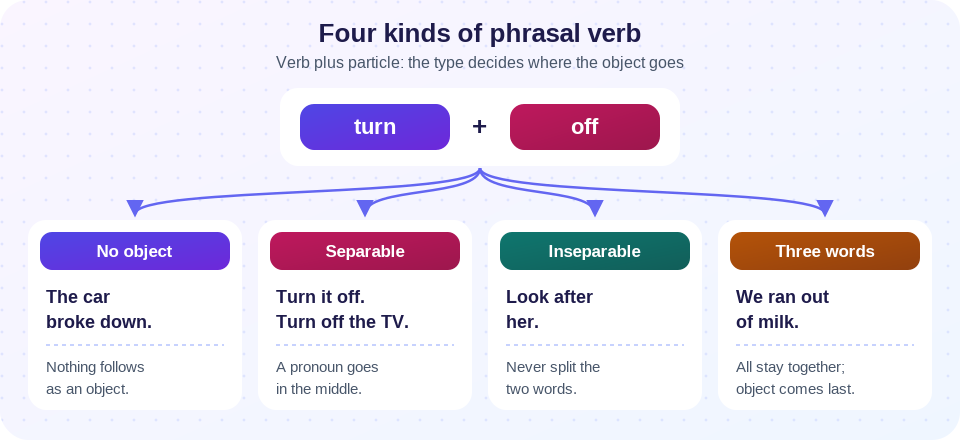
- The four grammar types and their word order.
- Why pronouns such as it and them behave in a special way.
- How to write a useful note for each new phrasal verb.
Verb + particle
Four types
Learn the type with the verb
Literal and non-literal meanings
Some phrasal verbs are easy. In sit down and come in, the particle just adds a direction. Others are idiomatic, which means the whole has a new meaning.
| Phrasal verb | Meaning | Example |
|---|---|---|
| sit down | take a seat | Please sit down. |
| give up | stop trying | The puzzle was hard, but I did not give up. |
| look up | search for information | I looked up the word in a dictionary. |
| turn down | refuse | She turned down the offer. |
Many phrasal verbs have more than one meaning. Take off means "remove clothing" in Take off your coat, but "leave the ground" in The plane took off. The surrounding sentence tells you which meaning is used.
Type 1: no object
These verbs are intransitive: they do not take an object (a thing that receives the action).
- My old car broke down on the highway.
- I usually wake up at seven.
- Only two guests showed up.
You cannot say I woke up him with this pattern. When wake up does take an object (I woke him up), it follows the separable pattern below. Dictionaries list both uses.
Type 2: separable verbs
A separable phrasal verb takes an object, and the object can go in two places.
- Turn the light off.
- Turn off the light.
Both are correct. There is one important rule. If the object is a pronoun (me, you, him, her, it, us, them), it must go in the middle.
- Turn it off. (correct)
- Turn off it. (not correct)
Other common separable verbs are pick up, put on, take off (clothes), fill in (a form), write down and throw away. A very long object usually goes at the end because it is easier to read: Please fill in all the forms that I sent you yesterday.
Type 3: inseparable verbs
An inseparable verb takes an object, but nothing can come between the verb and the particle. This is true for nouns and pronouns.
- She looks after her grandfather. She looks after him.
- I ran into an old friend. I ran into her.
- Can you look into the problem? Can you look into it?
She looks him after is not correct. Here run into means "meet by chance" and look into means "investigate".
Type 4: three-word verbs
These have a verb and two particles. They keep the words together, and the object comes at the end.
| Three-word verb | Meaning | Example |
|---|---|---|
| look forward to | feel happy about something coming | I look forward to the trip. |
| run out of | have no more | We have run out of bread. |
| put up with | tolerate | I cannot put up with the noise. |
| get along with | have a friendly relationship | Do you get along with your neighbors? |
| come up with | think of | Tom came up with a good idea. |
After look forward to, use a noun or an -ing form: I look forward to meeting you. The to here is a preposition, so I look forward to meet you is not standard.
Nouns made from phrasal verbs
Some phrasal verbs become nouns, often written as one word or with a hyphen. The stress usually moves to the first part when you say the noun.
- to break down (verb) and a breakdown (noun)
- to check in (verb) and the check-in (noun)
- to set up (verb) and the setup (noun)
Keep the verb as two words: Please set up the table but The setup took an hour.
Record each verb with its pattern
A short note saves many mistakes. Write the verb, a placeholder that shows the object, a meaning and your own sentence.
| Note | Meaning | My sentence |
|---|---|---|
| turn something off | stop a machine | I turned the heater off. |
| look after someone | care for | I look after my cousin on Fridays. |
| run out of something | have none left | My phone ran out of battery. |
The word something or someone in the middle of your note shows that the verb is separable. If it comes after the particle, the verb is inseparable. For more ideas on keeping notes, see the practice work in Vocabulary mini-projects.
Common mistakes
- Pronoun after a separable verb. Write pick it up, not pick up it.
- Splitting an inseparable verb. Write look after the children, not look the children after.
- Using the base verb after a preposition. Write look forward to hearing, not look forward to hear.
- Guessing from the parts. Give up does not mean "hand something upward". Check a learner's dictionary.
Try it
First, decide whether each sentence uses the correct word order. Then fill in the gaps with a word that fits.
Check your understanding
Quick check · 4 questions
of 4 answered You scored / 4 · perfect!
-
1. Where must the pronoun go with a separable verb?
We say pick it up, with the pronoun in the middle. -
2. Which verb takes no object in this sentence: The car broke down.
The car broke down has no object, so the verb is intransitive here. -
3. Which sentence is correct?
The to in this verb is a preposition, so an -ing form follows. -
4. What does put up with mean?
If you put up with noise, you accept it although you dislike it.
Summary
- A phrasal verb is a verb plus one or two particles, used as one unit.
- The four types are: no object, separable, inseparable and three-word.
- With separable verbs, a pronoun object goes in the middle.
- Some phrasal verbs become nouns such as breakdown and check-in.
- Note the pattern (something or someone) with each new verb.
Volg je voortgang
Maak een gratis account om lessen af te vinken en op elk apparaat verder te gaan waar je gebleven was.