
























레슨 6 · Audience and Purpose
Analyze Your Audience
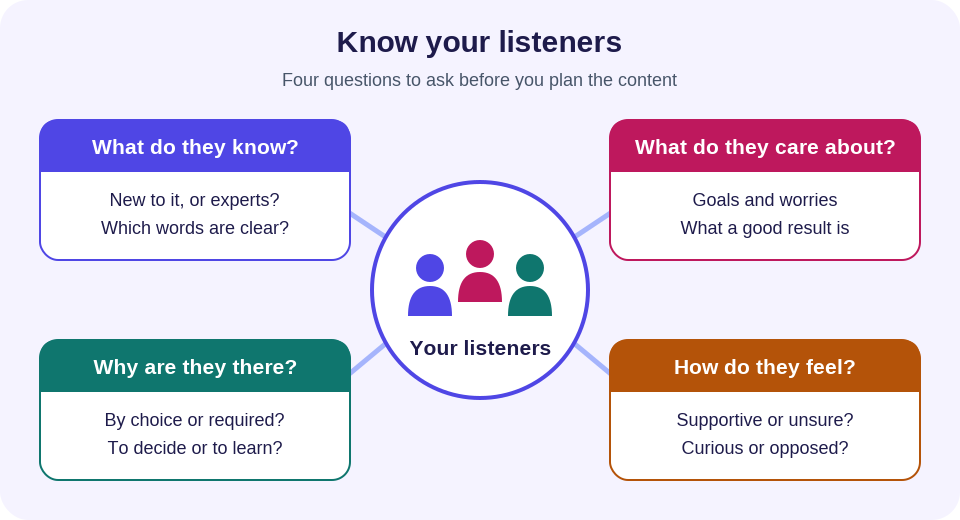
Find out who your listeners are, what they already know, what they care about and why they are there, then use the answers to shape every part of your talk.
The same topic can need very different talks. "Online safety" means one thing for parents, another for twelve-year-olds and another for a company's technical team.
Audience analysis means learning about your listeners before you decide what to say. It does not mean guessing their private thoughts. It means asking practical questions and using the answers.
What you will learn
- Four questions that guide audience analysis
- How to collect information without much effort
- How to handle a mixed audience
- How to turn your findings into decisions
- Why you should avoid stereotypes
Question 1: What do they already know?
If you explain too little, listeners get lost. If you explain too much, experts may stop paying attention.
Find out:
- Have they heard of the topic?
- Which key words will they understand?
- What might they believe that is out of date or incomplete?
- Have they received an earlier talk or document about it?
For example, in a talk about a new library catalog, staff may already know the old system well. They need the differences. New members need the basic steps.
Question 2: What do they care about?
People listen more closely when a talk connects with their goals or problems. Think about:
- what they want to achieve;
- what takes their time or money;
- what worries them about your topic;
- what a good result would look like for them.
Suppose you propose a new way to record homework. Students may care about missing fewer deadlines. Teachers may care about extra work. Parents may care about seeing what is due. It is one idea with three different points of connection.
Question 3: Why are they there?
Some people choose to attend. Others must. Some arrive with a decision to make. Others want to relax at a social event.
A required safety briefing may need a quick reason to care. A group that signed up for a workshop may expect to practice, not only listen. A boss with a decision to make may want the recommendation first and the history later.
Question 4: How do they feel about the topic?
Listeners may be supportive, curious, unsure, uninterested or opposed.
| Starting attitude | What often helps |
|---|---|
| Supportive | Move quickly to practical next steps |
| Curious | Give clear explanations and examples |
| Unsure | Address likely concerns and compare options |
| Uninterested | Show the link to their daily life early |
| Opposed | Begin with shared goals, and be fair about disagreements |
These are starting points, not fixed rules. One room can contain all five.
How to find out
You often need only a few minutes.
- Ask the organizer. "Who is coming? How many people? What do they know? What happened before my talk? What would make this useful?"
- Talk to two or three listeners. Ask what they find confusing or important.
- Read public information about the group, such as an event program.
- Send a short survey if the organizer agrees. Keep it to a few questions and explain how you will use the answers.
- Observe on the day. Notice earlier speakers, common questions and the mood of the room.
Collect only what you need. Avoid personal details that have nothing to do with your talk.
Mixed audiences
Many audiences are mixed. You cannot give every person a perfect talk, but you can make good choices.
- Choose a primary audience. Who most needs to understand or act? Design mainly for that group.
- Define key terms briefly. "A password manager, which is a tool that stores your passwords, can help." Experts lose only a few seconds.
- Use layers. Give the simple idea first, then add one deeper detail.
- Vary your examples. Use situations that different listeners recognize.
- Offer more elsewhere. Point experts to a handout or a later conversation.
Avoid stereotypes
Age, job or home country does not tell you what one person knows or values. An older listener may be a technology expert. A young listener may have managed a budget for years.
Treat your early ideas as guesses and check them. "Several of them told me they have never used the system" is information. "They are older, so they hate technology" is a stereotype.
Turn findings into decisions
Analysis is useful only if it changes something. For each finding, write one decision.
| Finding | Decision |
|---|---|
| Most listeners are new to the topic | Explain three key terms and cut the technical history |
| They worry about extra work | Show how long the task takes, based on a real trial |
| The talk is right after lunch | Add a short question early to involve people |
| Several listeners use English as a second language | Use common words and avoid idioms |
Worked example: One topic, two audiences
Nadia is speaking about reducing food waste.
For restaurant staff: They know food handling but not the new tracking sheet. They care about busy shifts. She shows the sheet, walks through one entry and explains when to fill it in.
For a school parents' group: Their experience varies. They may care about their shopping budget and family habits. She gives three home ideas, such as planning meals and checking what is already in the fridge.
The topic is the same. The examples, details and requested action are different.
Common mistakes
- Preparing the talk you would enjoy and assuming others want it too.
- Using insider words without checking whether listeners know them.
- Guessing attitudes from age, gender or nationality.
- Collecting many facts about the audience but changing nothing.
Try it
Choose the best decision for each audience finding.
Check your understanding
Quick check · 4 questions
of 4 answered You scored / 4 · perfect!
-
1. What is audience analysis?
Its purpose is to help you shape a talk that fits the people hearing it. -
2. Your audience is unsure about your proposal. What often helps?
Unsure listeners usually need their questions taken seriously. -
3. What can you do for a mixed audience?
A clear focus plus short definitions serves most people well. -
4. Which statement is information rather than a stereotype?
It comes from what listeners actually said.
Summary
- Ask what listeners know, what they care about, why they are there and how they feel.
- Use the organizer, short conversations and observation to find answers.
- For mixed groups, choose a primary audience and add layers.
- Check your guesses and avoid stereotypes.
- Turn every important finding into a decision.