
























레슨 5 · The Keyboard and Notes
The Keyboard Layout
Understand the piano keyboard layout: the repeating groups of two and three black keys, how to find every C and F, and how pitch moves from left to right.
At first, a keyboard looks like a long row of identical keys. It is not. The black keys form a repeating pattern, and that pattern is your map. Once you can see it, you can find any note without counting from the end.
What you will learn
- How pitch changes from left to right
- The repeating groups of two and three black keys
- How to find every C and every F
- How the pattern repeats along the whole keyboard
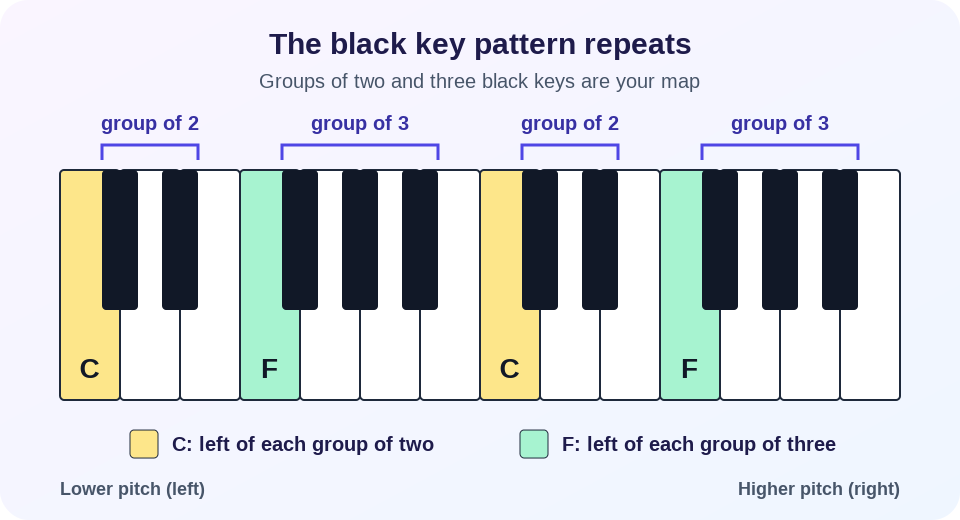
Low on the left, high on the right
Sit at your instrument and play the key at the far left. Then play the key at the far right. The left side sounds low. The right side sounds high.
Musicians say that you go up when you move right and down when you move left. "Up" means higher in pitch, not higher in the air.
White keys and black keys
White keys are the long, wide keys at the front. Black keys are shorter and sit farther back, raised above the white keys. A full 88-key piano has 52 white keys and 36 black keys.
The black key pattern
Look only at the black keys. You will see them in groups of two and groups of three. These groups take turns: two, three, two, three, all along the keyboard.
Between some pairs of white keys there is no black key. That gap is what creates the groups. Without it, you could not tell one part of the keyboard from another.
Try this: with your eyes open, play all the groups of two black keys, one group after another, from low to high. Then do the same with the groups of three.
Finding C
C is the white key just to the left of a group of two black keys.
Every time you see a group of two, the white key on its left is a C. Play every C you can find. They sound "the same but higher" as you move right. The next lesson explains why.
Finding F
F is the white key just to the left of a group of three black keys.
C and F are your two anchor keys. With them, you can reach any other white key quickly.
One repeating unit
If you start on a C and move right until just before the next C, you pass:
- 7 white keys
- 5 black keys (a group of 2 and a group of 3)
That is 12 keys in total. After that, the exact same layout starts again. When you know one unit, you know the whole keyboard.
| Section | White keys | Black keys |
|---|---|---|
| From C up to E | 3 | 2 |
| From F up to B | 4 | 3 |
| Whole unit, C to B | 7 | 5 |
A worked example
You want to find F on an unfamiliar keyboard. Follow these steps:
- Look at the black keys, not the white keys.
- Find a group of three black keys.
- Move to the white key right next to the left end of that group.
- That is F.
It takes only a second, even if you cannot see the end of the keyboard.
Do not rely on stickers forever
Note stickers can help in the first days. Over time, they can stop your eyes from learning the black key pattern. If you use them, remove them gradually. For example, keep only the C stickers for a week, then remove those too.
Practice routine
Spend two or three minutes on these:
- Play every group of two black keys with fingers 2 and 3 (right hand), going up.
- Play every group of three black keys with fingers 2, 3 and 4, going up.
- Play every C with your right thumb, then every F.
- Look away, then look back and point to a C as fast as you can.
Move your whole arm to each new place. Do not stretch your hand to reach.
Looking and feeling
Experienced players often find keys partly by touch. The edges of the black key groups tell your fingers where they are. You can start building this skill early. Rest your right fingers 2 and 3 lightly on a group of two black keys without pressing. Then slide your thumb down to the white key just left of them. You have found a C. Check with your eyes. At first you will look a lot, and that is fine.
Common mistakes
- Mixing up the group of two and the group of three.
- Thinking C is to the right of the two black keys. It is on the left.
- Counting from the lowest key every time instead of using the pattern.
- Stretching your fingers to reach a faraway key instead of moving your arm.
Try it
A white key is highlighted on a small keyboard. Is it a C, an F or another key? Use the black key groups to decide.
Check your understanding
Quick check · 4 questions
of 4 answered You scored / 4 · perfect!
-
1. Which direction goes up in pitch?
Moving right goes higher in pitch. -
2. Where is C?
The white key to the left of each pair of black keys is C. -
3. How many keys, white and black, are in one repeating unit from C to B?
There are 7 white keys and 5 black keys, for 12 keys. -
4. How can you quickly find F?
F sits just to the left of every group of three black keys.
Summary
- Left is low and right is high.
- Black keys come in alternating groups of two and three.
- C is left of each group of two; F is left of each group of three.
- A 12-key unit repeats along the keyboard.
Next: Note Names and Octaves