
























레슨 28 · Scales and the Fretboard
Notes on the Fretboard
Learn the twelve note names, where natural notes sit on each string up to fret 12, and quick methods such as octave shapes to find any note.
Every fret on your guitar is a note with a name. When you know those names, chords, scales and songs become much easier to understand. You do not need to memorize every spot at once. You can build the map in layers.
What you will learn
- The twelve notes and how sharps and flats work
- The natural notes up to fret 12
- Octave shapes that connect strings
- A simple memorizing plan
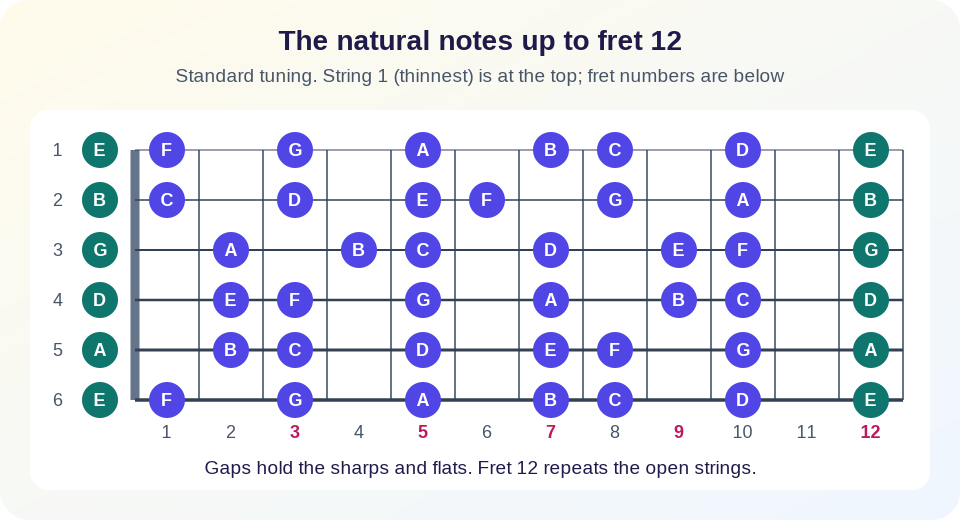
Twelve notes
In Western music, there are twelve different pitches before the pattern repeats:
C, C#, D, D#, E, F, F#, G, G#, A, A#, B
Each step is one semitone, which equals one fret. A sharp (#) raises a note by one semitone. A flat (b) lowers it by one. So C# and Db are the same pitch, with two names.
Two pairs of natural notes sit right next to each other, with no note between them: E to F and B to C. All other neighboring natural notes are two frets apart.
One string at a time
Start with string 6, the low E. Walk up from the open E:
Fret:  0   1   3   5   7   8   10  12
Note:  E   F   G   A   B   C   D   E
The missing frets hold sharps and flats. Fret 12 gives the same note names as the open string, one octave higher. From there the pattern repeats.
String 5 starts on A:
Fret:  0   2   3   5   7   8   10  12
Note:  A   B   C   D   E   F   G   A
The thinnest string, string 1, is also an E. It has the same notes at the same frets as string 6, two octaves higher. That is one string less to learn.
Reference frets
Many guitars have dots near frets 3, 5, 7, 9 and a double dot at 12. Learn what the dotted frets are on strings 6 and 5 first.
| Fret | String 6 | String 5 |
|---|---|---|
| 3 | G | C |
| 5 | A | D |
| 7 | B | E |
| 9 | C# | F# |
| 12 | E | A |
Octave shapes
An octave is the same note name, higher or lower. These shapes help you find a note on another string.
- From string 6, move up two strings and two frets: that lands on string 4.
- From string 5, move up two strings and two frets: that lands on string 3.
- From string 4, move up two strings and three frets: that lands on string 2.
- From string 3, move up two strings and three frets: that lands on string 1.
Here, "up two strings" means toward the thinner strings, and "up two frets" means toward the body. The change to three frets happens because the B string is tuned differently from the others.
Example: G on string 6 at fret 3. Two strings over and two frets up is string 4 at fret 5. That is also G.
A worked example: finding C
- On string 5, C is at fret 3.
- Use the octave shape: string 3 at fret 5 is also C.
- On string 2, C is at fret 1.
- On string 6, C is at fret 8. Use the octave shape to find C on string 4 at fret 10.
Now you know five places for C.
A memorizing plan
- Learn the natural notes on string 6, then on string 5.
- Use octave shapes to build strings 4 and 3.
- Learn string 2 (B): it starts on B, then C at fret 1, D at fret 3, E at fret 5.
- Copy string 6 to string 1.
- Quiz yourself: pick a note and find it on every string.
Short daily drills work better than one long session. Say the names out loud as you play.
Why this matters
This map lets you name any barre chord, move scale patterns to new keys, and find notes when you work out a song by ear.
Practice with only one note per day. For example, find every F in the first twelve frets. Next day, find every G.
Sharps and flats in practice
When you read a chord chart, you may see names like Bb or Eb. They are the same pitches as A# and D#. Which name musicians choose depends on the key. For now, just know that each in-between note can have two common names.
Here are the pairs: C#/Db, D#/Eb, F#/Gb, G#/Ab and A#/Bb.
A quick game
Play this game with a timer. Pick a note, such as D. Find it on string 6, then string 5, then all the others, in order. Say each fret number out loud. When you can do it without long pauses, choose a new note. Do not race. Accuracy comes first.
Check by ear
On a tuned guitar, some positions give the same pitch. Fret 5 on string 6 matches the open string 5, both A. The same fret 5 rule works from string 5 to open string 4, from string 4 to open string 3, and from string 2 to open string 1. The exception is string 3: use fret 4 to match the open B. This exception comes from the tuning, just like the different octave shapes.
Linking notes to chords
Look at the open C chord. The lowest note you play is on string 5 at fret 3, which is C. Now the shape makes more sense. Find the root in each chord you know.
Common mistakes
- Thinking there is a sharp between E and F, or between B and C.
- Using the two-fret octave shape across the B string.
- Memorizing only shapes and never saying the note names.
- Forgetting that fret 12 repeats the open-string names.
Try it
Find the note. Pick the right name for the random string and fret.
Check your understanding
Quick check · 4 questions
of 4 answered You scored / 4 · perfect!
-
1. How far apart are E and F?
There is no note between E and F. -
2. Which note is at fret 5 on string 6?
Counting up from E, fret 5 is A. -
3. Which two strings share the same note names fret by fret?
Both are E strings. -
4. From string 4, how do you find the octave on string 2?
The B string's tuning changes the shape to three frets.
Summary
- There are twelve notes, one per fret, before the names repeat.
- E to F and B to C are one fret apart.
- Learn strings 6 and 5 first, then use octave shapes.
- The shape changes to three frets when it crosses to string 2 or 1.
- Short, daily drills build a lasting map.
Next: The Major Scale