
























레슨 23 · Reading for Detail and Inference
Close Reading for Detail
Learn close reading: break long English sentences into parts, watch limiting words and numbers, and check details against the text.
Close reading means reading slowly and carefully so that you understand exactly what a text says. It is the right tool for instructions, rules, agreements, exam questions and any message where a small mistake would matter.
Close reading is not just reading slowly. You can read slowly and still miss a tiny word. What helps is a method: look at the parts of each sentence and ask what each part changes.
What you will learn
- How to find the core of a long sentence
- Which small words change meaning
- How to read numbers and limits
- How to compare a statement with what the text really says
Find the core first
A long sentence usually has a core: who does what. Everything else adds information.
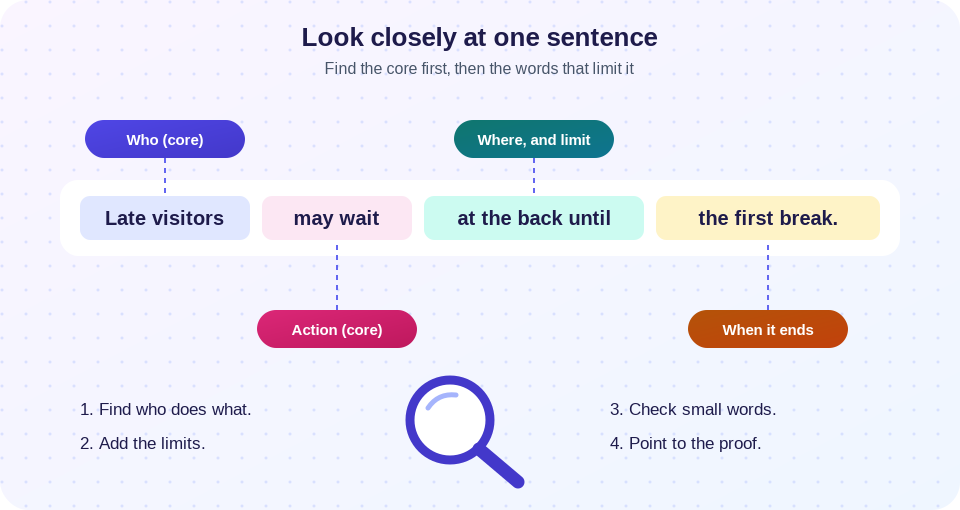
Visitors who arrive after the show has started may have to wait at the back until the first break.
- Who: visitors (which ones? those who arrive after the start)
- What: may have to wait
- Where: at the back
- Until when: the first break
Say the core aloud first: "Late visitors may have to wait." Then add the details back one at a time.
Step 1: Core
Step 2: Limits
Step 3: Conditions
Step 4: Check
Small words with big effects
| Word | Effect | Example |
|---|---|---|
| only | limits | Only staff may use this door. |
| unless | gives the one exception | You will be charged unless you cancel. |
| until | marks an end point | The shop is open until 6. |
| by | not later than | Return the form by Friday. |
| may / must | possibility or permission / obligation | You may bring a guest. You must sign in. |
| at least / at most | a minimum / a maximum | Bring at least two photos. |
| except | removes something | Open daily except Monday. |
| hardly | almost not | There was hardly any room. |
Compare these two sentences: "You may bring food" gives you a choice. "You must bring food" gives you a duty. One word changes what you need to do.
Watch negatives
Double negatives and negative prefixes need care. "It is not uncommon to wait" means waiting happens quite often. If a sentence confuses you, rewrite it in a positive form.
Numbers and comparisons
Write down what each number measures. In "Tickets cost 4 less if bought before the 10th", the 4 is a discount, not a price. Watch words such as more than, fewer than, up to and from. "Up to 30 people" means 30 or fewer. "From 30 people" means 30 or more.
Point to your proof
When you answer a question about a text, put your finger (or your cursor) on the words that support your answer. If you cannot point to anything, you may be using your own knowledge or a guess. A statement can be:
- Supported: the text says it, perhaps in other words.
- Contradicted: the text says the opposite.
- Not stated: the text gives no answer either way.
"Not stated" is not the same as "false". That difference is very important.
Worked example
Members may borrow up to five items at a time. DVDs can be kept for one week; all other items for three weeks. An item may be renewed once, unless another member has requested it.
| Statement | Verdict | Proof |
|---|---|---|
| A member can have four books at once. | Supported | Four is within "up to five". |
| DVDs can be kept for three weeks without renewing. | Contradicted | DVDs are for one week. |
| A requested book can be renewed. | Contradicted | "Unless another member has requested it". |
| Late returns cost money. | Not stated | The text says nothing about fines. |
The last row is a trap that comes from experience. Many libraries have rules about late items, but this text does not mention any.
Reading twice
On the first read, find the core and the general shape. On the second read, circle the limiting words and numbers. If the text matters a lot, read it a third time with your question in mind. Read difficult sentences aloud quietly; hearing the pauses can help you see where one idea ends.
A second worked example
Applications received after 30 June will be considered only if places remain.
Start with the core: applications will be considered. Next, find which applications: those received after 30 June. Then find the condition: only if places remain. A late application is therefore not automatically refused, but it is not guaranteed a look either. A reader who sees only "after 30 June" and "considered" might think that late forms are always welcome. A reader who sees only "after 30 June" might think they are always rejected. Both readings miss part of the sentence.
Try rewriting it in two short sentences: "You can still apply after 30 June. We will only look at your form if there is space." If your rewrite keeps the condition, you have understood it. If it drops the condition, go back and read again.
When two parts seem to disagree
Sometimes a rule in one place seems to clash with a note in another. A common reason is that the note is an exception to the general rule. "All rooms close at 20:00. The study room stays open until 22:00 during exam weeks." The second sentence does not cancel the first; it narrows it for one room and one period. If you cannot see which part wins, ask the author instead of choosing the one that suits you.
Common mistakes
- Missing a small word such as only, not or unless.
- Confusing may with must, or by with after.
- Treating a "not stated" detail as true because it sounds normal.
- Keeping the first meaning you understood even when a later phrase changes it.
- Remembering a number but forgetting what it measures.
Try it
Read the notice, then judge each statement.
Now choose the sentence that means the same.
Check your understanding
Quick check · 5 questions
of 5 answered You scored / 5 · perfect!
-
1. What should you find first in a long sentence?
The core gives you a frame for the other details. -
2. What does 'by Friday' mean?
By marks a deadline. -
3. A text says nothing about parking. 'Parking is free' is
Silence is not proof either way. -
4. Which sentence gives a duty?
Must shows obligation. -
5. What does 'up to 24 people' allow?
Up to sets a maximum.
Summary
- Find the core of a sentence, then add the limits and conditions.
- Look carefully at only, unless, until, by, may, must and negatives.
- Note what each number measures.
- Sort statements into supported, contradicted and not stated.
- Point to the words that prove your answer.