
























레슨 26 · Difficult Conversations and Conflict
Preparing for a Difficult Conversation
Plan a hard conversation: set a realistic goal, separate facts from stories, think about feelings and needs, choose a time and write a calm opening sentence.
Some conversations are easy to put off: asking a roommate to pay their share, telling a teammate that their jokes bother you, or asking your boss about a pay question. You may fear anger, tears or damage to the relationship.
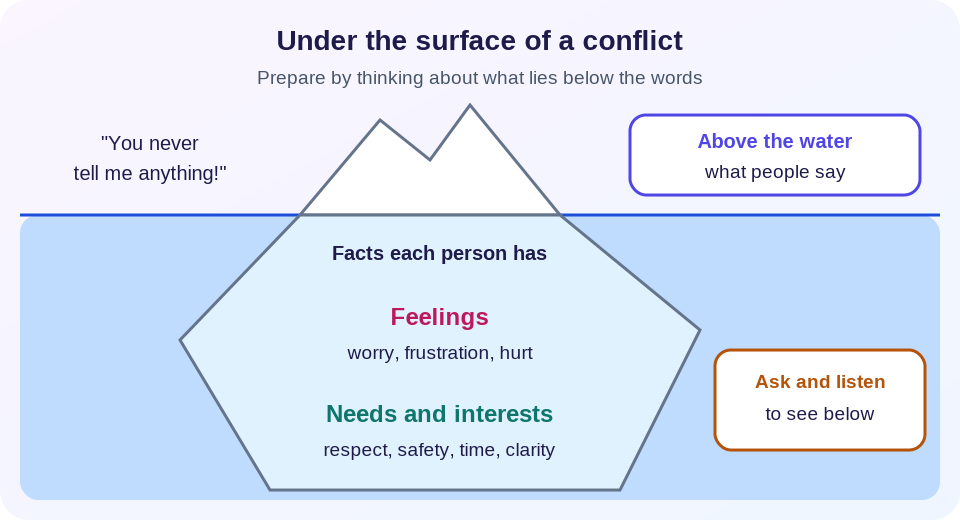
Preparation will not make every talk comfortable. It can help you stay clear and fair. The key idea is to look under the surface. The words people say are often only a small, visible part of the problem.
What you will learn
- How to decide whether to have the conversation
- How to set a goal you can control
- How to separate facts, stories and feelings
- How to write a calm opening
First, check safety
Before anything else, ask whether a direct talk is safe. If there is violence, threats, stalking, abuse or harassment, a private conversation may not be the right step. Look for help from trusted people, support services, a manager, human resources or the authorities, depending on the situation and where you live. In an emergency, contact your local emergency services.
Should you raise it?
For ordinary conflicts, consider:
- Does it matter enough to you, or will it fade?
- Is it a pattern or a one-time slip?
- What happens if you say nothing? Will resentment grow?
- Can the other person affect it?
Choosing not to raise something can be wise. Just make sure you are really letting it go, not storing it for a later fight.
Set a goal you can control
"Make Dev agree with me" depends on Dev. Better goals depend partly on you:
- "Explain how the late dishes affect me and learn Dev's view."
- "Agree on one change we both try for two weeks."
- "Find out why the deadline keeps moving."
Also think about what you will do if you do not reach agreement. Will you try again later, involve a neutral person or change your own plans?
Facts, stories and feelings
Write down three columns.
| Fact | My story | My feeling |
|---|---|---|
| Dev left dishes in the sink three nights this week. | "He thinks I'm his cleaner." | Annoyed, a bit disrespected |
| My manager moved the deadline twice. | "She doesn't value my time." | Stressed, frustrated |
| Jo did not reply to two messages. | "Jo is ignoring me." | Worried, hurt |
A story is your explanation. It might be right, but it might not. Dev may have been working late. Jo may be ill. Treat your story as a question to explore.
Now guess, gently, the other side: What facts might they have? What might they feel? What might they need? Hold these guesses lightly. You will find out more in the talk.
Also ask: What is my part? Did I agree to something unclearly? Did I stay silent for weeks? Owning your part, if there is one, can lower tension.
Choose time and place
- Choose a private place if possible.
- Pick a time when neither of you is rushed, hungry or very upset, if you can.
- Ask for the time: "Could we talk about the kitchen this evening? Maybe twenty minutes?"
- Prefer a live talk (in person or video) for sensitive topics. Long angry messages can make things worse.
- If you feel unsafe being alone, bring or arrange appropriate support.
Write your opening
The first lines shape the tone. A useful opening can include:
- the topic,
- a neutral description,
- your reason for raising it, and
- an invitation to share views.
"I'd like to talk about the kitchen. This week the dishes stayed in the sink overnight three times. It makes it hard for me to cook in the morning. I'd like to hear how it looks from your side, and then find something that works for both of us."
Compare that with: "You never clean up. I'm sick of it." The second version starts a fight about the word "never."
Plan for strong reactions
You cannot predict everything, but you can plan a few moves.
- If they get defensive: "I'm not trying to blame you. I want us to solve this."
- If you get upset: "I need a minute. I do want to continue."
- If it goes off topic: "That matters too. Can we finish the kitchen first, then talk about it?"
- If it becomes abusive or unsafe: end the conversation and get to safety.
Practice your opening aloud once or twice. Do not memorize a whole script. You need room to respond to what you hear.
A worked preparation
Situation: A teammate often presents your joint work as "my analysis."
- Goal: agree on how we credit shared work.
- Fact: in two meetings this month she said "my analysis" about work we did together.
- My story: she wants all the credit. Other possibility: it was a habit of speech.
- Feeling: overlooked.
- Need: fair recognition.
- My part: I did not speak up the first time.
- Opening: "Can we talk about how we present our shared work? In the last two meetings it was described as your analysis. I want my part to be visible too. How did you see it?"
Common mistakes
- Starting the talk while very angry or in a hurry
- Treating your story about motives as a proven fact
- Setting a goal that only the other person can reach
- Opening with "you always" or "you never"
- Trying to handle a dangerous situation alone
Try it
Fill in your plan. The tool joins your answers into an opening you can practice. Do not include real names or private details if others can see your screen.
Check your understanding
Quick check · 4 questions
of 4 answered You scored / 4 · perfect!
-
1. Which goal depends most on things you can affect?
You can explain and ask. You cannot control agreement or feelings. -
2. 'My roommate thinks I am his cleaner.' What is this?
It is an interpretation that needs checking. -
3. What should you consider first if there are threats or violence?
A direct talk may not be safe. Seek help. -
4. Which opening is calmest?
It names the topic, a fact and an invitation.
Summary
- Check safety first, then decide whether and why to raise the issue.
- Set a goal you can influence.
- Separate facts, stories and feelings, and consider your own part.
- Choose a good time and prepare a calm opening.