
























レッスン 23 · Procrastination
Why We Delay
Understand why you put off important tasks, see how short relief keeps the delay loop going, and diagnose the real cause so you can choose a fix that fits it.
You know the task matters. You know when it is due. Still, you clean your desk, check your messages or decide that tomorrow will be better. This is a very common experience.
Procrastination means putting off something you intended to do, even though you expect the delay to make things worse. It is often less about the clock and more about how the task makes you feel.
What you will learn
- The difference between delay and procrastination
- How the avoidance loop works
- Common causes behind putting things off
- How to match a fix to the cause
Not every delay is procrastination
Sometimes waiting is wise. You may wait for missing information, rest when you are ill, or move a low-value task because something more important appeared. These are planned delays. You made a choice, and you can explain it.
Procrastination feels different. You still intend to do the task now or soon. You expect that waiting will cost you. Yet you move to something else.
| Situation | What it is likely to be |
|---|---|
| You wait for a teacher's answer before finishing a section | Planned delay |
| You move a minor chore to help a sick friend | A change of priority |
| You reorganize your music instead of starting a form that is due today | Procrastination |
The avoidance loop
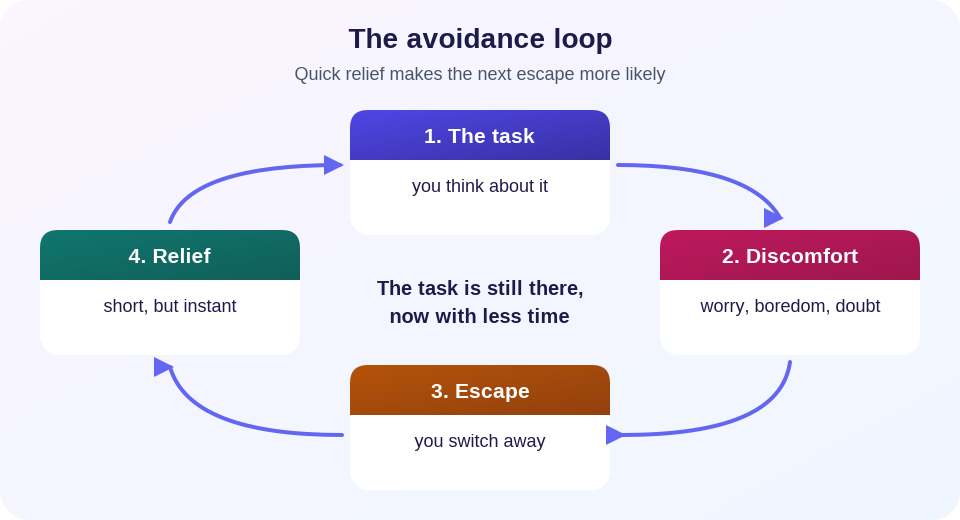
Many cases follow a loop:
- You think about the task.
- You feel something unpleasant: confusion, boredom, worry or self-doubt.
- You switch to something easier or more pleasant.
- You feel better for a while.
- The task is still there, now with less time and sometimes with guilt.
Step 4 is the trap. The relief is real, and it arrives immediately. This teaches you that switching away "works," so you may do it again. The cost arrives later.
This view is useful because it changes the question. Instead of "Why am I so lazy?" ask, "What feeling am I trying to get away from?"
Common causes
The task is unclear
"Sort out the project" is not an action. If you do not know the first step, starting is hard. Fix: write the next physical action, such as "open the instructions and list the required parts."
The task feels too big
A whole thesis or a full house move can feel impossible. Fix: cut it into pieces, and look only at the next one.
The task is boring
There is little reward while you do it. Fix: use a short timed block, pair it with something pleasant that does not need attention, or work near someone else.
You fear a bad result
If your work might be judged, not finishing can feel safer than finishing and hearing criticism. Fix: make a deliberately rough first version.
The reward is far away
Studying today for an exam in two months gives little immediate feedback. Fix: create nearer checkpoints that you can see, such as a short self-test each week.
You are exhausted
Sometimes the problem is not the task. You need sleep, food, rest or less on your list. Fix: deal with the shortage. A productivity trick cannot replace rest.
Diagnose before you treat
A fix that matches one cause may fail for another. A strict deadline does little for someone who does not understand the instructions. A to-do list does not remove fear of criticism.
When you notice delay, pause for one minute and write three lines:
- Task: what am I avoiding?
- Feeling: what comes up when I think about it?
- Missing: what do I lack, such as information, a first step, energy or confidence?
Example: Lina's application
Lina has put off a job application for a week. She writes: "Task: cover letter. Feeling: worry that I sound foolish. Missing: an example of what to include." Her next action is not "write a perfect letter." It is "list three things from the job advert and one example from my experience for each." That list takes a short time, and it gives her material for a first draft.
One task, different causes
Two people can avoid the same task for different reasons. Imagine two students who put off a lab write-up. Ben does not understand what the results section should contain. Asha understands it well, but she finds it dull. Ben needs an explanation or an example from his teacher. Asha needs a short block with a clear end, perhaps beside a friend who is also working.
Your own cause can also change from one day to the next. Check again instead of assuming that you already know the answer.
Be kind and honest
Harsh self-talk adds more unpleasant feelings to the task. That can feed the loop. Try a neutral statement: "I put this off. What is one small step now?" Kindness is not an excuse. You still take responsibility for the next action.
If delay is severe, lasts a long time and affects your health, studies or work, or if you often feel very low or anxious, consider talking to a doctor, counselor or student support service. This course cannot diagnose anything.
Common mistakes
- Calling yourself lazy and stopping there. A label does not show you what to change.
- Using the same fix for every kind of delay.
- Waiting to feel motivated before doing anything. A small start may come first.
- Spending a long time studying your procrastination instead of taking a small step.
Try it
Match each thought to its most likely cause.
Check your understanding
Quick check · 4 questions
of 4 answered You scored / 4 · perfect!
-
1. Which is a planned delay?
A planned delay has a clear reason and does not come from avoiding a feeling. -
2. Why can the avoidance loop be hard to break?
Quick relief rewards the switch, while the cost arrives later. -
3. A task feels unclear. Which fix fits best?
A concrete next action removes the uncertainty about how to begin. -
4. What is a helpful way to talk to yourself after a delay?
A neutral statement avoids extra blame and keeps your attention on action.
Summary
- Procrastination is delaying something even though you expect it to cost you.
- Quick relief can keep the avoidance loop going.
- Causes include unclear or huge tasks, boredom, fear, distant rewards and exhaustion.
- Name the task, the feeling and what is missing, then pick a matching fix.
- Get support if the problem is serious or long-lasting.
Next: Starting Small