
























レッスン 9 · Rhythm
Beat and Tempo
Feel a steady beat, understand tempo and beats per minute, learn common tempo words and use a metronome well so your piano playing stays in time.
Pitch tells you which key to play. Rhythm tells you when to play it and for how long. Rhythm starts with a steady beat. If the beat is steady, even simple notes sound like music.
What you will learn
- What the beat is and how it differs from rhythm
- What tempo and beats per minute (BPM) mean
- Common Italian tempo words
- How to practice with a metronome
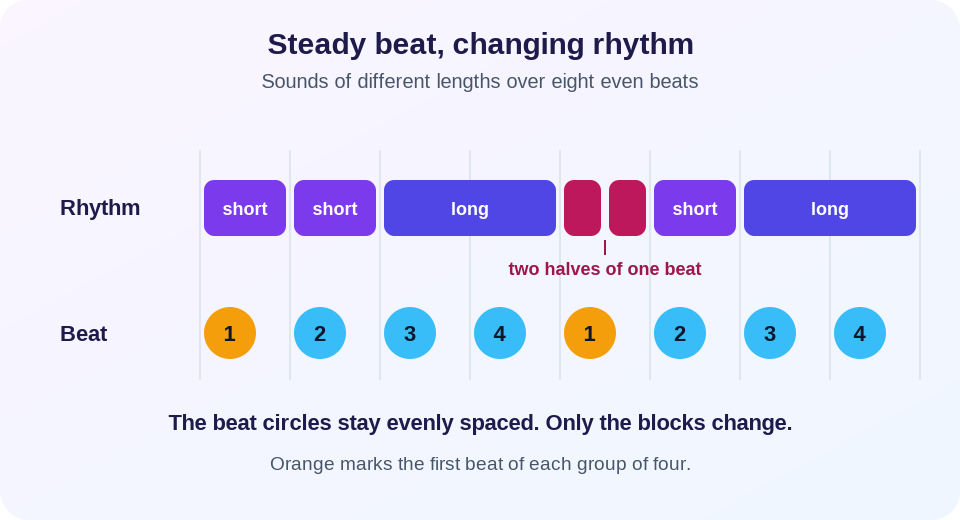
The beat
The beat is a steady pulse underneath the music. It is what you tap your foot to. A clock tick is a good picture: each tick is evenly spaced.
Rhythm is the pattern of long and short sounds and silences on top of that pulse. The beat stays the same. The rhythm changes.
Try this: tap a steady beat on your knee. While you tap, say a sentence in a natural way. Your words make a changing rhythm over your steady taps.
Tempo
Tempo is the speed of the beat. It is often written as BPM, which means beats per minute.
- At 60 BPM, there is one beat each second.
- At 120 BPM, there are two beats each second.
- At 90 BPM, there are three beats every two seconds.
A marking such as "quarter note = 80" means there are 80 quarter-note beats in a minute.
Finding the time per beat
Use this formula:
seconds per beat = 60 ÷ BPM
For example, at 75 BPM: 60 ÷ 75 = 0.8 seconds per beat.
Tempo words
Printed music often uses Italian words. Their speeds are not exact numbers. Performers and metronomes may use somewhat different ranges.
| Word | General meaning |
|---|---|
| Largo | Very slow and broad |
| Adagio | Slow |
| Andante | At a walking pace |
| Moderato | Moderate |
| Allegro | Fast and lively |
| Presto | Very fast |
You may also see ritardando (or "rit."), which means gradually slow down, and accelerando, which means gradually speed up. A tempo means return to the earlier speed.
Using a metronome
A metronome gives a steady click or flash at the tempo you choose. Many keyboards have one built in, and free apps are available.
To use it well:
- Listen first. Hear several clicks before you play.
- Count with it. Say "1, 2, 3, 4" aloud along with the clicks.
- Clap with it. Try to make your clap land exactly on the click.
- Then play. Start with one note per click.
- Start slow. Choose a tempo where you can play without mistakes.
- Speed up gradually. Add a few BPM at a time, only when the slower speed feels easy.
If the metronome makes you tense, turn it off for a moment and count aloud. Then try it again at a slower speed.
Internal counting
A metronome is a training tool. The goal is a beat you can feel inside. Try this "disappearing click" exercise:
- Set 70 BPM and clap along for 8 beats.
- Stop clapping and just listen for 8 beats.
- Turn off the sound or mute it, and keep counting for 8 beats.
- Turn it back on at the start of the next count of 8. Are you still together?
A worked example
A piece you like is marked at 96 BPM, but you make mistakes at that speed. Here is a plan:
| Step | Tempo | Goal |
|---|---|---|
| 1 | 60 | Right notes, steady count |
| 2 | 66 | Same, with relaxed hands |
| 3 | 72 | Three clean plays in a row |
| 4 | 80 | Check that the hard bar still works |
| 5 | 88 and up | Add speed only while it stays clean |
This may take several days. That is normal.
Finding the beat in music you hear
Listen to a song with a clear pulse. Tap along on your knee. Do your taps feel natural, or could you tap twice as fast or half as fast? Several levels of pulse can feel right. Musicians usually pick the one that is most comfortable to count. Next, try to hear which taps feel strongest. This prepares you for the groups of beats in the lesson on time signatures.
Counting in
Before you play, count one or two empty groups of beats at your chosen tempo. This is called a count-in. It gives you the speed before the first note, so you do not have to guess it while your hands are already busy. Say it in the same calm voice you will use while playing.
If your count-in feels rushed, stop, breathe and start it again. Restarting before the first note is much easier than repairing an uneven beginning.
Common mistakes
- Speeding up on easy parts and slowing on hard parts.
- Stopping to fix every mistake while practicing with the beat. Sometimes keep going and fix it afterward.
- Choosing a metronome speed that is too fast to start.
- Confusing the beat with the rhythm.
Try it
This silent visual metronome flashes the beat. Set a tempo, clap along with the circle, and watch the accent on beat 1.
Check your understanding
Quick check · 4 questions
of 4 answered You scored / 4 · perfect!
-
1. What is the beat?
The beat is the even pulse that rhythm sits on. -
2. How long is one beat at 120 BPM?
60 divided by 120 is 0.5 seconds. -
3. What does andante generally suggest?
Andante is often described as a walking pace. -
4. What is the best way to build speed?
Gradual increases keep your playing accurate and relaxed.
Summary
- The beat is a steady pulse; rhythm is the pattern over it.
- Tempo is beat speed, often in BPM.
- Seconds per beat equals 60 divided by BPM.
- Use a metronome slowly, then speed up in small steps.
Next: Note Values and Rests