
























レッスン 18 · Infection Prevention
The Chain of Infection
Learn the six links in the chain of infection, how germs travel from one person to another, and how everyday nursing actions can break the chain.
Infection prevention is part of almost everything a nurse does. A person who is ill, injured, very young or very old may catch an infection more easily. Care itself brings many people, hands and objects close together.
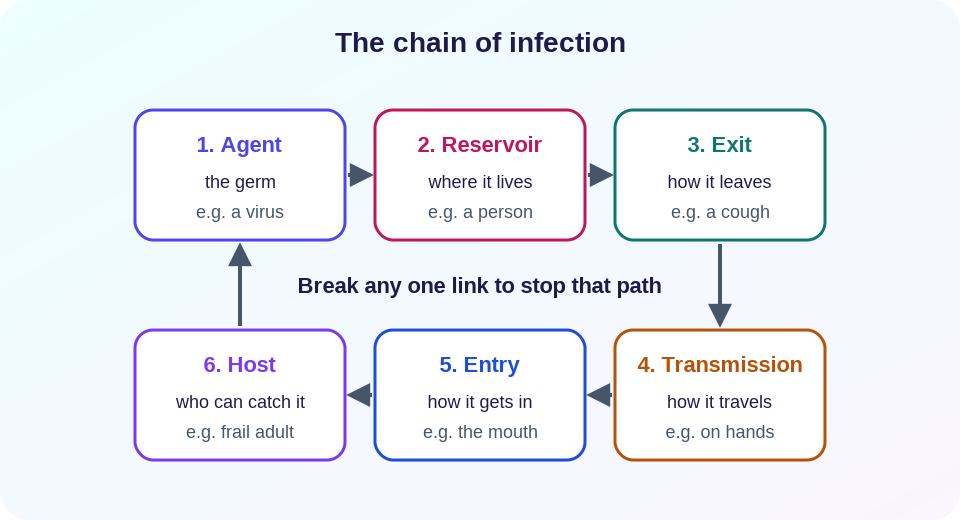
The chain of infection is a simple model. It shows what must happen for an infection to spread. If you break any one link, you can stop that spread.
What you will learn
- The six links in the chain of infection
- The difference between colonization and infection
- Common routes of spread
- Which everyday actions break each link
Key words first
A pathogen is a germ that can cause disease. Examples include some bacteria, viruses, fungi and parasites. Many microorganisms are harmless, and many that live on and in your body help you.
Colonization means a germ is present on or in a person but is not causing illness. Infection means the germ is multiplying and harming the body, or the body is reacting to it. A colonized person can feel well and still pass the germ to others. This is one reason you take basic precautions with everyone.
A healthcare-associated infection is an infection that a person gets while receiving care, which was not present or developing when that care began.
The six links
1. Infectious agent
This is the germ itself. Germs differ a lot. Some survive on dry surfaces for a long time. Some are harder to kill than others.
2. Reservoir
The reservoir is the place where the germ lives and may multiply. It can be a person, an animal, water, food, soil or contaminated equipment.
3. Portal of exit
This is how the germ leaves the reservoir. Examples are coughing, sneezing, stool, blood, wound drainage and other body fluids.
4. Mode of transmission
This is how the germ travels. Direct contact is body to body. Indirect contact goes through an object, such as a bed rail or a blood pressure cuff. Germs can also travel in droplets, through the air in very small particles, through food or water, or through carriers such as mosquitoes.
5. Portal of entry
This is how the germ gets into the next person. Examples are the mouth, nose, eyes, broken skin, the urinary tract and places where a medical device enters the body.
6. Susceptible host
This is a person who can become infected. Risk may be higher with older age or very young age, poor nutrition, some long-term illnesses, some medicines that weaken immunity, damaged skin or medical devices.
Breaking the chain
| Link | Examples of actions that help break it |
|---|---|
| Infectious agent | Cleaning, disinfection, sterilization; treatment ordered by a prescriber |
| Reservoir | Cleaning spills, changing soiled linen, safe food and water handling |
| Portal of exit | Covering coughs, covering wounds, containing body fluids |
| Mode of transmission | Hand hygiene, protective equipment, cleaning shared items |
| Portal of entry | Protecting skin, careful care around devices by trained staff |
| Susceptible host | Vaccination, good nutrition, rest and mobility support |
A worked example
Imagine a care home. Ms. Okafor has a stomach illness with diarrhea. A care worker helps her, then moves a shared walking frame. Next, Mr. Silva uses the frame and then eats a snack with his hands.
- Agent: the germ causing the stomach illness.
- Reservoir: Ms. Okafor's gut.
- Exit: stool.
- Transmission: the care worker's hands, then the walking frame, then Mr. Silva's hands.
- Entry: Mr. Silva's mouth.
- Host: Mr. Silva, an older adult.
Where could the chain break? The worker could clean their hands at the right times and use gloves and a gown as local policy requires. The frame could be cleaned between users. Mr. Silva could be helped to clean his hands before eating. One action may be enough, but teams use several together because any single step can be missed.
Noticing possible infection
Nurses and care staff often see early changes first. Possible warning signs include fever or an unusually low temperature, a new cough, new pain, redness, warmth, swelling, unusual drainage, vomiting, diarrhea or sudden confusion. Older adults may not have a fever. None of these signs proves infection. As a learner, your job is to notice, record and tell the responsible nurse or clinician promptly.
A second example: a clinic waiting room
A man with a cough sits close to other people in a small clinic. Here the agent is a respiratory germ, and he is the reservoir. His cough is the portal of exit. Droplets or small particles carry the germ. The eyes, nose and mouth of nearby people are portals of entry.
Staff can act at several points. They can offer him a mask if he can wear it safely, give him tissues, show him where to clean his hands, and seat him according to the clinic's screening rules. Fresh air and good ventilation also matter for germs that travel through the air. Nobody needs to be rude or alarmed. A calm sentence helps: "We offer a mask to everyone with a cough, to protect other people here." When you study any new infection topic, try to name all six links. If you cannot name one, that is a good question for your instructor.
Common mistakes
- Thinking that a person who looks well cannot carry germs.
- Forgetting objects: phones, keyboards, cuffs and bed rails can all carry germs.
- Treating the person as "the infection". The person deserves respect and normal human contact.
- Relying on one protective step and skipping the others.
Try it
Check your understanding
Quick check · 4 questions
of 4 answered You scored / 4 · perfect!
-
1. What can happen if one link in the chain of infection is broken?
Every link is needed, so breaking one can stop that route of spread. -
2. What does colonization mean?
A colonized person has no illness from the germ but may still pass it on. -
3. Which is an example of indirect contact?
Indirect contact uses an object or surface between the two people. -
4. You notice that an older resident is suddenly confused. What is the best next step?
Sudden confusion has many possible causes and needs prompt assessment by qualified staff.
Summary
- The six links are agent, reservoir, portal of exit, mode of transmission, portal of entry and susceptible host.
- Colonization is presence without illness. Infection involves harm or a body response.
- Breaking any link stops that path, and teams use several protections together.
- Notice possible signs of infection and pass them on quickly.
Next: Hand Hygiene